Fischer Andreas, Lasser Tobias, Schrapp Michael, Stephan Jürgen, Noël Peter B
Siemens AG, Corporate Technology, 81730 Munich, Germany.
Computer Aided Medical Procedures (CAMP), Technische Universität München, 85748 Garching, Germany.
Sci Rep. 2016 Jan 28;6:19135. doi: 10.1038/srep19135.
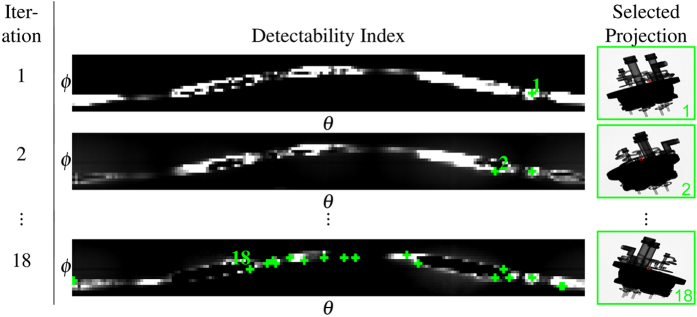
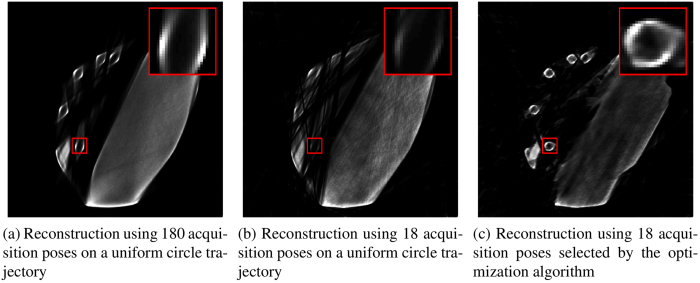
In industrial settings, X-ray computed tomography scans are a common tool for inspection of objects. Often the object can not be imaged using standard circular or helical trajectories because of constraints in space or time. Compared to medical applications the variance in size and materials is much larger. Adapting the acquisition trajectory to the object is beneficial and sometimes inevitable. There are currently no sophisticated methods for this adoption. Typically the operator places the object according to his best knowledge. We propose a detectability index based optimization algorithm which determines the scan trajectory on the basis of a CAD-model of the object. The detectability index is computed solely from simulated projections for multiple user defined features. By adapting the features the algorithm is adapted to different imaging tasks. Performance of simulated and measured data was qualitatively and quantitatively assessed.The results illustrate that our algorithm not only allows more accurate detection of features, but also delivers images with high overall quality in comparison to standard trajectory reconstructions. This work enables to reduce the number of projections and in consequence scan time by introducing an optimization algorithm to compose an object specific trajectory.
在工业环境中,X射线计算机断层扫描是检查物体的常用工具。由于空间或时间的限制,通常无法使用标准的圆形或螺旋轨迹对物体进行成像。与医学应用相比,物体在尺寸和材料方面的差异要大得多。使采集轨迹适应物体是有益的,有时甚至是不可避免的。目前尚无复杂的方法来实现这种适配。通常,操作员会根据自己的最佳判断放置物体。我们提出了一种基于可检测性指数的优化算法,该算法根据物体的CAD模型确定扫描轨迹。可检测性指数仅根据多个用户定义特征的模拟投影来计算。通过调整特征,该算法可适应不同的成像任务。对模拟数据和测量数据的性能进行了定性和定量评估。结果表明,与标准轨迹重建相比,我们的算法不仅能更准确地检测特征,还能提供整体质量较高的图像。通过引入一种优化算法来构建特定于物体的轨迹,这项工作能够减少投影数量,从而减少扫描时间。