Chang Yu-Ming, Shiao Chih-Chung, Huang Ya-Ting, Chen I-Ling, Yang Chuan-Lan, Leu Show-Chin, Su Hung-Li, Kao Jsun-Liang, Tsai Shih-Ching, Jhen Rong-Na, Uen Ching-Cherng
Division of Nephrology, Department of Internal Medicine, Saint Mary's Hospital Luodong, No. 160 Chong-Cheng South Road, Loudong, 265, Yilan, Taiwan, ROC.
Saint Mary's Medicine, Nursing and Management College, No. 100, Ln. 265, Sec. 2, Sanxing Rd., Sanxing Township, Yilan County, 266, Taiwan, ROC.
Cardiovasc Diabetol. 2016 Jan 27;15:16. doi: 10.1186/s12933-016-0328-2.
Both uremia and metabolic syndrome (MetS) affect heart rate variability (HRV) which is a risk factor of poor prognoses. The aim of this study was to evaluate the impact of MetS on HRV among chronic hemodialysis patients.
This cross-sectional study was carried out in a teaching hospital in Northern Taiwan from June to August, 2010. Adult patients on chronic hemodialysis without active medical conditions were enrolled. HRV were measured for 4 times on the index hemodialysis day (HRV-0, -1, -2, and -3 at before, initial, middle, and late phases of hemodialysis, respectively), and the baseline demographic data and clinical parameters during the hemodialysis session were documented. Then we evaluated the impacts of MetS and its five components on HRV.
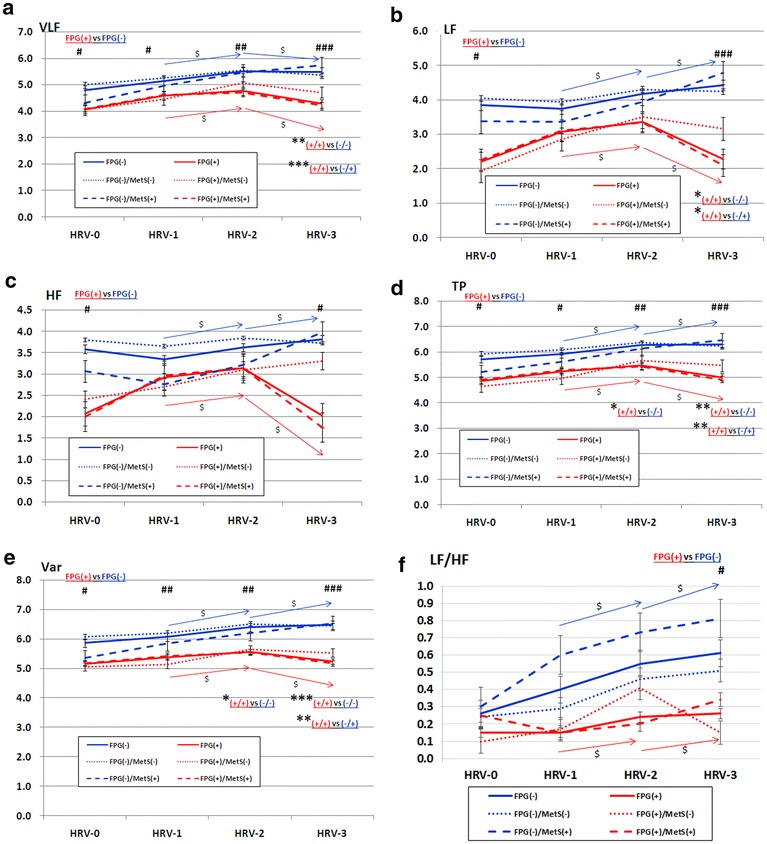
One hundred and seventy-five patients (100 women, mean age 65.1 ± 12.9 years) were enrolled and included those with MetS (n = 91, 52 %) and without MetS (n = 84, 48 %). The patients with MetS(+) had significantly lower very low frequency, total power, and variance in HRV-0, total power and variance in HRV-2, and variance in HRV-3. (all p ≦ 0.05) When using the individual components of MetS to evaluate the impacts on HRV indices, the fasting plasma glucose (FPG) criterion significantly affected most indices of HRV while other four components including "waist circumference", "triglycerides", "blood pressure", and "high-density lipoprotein" criteria exhibited little impacts on HRV. FPG criterion carried the most powerful influence on cardiac ANS, which was even higher than that of MetS. The HRV of patients with FPG(+) increased initially during the hemodialysis, but turned to decrease dramatically at the late phase of hemodialysis.
The impact of FPG(+) outstood the influence of uremic autonomic dysfunction, and FPG criterion was the most important one among all the components of MetS to influence HRV. These results underscored the importance of interpretation and management for abnormal glucose metabolism.
尿毒症和代谢综合征(MetS)均会影响心率变异性(HRV),而心率变异性是预后不良的一个危险因素。本研究旨在评估MetS对慢性血液透析患者心率变异性的影响。
本横断面研究于2010年6月至8月在台湾北部的一家教学医院开展。纳入无活动性疾病的成年慢性血液透析患者。在透析当日对心率变异性进行4次测量(分别在血液透析前、开始时、中间和后期的HRV-0、-1、-2和-3),并记录血液透析期间的基线人口统计学数据和临床参数。然后我们评估了MetS及其五个组分对心率变异性的影响。
共纳入175例患者(100名女性,平均年龄65.1±12.9岁),包括患有MetS的患者(n = 91,52%)和未患有MetS的患者(n = 84,48%)。患有MetS(+)的患者在HRV-0中的极低频、总功率和方差显著更低,在HRV-2中的总功率和方差以及在HRV-3中的方差也显著更低。(所有p≤0.05)当使用MetS各组分评估对心率变异性指标的影响时,空腹血糖(FPG)标准显著影响大多数心率变异性指标,而其他四个组分包括“腰围”、“甘油三酯”、“血压”和“高密度脂蛋白”标准对心率变异性影响甚微。FPG标准对心脏自主神经系统的影响最为显著,甚至高于MetS。FPG(+)患者的心率变异性在血液透析开始时最初升高,但在血液透析后期急剧下降。
空腹血糖升高(FPG+)的影响超过尿毒症自主神经功能障碍的影响,并且FPG标准是MetS所有组分中影响心率变异性最重要的因素。这些结果强调了对异常糖代谢进行解读和管理的重要性。