Weber Daniela
Wittgenstein Centre (IIASA, ÖAW, WU), International Institute for Applied Systems Analysis, Schlossplatz 1, Laxenburg, 2361, Austria.
BMC Geriatr. 2016 Jan 28;16:31. doi: 10.1186/s12877-016-0201-x.
Physical functioning and mobility of older populations are of increasing interest when populations are aging. Lower body functioning such as walking is a fundamental part of many actions in daily life. Limitations in mobility threaten independent living as well as quality of life in old age. In this study we examine differences in physical aging and convert those differences into the everyday measure of single years of age.
We use the English Longitudinal Study of Ageing, which was collected biennially between 2002 and 2012. Data on physical performance, health as well as information on economics and demographics of participants were collected. Lower body performance was assessed with two timed walks at normal pace each of 8 ft (2.4 m) of survey participants aged at least 60 years. We employed growth curve models to study differences in physical aging and followed the characteristic-based age approach to illustrate those differences in single years of age.
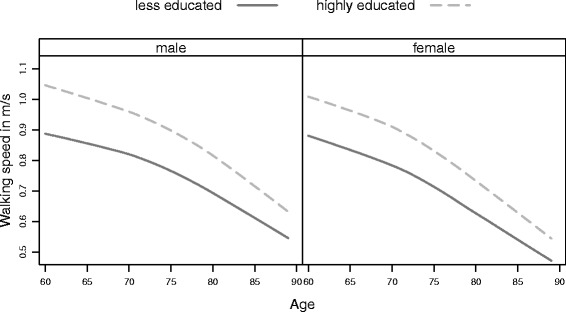
First, we examined walking speed of about 11,700 English individuals, and identified differences in aging trajectories by sex and other characteristics (e.g. education, occupation, regional wealth). Interestingly, higher educated and non-manual workers outperformed their counterparts for both men and women. Moreover, we transformed the differences between subpopulations into single years of age to demonstrate the magnitude of those gaps, which appear particularly high at early older ages.
This paper expands research on aging and physical performance. In conclusion, higher education provides an advantage in walking of up to 15 years for men and 10 years for women. Thus, enhancements in higher education have the potential to ensure better mobility and independent living in old age for a longer period.
随着人口老龄化,老年人群的身体机能和活动能力越来越受到关注。诸如行走等下肢功能是日常生活中许多活动的基本组成部分。行动能力的限制会威胁到老年人的独立生活以及生活质量。在本研究中,我们考察身体衰老方面的差异,并将这些差异转化为以单一年龄表示的日常衡量指标。
我们使用英国老龄化纵向研究,该研究在2002年至2012年期间每两年收集一次数据。收集了参与者的身体机能、健康数据以及经济和人口统计学信息。对至少60岁的调查参与者进行两次以正常步速行走8英尺(2.4米)的定时测试,以此评估下肢机能。我们采用生长曲线模型来研究身体衰老方面的差异,并采用基于特征的年龄方法来以单一年龄说明这些差异。
首先,我们考察了约11,700名英国个体的行走速度,并确定了按性别和其他特征(如教育程度、职业、地区财富)划分的衰老轨迹差异。有趣的是,无论男性还是女性,受教育程度较高者和非体力劳动者的表现都优于其同龄人。此外,我们将亚人群之间的差异转化为单一年龄,以展示这些差距的大小,这些差距在老年早期显得尤为突出。
本文拓展了关于衰老和身体机能的研究。总之,高等教育使男性在行走方面具有长达15年的优势,女性则有10年的优势。因此,高等教育的提升有可能确保老年人在更长时期内拥有更好的行动能力和独立生活能力。