Ashu Eta E, Jarju Sheikh, Dione Michel, Mackenzie Grant, Ikumapayi Usman N, Manjang Ahmed, Azuine Romuladus, Antonio Martin
Department of Biology, McMaster University, 1280 Main St. W, Hamilton, ON, L8S 4 K1, Canada.
Medical Research Council Unit, P. O. Box 273, Fajara, The Gambia.
BMC Infect Dis. 2016 Jan 28;16:33. doi: 10.1186/s12879-016-1370-0.
Streptococcus pneumoniae serotype 5 is among the most common serotypes causing invasive pneumococcal disease (IPD) in The Gambia. We anticipate that introduction of the 13-valent pneumococcal conjugate vaccine (PCV-13) into routine vaccination in The Gambia will reduce serotype 5 IPD. However, the emergence of new clones that have altered their genetic repertoire through capsular switching or genetic recombination after vaccination with PCV-13 poses a threat to this public health effort. In order to monitor for potential genetic changes post-PCV-13 vaccination, we established the baseline population structure, epidemiology, and antibiotic resistance patterns of serotype 5 before the introduction of PCV-13.
Fifty-five invasive S. pneumoniae serotype 5 isolates were recovered from January 2009 to August 2011 in a population-based study in the Upper River Region of The Gambia. Serotyping was done by latex agglutination and confirmed by serotype-specific Polymerase Chain Reaction (PCR). Genotyping was undertaken using Multilocus Sequence Typing (MLST). Antimicrobial sensitivity was done using disc diffusion. Contingency table analyses were conducted using Pearson's Chi(2) and Fisher's exact test. Clustering was performed using Bionumerics version 6.5.
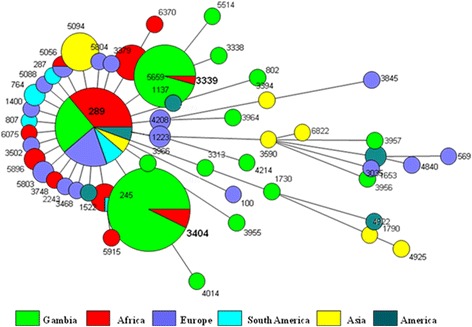
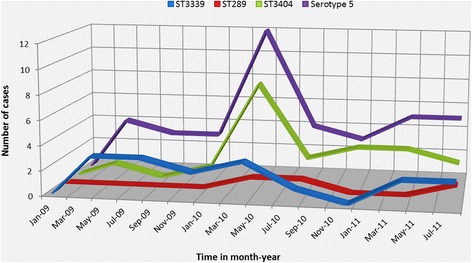
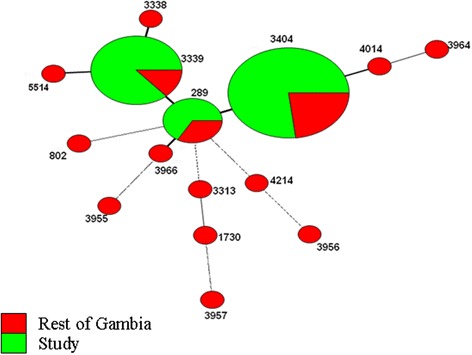
MLST resolved S. pneumoniae serotype 5 isolates into 3 sequence types (ST), namely ST 289(6/55), ST 3339(19/55) and ST 3404(30/55). ST 289 was identified as the major clonal complex. ST 3339, the prevalent genotype in 2009 [84.6% (11/13)], was replaced by ST 3404 [70.4% (19/27)] in 2010 as the dominant ST. Interestingly, ST 3404 showed lower resistance to tetracycline and oxacillin (P < 0.001), an empirical surrogate to penicillin in The Gambia.
There has been an emergence of ST 3404 in The Gambia prior to the introduction of PCV-13. Our findings provide important background data for future assessment of the impact of PCV-13 into routine immunization in developing countries, such as The Gambia.
肺炎链球菌5型是冈比亚引起侵袭性肺炎球菌疾病(IPD)最常见的血清型之一。我们预计在冈比亚将13价肺炎球菌结合疫苗(PCV - 13)引入常规疫苗接种后,5型IPD将会减少。然而,接种PCV - 13后通过荚膜转换或基因重组改变其基因库的新克隆的出现,对这项公共卫生工作构成了威胁。为了监测PCV - 13接种后潜在的基因变化,我们在引入PCV - 13之前建立了5型的基线人群结构、流行病学和抗生素耐药模式。
在冈比亚上河区的一项基于人群的研究中,从2009年1月至2011年8月共收集了55株侵袭性肺炎链球菌5型分离株。通过乳胶凝集法进行血清分型,并通过血清型特异性聚合酶链反应(PCR)进行确认。使用多位点序列分型(MLST)进行基因分型。采用纸片扩散法进行抗菌药物敏感性试验。使用Pearson卡方检验和Fisher精确检验进行列联表分析。使用Bionumerics 6.5版本进行聚类分析。
MLST将肺炎链球菌5型分离株分为3种序列类型(ST),即ST 289(6/55)、ST 3339(19/55)和ST 3404(30/55)。ST 289被确定为主要克隆复合体。ST 3339是2009年的流行基因型[84.6%(11/13)],在2010年被ST 3404[70.4%(19/27)]取代成为优势ST。有趣的是,ST 3404对四环素和苯唑西林的耐药性较低(P < 0.001),在冈比亚苯唑西林是青霉素的经验替代药物。
在引入PCV - 13之前,冈比亚已出现ST 3404。我们的数据为未来评估PCV - 13对冈比亚等发展中国家常规免疫的影响提供了重要的背景资料。