Komac Benjamin, Esteban Pere, Trapero Laura, Caritg Roger
Centre d'Estudis de la Neu i la Muntanya d'Andorra, Institut d'Estudis Andorrans (CENMA - IEA), Avinguda Rocafort 21-23, AD600 Sant Julià de Lòria, Principality of Andorra.
Departament de Geografia Física i Anàlisi Geogràfica Regional, Facultat de Geografia i Història, Universitat de Barcelona, Carrer de Montalegre 6-8, 08001 Barcelona, Spain.
PLoS One. 2016 Jan 29;11(1):e0147324. doi: 10.1371/journal.pone.0147324. eCollection 2016.
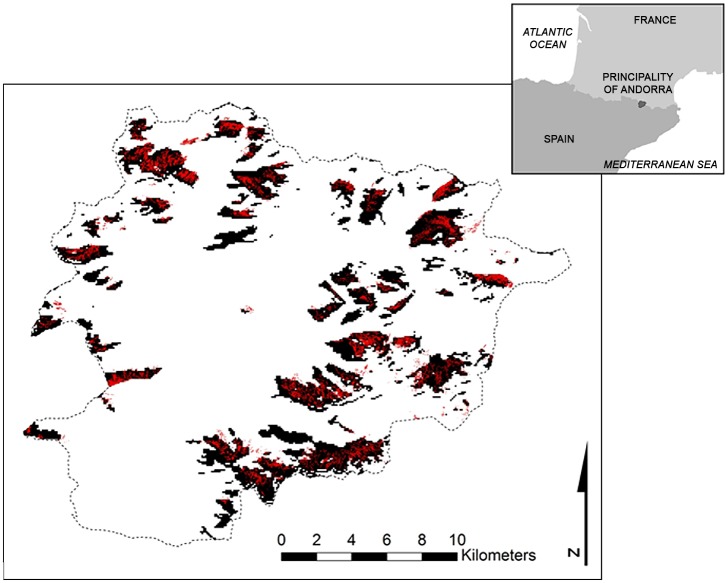
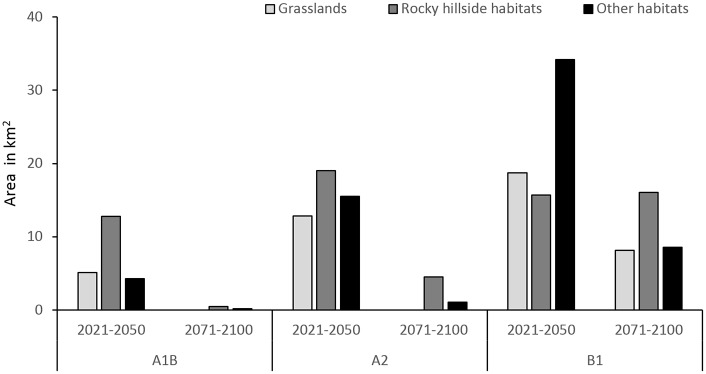
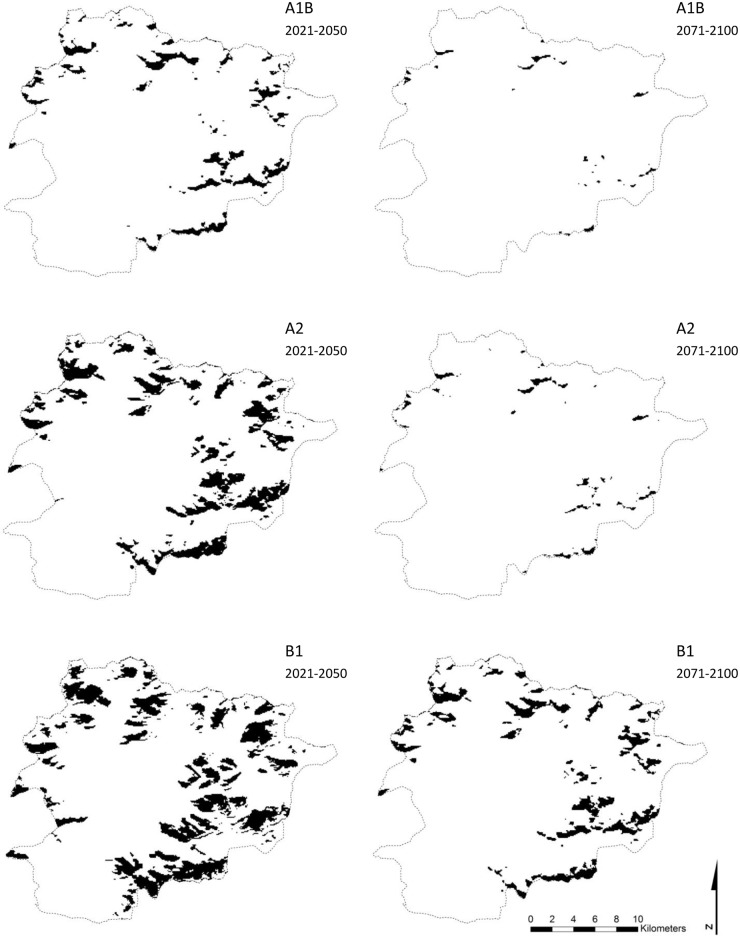
Mountain areas are particularly sensitive to climate change. Species distribution models predict important extinctions in these areas whose magnitude will depend on a number of different factors. Here we examine the possible impact of climate change on the Rhododendron ferrugineum (alpenrose) niche in Andorra (Pyrenees). This species currently occupies 14.6 km2 of this country and relies on the protection afforded by snow cover in winter. We used high-resolution climatic data, potential snow accumulation and a combined forecasting method to obtain the realized niche model of this species. Subsequently, we used data from the high-resolution Scampei project climate change projection for the A2, A1B and B1 scenarios to model its future realized niche model. The modelization performed well when predicting the species's distribution, which improved when we considered the potential snow accumulation, the most important variable influencing its distribution. We thus obtained a potential extent of about 70.7 km(2) or 15.1% of the country. We observed an elevation lag distribution between the current and potential distribution of the species, probably due to its slow colonization rate and the small-scale survey of seedlings. Under the three climatic scenarios, the realized niche model of the species will be reduced by 37.9-70.1 km(2) by the end of the century and it will become confined to what are today screes and rocky hillside habitats. The particular effects of climate change on seedling establishment, as well as on the species' plasticity and sensitivity in the event of a reduction of the snow cover, could worsen these predictions.
山区对气候变化尤为敏感。物种分布模型预测这些地区将出现重大物种灭绝,其规模将取决于许多不同因素。在此,我们研究气候变化对安道尔(比利牛斯山脉)铁锈色杜鹃(阿尔卑斯玫瑰)生态位的可能影响。该物种目前在该国占据14.6平方公里的面积,并依赖冬季积雪提供的保护。我们使用高分辨率气候数据、潜在积雪量和一种综合预测方法来获得该物种的实际生态位模型。随后,我们使用来自高分辨率Scampei项目针对A2、A1B和B1情景的气候变化预测数据,来模拟其未来的实际生态位模型。在预测该物种的分布时,该模型表现良好,当我们考虑潜在积雪量(影响其分布的最重要变量)时,预测效果有所改善。由此我们得出其潜在分布范围约为70.7平方公里,占该国面积的15.1%。我们观察到该物种当前分布与潜在分布之间存在海拔滞后现象,这可能是由于其缓慢的定殖速率和对幼苗的小规模调查所致。在这三种气候情景下,到本世纪末,该物种的实际生态位模型面积将减少37.9 - 70.1平方公里,并且将局限于如今的碎石坡和岩石山坡栖息地。气候变化对幼苗定植的特殊影响,以及在积雪减少情况下该物种的可塑性和敏感性,可能会使这些预测结果更加糟糕。