Andrews Michael A, Bauch Chris T
University of Guelph, 50 Stone Rd. E. Guelph, Ontario, Canada.
University of Guelph, 50 Stone Rd. E. Guelph, Ontario, Canada; University of Waterloo, 200 University Ave. W. Waterloo, Ontario, Canada.
J Theor Biol. 2016 Apr 21;395:1-10. doi: 10.1016/j.jtbi.2016.01.027. Epub 2016 Jan 29.
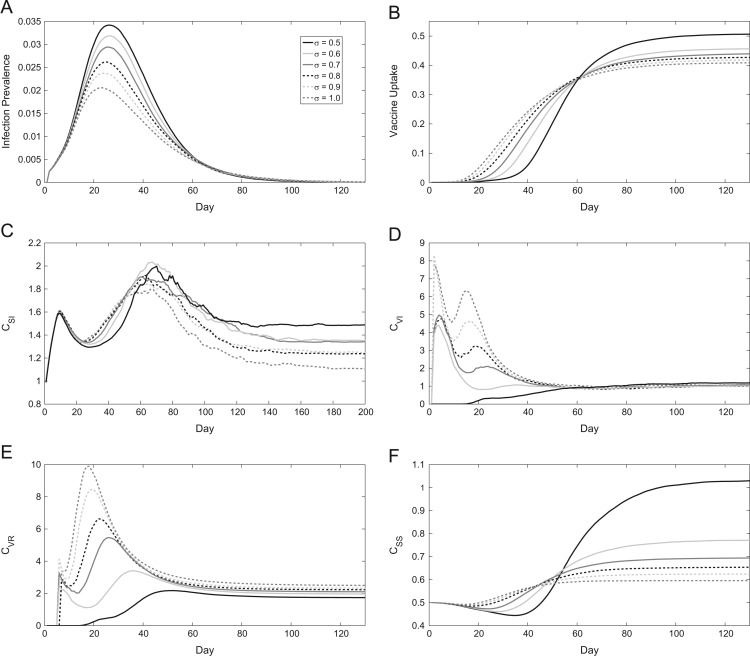
Mathematical models of the interplay between disease dynamics and human behavioural dynamics can improve our understanding of how diseases spread when individuals adapt their behaviour in response to an epidemic. Accounting for behavioural mechanisms that determine uptake of infectious disease interventions such as vaccination and non-pharmaceutical interventions (NPIs) can significantly alter predicted health outcomes in a population. However, most previous approaches that model interactions between human behaviour and disease dynamics have modelled behaviour of these two interventions separately. Here, we develop and analyze an agent based network model to gain insights into how behaviour toward both interventions interact adaptively with disease dynamics (and therefore, indirectly, with one another) during the course of a single epidemic where an SIRV infection spreads through a contact network. In the model, individuals decide to become vaccinated and/or practice NPIs based on perceived infection prevalence (locally or globally) and on what other individuals in the network are doing. We find that introducing adaptive NPI behaviour lowers vaccine uptake on account of behavioural feedbacks, and also decreases epidemic final size. When transmission rates are low, NPIs alone are as effective in reducing epidemic final size as NPIs and vaccination combined. Also, NPIs can compensate for delays in vaccine availability by hindering early disease spread, decreasing epidemic size significantly compared to the case where NPI behaviour does not adapt to mitigate early surges in infection prevalence. We also find that including adaptive NPI behaviour strongly mitigates the vaccine behavioural feedbacks that would otherwise result in higher vaccine uptake at lower vaccine efficacy as predicted by most previous models, and the same feedbacks cause epidemic final size to remain approximately constant across a broad range of values for vaccine efficacy. Finally, when individuals use local information about others' behaviour and infection prevalence, instead of population-level information, infection is controlled more efficiently through ring vaccination, and this is reflected in the time evolution of pair correlations on the network. This model shows that accounting for both adaptive NPI behaviour and adaptive vaccinating behaviour regarding social effects and infection prevalence can result in qualitatively different predictions than if only one type of adaptive behaviour is modelled.
疾病动态与人类行为动态之间相互作用的数学模型,可以增进我们对于在个体针对流行病调整自身行为时疾病如何传播的理解。将决定诸如疫苗接种和非药物干预措施(NPIs)等传染病干预措施采用情况的行为机制考虑在内,能够显著改变对人群中健康结果的预测。然而,此前大多数对人类行为与疾病动态之间相互作用进行建模的方法,都是分别对这两种干预措施的行为进行建模。在此,我们开发并分析了一个基于主体的网络模型,以深入了解在一种SIRV感染通过接触网络传播的单一流行病过程中,针对这两种干预措施的行为如何与疾病动态(因而间接地彼此之间)进行适应性相互作用。在该模型中,个体基于感知到的感染流行率(局部或全局)以及网络中其他个体的行为,决定是否接种疫苗和/或采取非药物干预措施。我们发现,由于行为反馈,引入适应性非药物干预措施行为会降低疫苗接种率,同时也会减小流行病的最终规模。当传播率较低时,仅非药物干预措施在降低流行病最终规模方面与非药物干预措施和疫苗接种相结合时同样有效。此外,非药物干预措施可以通过阻碍疾病早期传播来弥补疫苗供应延迟的问题,与非药物干预措施行为不适应以减轻感染流行率早期激增情况相比,显著减小流行病规模。我们还发现,纳入适应性非药物干预措施行为会强烈减轻否则会如大多数先前模型所预测的那样在较低疫苗效力下导致更高疫苗接种率的疫苗行为反馈,并且相同的反馈会使流行病最终规模在广泛的疫苗效力值范围内大致保持恒定。最后,当个体使用关于他人行为和感染流行率的局部信息而非总体水平信息时,通过环状疫苗接种能更有效地控制感染,这在网络上成对相关性的时间演变中得到体现。该模型表明,考虑到关于社会影响和感染流行率的适应性非药物干预措施行为和适应性疫苗接种行为,与仅对一种类型的适应性行为进行建模相比,会得出性质上不同的预测结果。