Prole David L, Taylor Colin W
Department of Pharmacology, University of Cambridge, Cambridge, CB2 1PD, UK.
J Physiol. 2016 Jun 1;594(11):2849-66. doi: 10.1113/JP271139. Epub 2016 Feb 24.
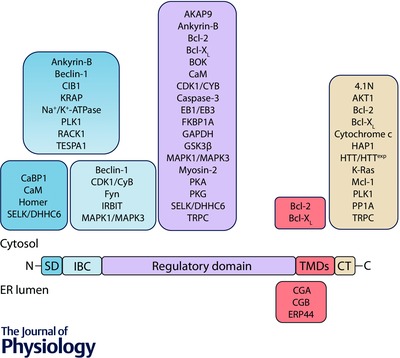
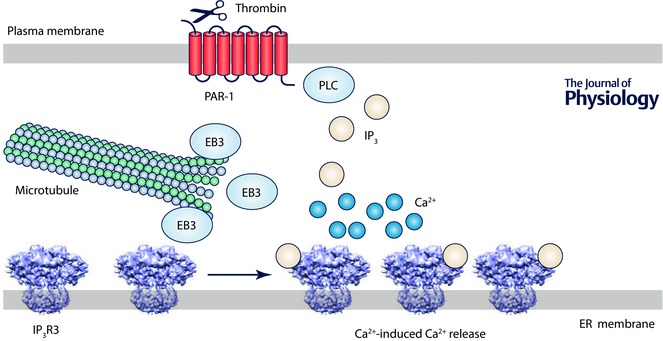
Inositol 1,4,5-trisphosphate receptors (IP3 Rs) are expressed in nearly all animal cells, where they mediate the release of Ca(2+) from intracellular stores. The complex spatial and temporal organization of the ensuing intracellular Ca(2+) signals allows selective regulation of diverse physiological responses. Interactions of IP3 Rs with other proteins contribute to the specificity and speed of Ca(2+) signalling pathways, and to their capacity to integrate information from other signalling pathways. In this review, we provide a comprehensive survey of the proteins proposed to interact with IP3 Rs and the functional effects that these interactions produce. Interacting proteins can determine the activity of IP3 Rs, facilitate their regulation by multiple signalling pathways and direct the Ca(2+) that they release to specific targets. We suggest that IP3 Rs function as signalling hubs through which diverse inputs are processed and then emerge as cytosolic Ca(2+) signals.
肌醇1,4,5-三磷酸受体(IP3Rs)在几乎所有动物细胞中均有表达,它们介导细胞内钙库释放Ca(2+)。随之产生的细胞内Ca(2+)信号复杂的时空组织允许对多种生理反应进行选择性调节。IP3Rs与其他蛋白质的相互作用有助于Ca(2+)信号通路的特异性和速度,以及它们整合来自其他信号通路信息的能力。在本综述中,我们全面概述了被认为与IP3Rs相互作用的蛋白质以及这些相互作用产生的功能效应。相互作用的蛋白质可以决定IP3Rs的活性,促进它们通过多种信号通路进行调节,并将它们释放的Ca(2+)导向特定靶点。我们认为IP3Rs作为信号枢纽发挥作用,通过它处理各种输入信号,然后以胞质Ca(2+)信号的形式出现。