
透明颤菌血红蛋白的过表达增强了拟南芥和玉米对涝渍的耐受性。
Overexpression of Vitreoscilla hemoglobin increases waterlogging tolerance in Arabidopsis and maize.
作者信息
Du Hewei, Shen Xiaomeng, Huang Yiqin, Huang Min, Zhang Zuxin
机构信息
Engineering research center of Ecology and Agricultural Use of wetland, Ministry of Education, Yangzte University, Jingzhou, 434025, P.R. China.
College of Life Science, Yangtze University, Jingzhou, Hubei, 434025, P.R. China.
出版信息
BMC Plant Biol. 2016 Feb 1;16:35. doi: 10.1186/s12870-016-0728-1.
BACKGROUND
Vitreoscilla hemoglobin (VHb) is a type of hemoglobin found in the Gram-negative aerobic bacterium Vitreoscilla that has been shown to contribute to the tolerance of anaerobic stress in multiple plant species. Maize (Zea mays L.) is susceptible to waterlogging, causing significant yield loss. In this study, we approached this problem with the introduction of an exogenous VHb gene.
RESULTS
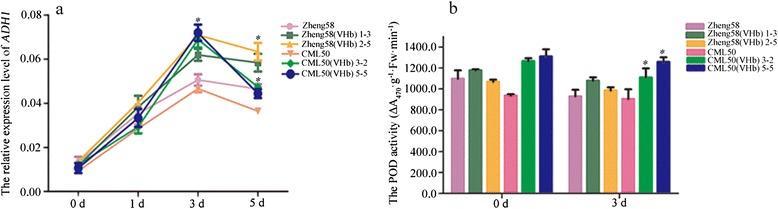
We overexpressed the VHb gene in Arabidopsis and maize under the control of the CaMV35S promoter. After 14 days of waterlogging treatment, the transgenic VHb Arabidopsis plants remained green, while the controls died. Under waterlogging, important plant growth traits of VHb plants, including seedling height, primary root length, lateral root number, and shoot dry weight were significantly improved relative to those of the controls. The VHb gene was also introduced into a maize line through particle bombardment and was then transferred to two elite maize inbred lines through marker-assisted backcrossing. The introduction of VHb significantly enhanced plant growth under waterlogging stress on traits, including seedling height, primary root length, lateral root number, root dry weight, and shoot dry weight, in both Zheng58 and CML50 maize backgrounds. Under the waterlogging condition, transgenic VHb maize seedlings exhibited elevated expression of alcohol dehydrogenase (ADH1) and higher peroxidase (POD) enzyme activity. The two VHb-containing lines, Zheng58 (VHb) and CML50 (VHb), exhibited higher tolerance to waterlogging than their negative control lines (Zheng58 and CML50).
CONCLUSIONS
These results demonstrate that the exogenous VHb gene confers waterlogging tolerance to the transgenic maize line. In Maize in the place of to the transgenic maize line, the VHb gene is a useful molecular tool for the improvement of waterlogging and submergence-tolerance.
背景
透明颤菌血红蛋白(VHb)是在革兰氏阴性需氧细菌透明颤菌中发现的一种血红蛋白,已证明它有助于多种植物物种耐受厌氧胁迫。玉米(Zea mays L.)对涝害敏感,会导致显著的产量损失。在本研究中,我们通过引入外源VHb基因来解决这个问题。
结果
我们在CaMV35S启动子的控制下,在拟南芥和玉米中过表达VHb基因。经过14天的涝害处理后,转基因VHb拟南芥植株仍保持绿色,而对照植株死亡。在涝害条件下,与对照相比,VHb植株的重要植物生长性状,包括苗高、主根长度、侧根数量和地上部干重均得到显著改善。VHb基因也通过微粒轰击导入一个玉米品系,然后通过标记辅助回交转移到两个优良玉米自交系中。在郑58和CML50玉米背景下,VHb的导入显著增强了涝害胁迫下植株在苗高、主根长度、侧根数量、根干重和地上部干重等性状上的生长。在涝害条件下,转基因VHb玉米幼苗的乙醇脱氢酶(ADH1)表达升高,过氧化物酶(POD)活性更高。两个含VHb的品系,郑58(VHb)和CML50(VHb),比其阴性对照品系(郑58和CML50)表现出更高的耐涝性。
结论
这些结果表明,外源VHb基因赋予转基因玉米品系耐涝性。在玉米中,VHb基因是提高耐涝性和耐淹性的一种有用的分子工具。


 Zotero 插件