Sterner-Kock Anja, Haider Wolfram, Sacchini Flavio, Liljander Anne, Meens Jochen, Poole Jane, Guschlbauer Maria, Heller Martin, Naessens Jan, Jores Joerg
Center for Experimental Medicine, University of Cologne, Medical School, University Hospital of Cologne, Robert-Koch-Straße 10, 50931, Cologne, Germany.
Institut für Tierpathologie, Schönhauser Straße 62, 13127, Berlin, Germany.
Trop Anim Health Prod. 2016 Mar;48(3):569-76. doi: 10.1007/s11250-016-0994-9. Epub 2016 Feb 2.
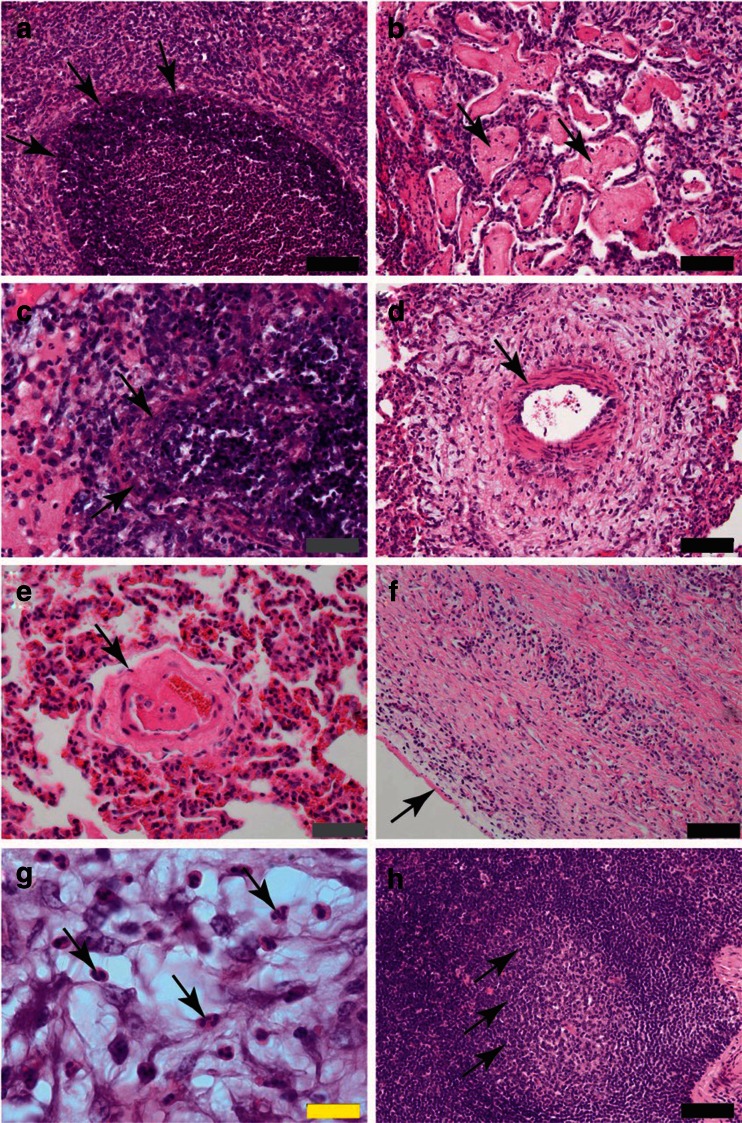
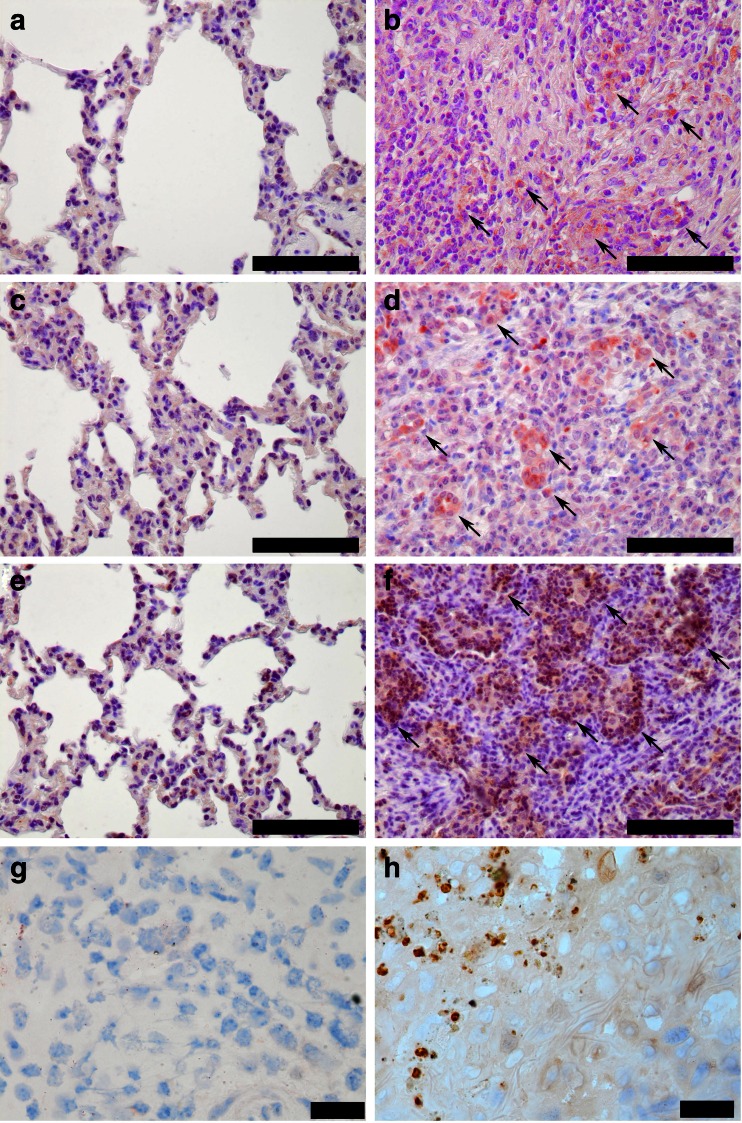
Contagious bovine pleuropneumonia (CBPP), a severe respiratory disease, is characterized by massive inflammation of the lung especially during the acute clinical stage of infection. Tissue samples from cattle, experimentally infected with Mycoplasma mycoides subsp. mycoides Afadé, were subjected to histopathological and immunohistochemical examination in order to provide insight into innate immune pathways that shape inflammatory host responses. Lung lesions were characterized by vasculitis, necrosis, and increased presence of macrophages and neutrophils, relative to uninfected animals. The presence of three cytokines associated with innate inflammatory immune responses, namely, IL-1β, IL-17A, and TNF-α, were qualitatively investigated in situ. Higher cytokine levels were detected in lung tissue samples from CBPP-affected cattle compared to samples derived from an uninfected control group. We therefore conclude that the cytokines TNF-α and IL-1β, which are prevalent in the acute phase of infections, play a role in the inflammatory response seen in the lung tissue in CBPP. IL-17A gets released by activated macrophages and attracts granulocytes that modulate the acute phase of the CBPP lesions.
牛传染性胸膜肺炎(CBPP)是一种严重的呼吸道疾病,其特征是肺部出现大量炎症,尤其是在感染的急性临床阶段。对实验感染丝状支原体丝状亚种阿法迪(Mycoplasma mycoides subsp. mycoides Afadé)的牛的组织样本进行了组织病理学和免疫组织化学检查,以便深入了解塑造炎症宿主反应的固有免疫途径。与未感染动物相比,肺部病变的特征为血管炎、坏死以及巨噬细胞和中性粒细胞数量增加。对与固有炎症免疫反应相关的三种细胞因子,即白细胞介素-1β(IL-1β)、白细胞介素-17A(IL-17A)和肿瘤坏死因子-α(TNF-α)的存在情况进行了原位定性研究。与未感染对照组的样本相比,在受CBPP影响的牛的肺组织样本中检测到更高的细胞因子水平。因此,我们得出结论,在感染急性期普遍存在的细胞因子TNF-α和IL-1β在CBPP肺组织中所见的炎症反应中起作用。IL-17A由活化的巨噬细胞释放,并吸引调节CBPP病变急性期的粒细胞。