Ko Byuk Sung, Kim Ji Yeon, Seo Dong-Woo, Kim Won Young, Lee Jae Ho, Sheikh Aziz, Bates David W
Department of Emergency Medicine, University of Ulsan College of Medicine, Asan Medical Center, Seoul, Korea.
Department of Biomedical Informatics, Asan Medical Center, Seoul, Korea.
Sci Rep. 2016 Feb 3;6:20168. doi: 10.1038/srep20168.
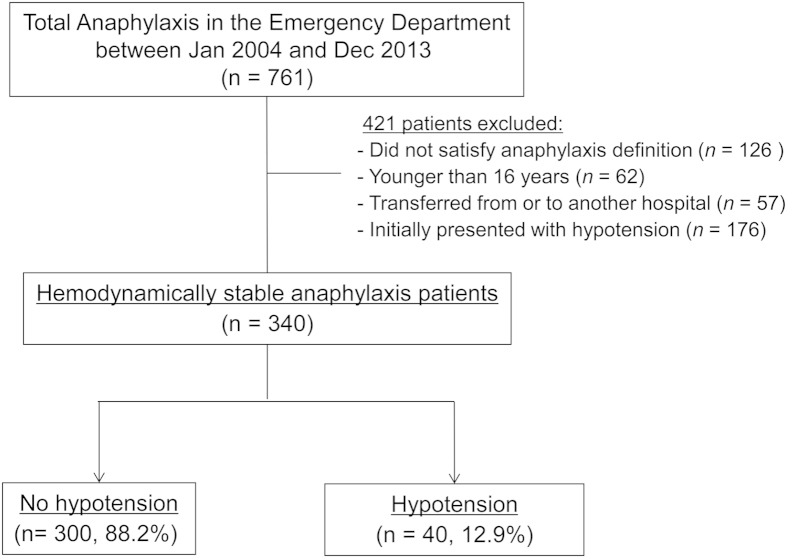
Although adrenaline (epinephrine) is a cornerstone of initial anaphylaxis treatment, it is not often used. We sought to assess whether use of adrenaline in hemodynamically stable patients with anaphylaxis could prevent the development of hypotension. We conducted a retrospective cohort study of 761 adult patients with anaphylaxis presenting to the emergency department (ED) of a tertiary care hospital over a 10-year period. We divided the patients into two groups according to the occurrence of hypotension and compared demographic characteristics, clinical features, treatments and outcomes. Of the 340 patients with anaphylaxis who were normotensive at first presentation, 40 patients experienced hypotension during their ED stay. The ED stay of the hypotension group was significantly longer than that of patients who did not experience hypotension (496 min vs 253 min, P = 0.000). Adrenaline use in hemodynamically stable anaphylaxis patient was independently associated with a lower risk of developing in-hospital occurrence of hypotension: OR, 0.254 [95% CI, 0.091-0.706]. Adrenaline use in hemodynamically stable anaphylaxis patients was associated with a reduced risk of developing in-hospital occurrence of hypotension. Adverse events induced by adrenaline were rare when the intramuscular route was used.
尽管肾上腺素是过敏性休克初始治疗的基石,但它并不常用。我们试图评估在血流动力学稳定的过敏性休克患者中使用肾上腺素是否能预防低血压的发生。我们对一家三级医院急诊科在10年期间收治的761例成年过敏性休克患者进行了一项回顾性队列研究。我们根据低血压的发生情况将患者分为两组,并比较了人口统计学特征、临床特征、治疗方法和结局。在首次就诊时血压正常的340例过敏性休克患者中,有40例在急诊科留观期间出现低血压。低血压组的急诊科留观时间明显长于未出现低血压的患者(496分钟对253分钟,P = 0.000)。在血流动力学稳定的过敏性休克患者中使用肾上腺素与住院期间发生低血压的风险较低独立相关:比值比,0.254 [95%可信区间,0.091 - 0.706]。在血流动力学稳定的过敏性休克患者中使用肾上腺素与住院期间发生低血压的风险降低相关。当采用肌肉注射途径时,肾上腺素引起的不良事件很少见。