Medina-Carmona Encarnación, Palomino-Morales Rogelio J, Fuchs Julian E, Padín-Gonzalez Esperanza, Mesa-Torres Noel, Salido Eduardo, Timson David J, Pey Angel L
Department of Physical Chemistry, Faculty of Sciences, University of Granada, Granada, Spain.
Department of Biochemistry and Molecular Biology I, Faculty of Sciences, University of Granada, Granada, Spain.
Sci Rep. 2016 Feb 3;6:20331. doi: 10.1038/srep20331.
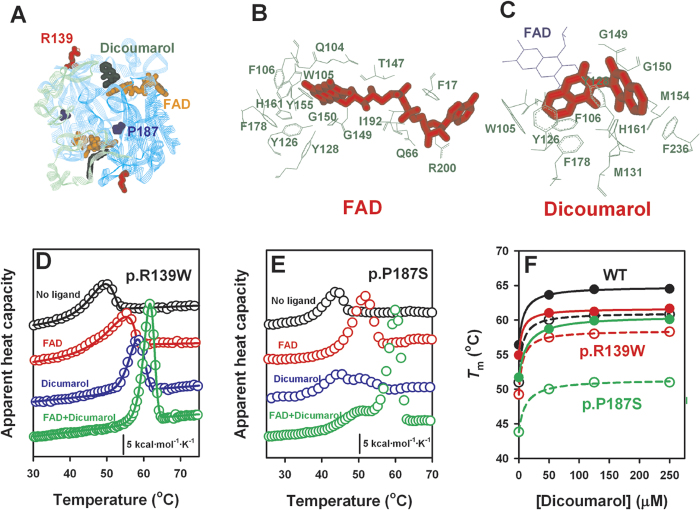
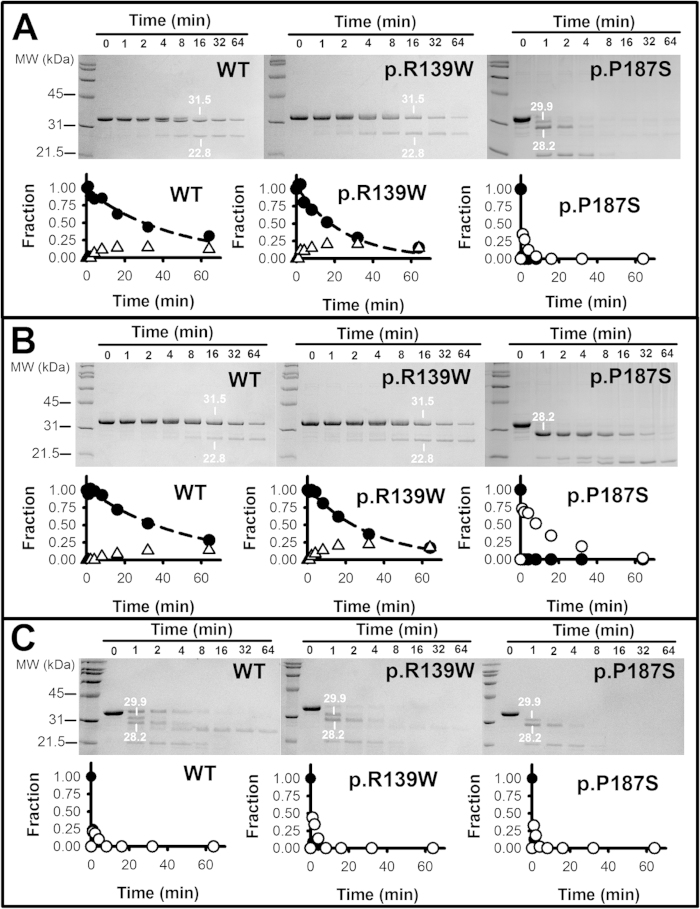
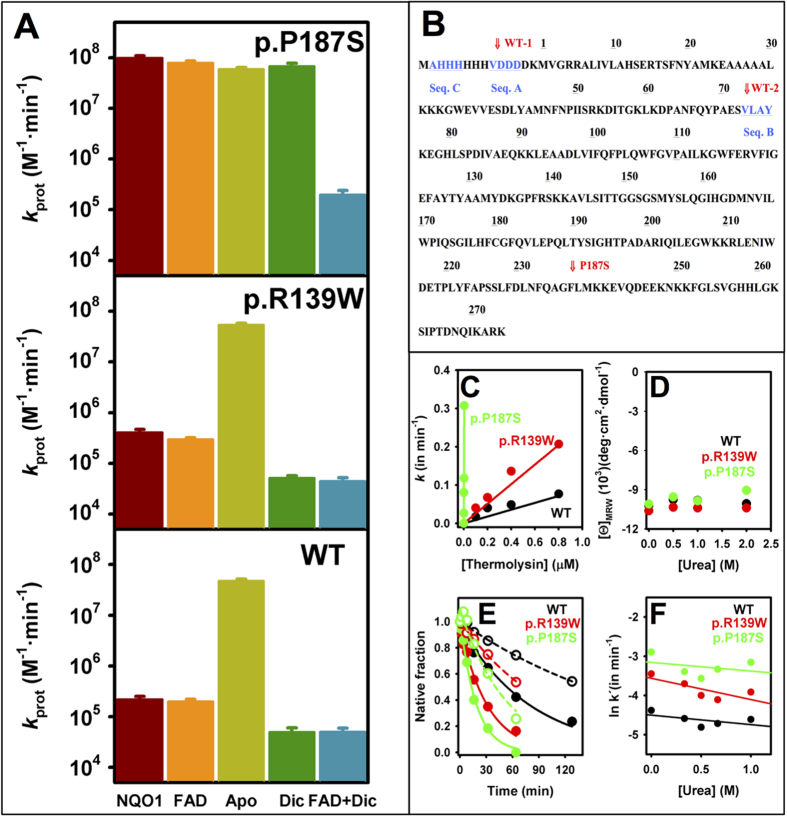
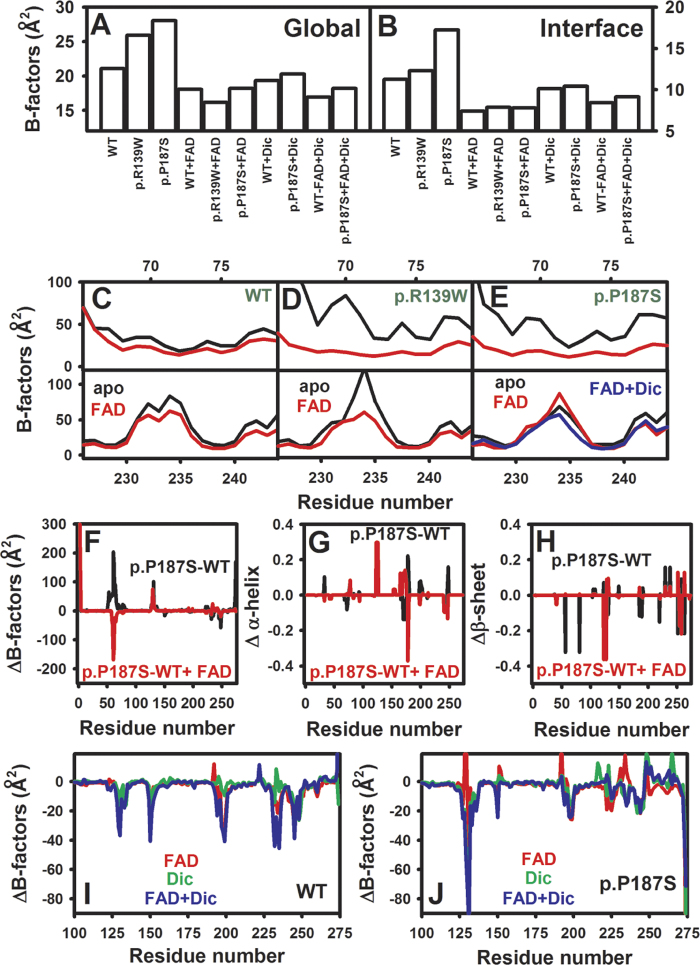
Protein dynamics is essential to understand protein function and stability, even though is rarely investigated as the origin of loss-of-function due to genetic variations. Here, we use biochemical, biophysical, cell and computational biology tools to study two loss-of-function and cancer-associated polymorphisms (p.R139W and p.P187S) in human NAD(P)H quinone oxidoreductase 1 (NQO1), a FAD-dependent enzyme which activates cancer pro-drugs and stabilizes several oncosuppressors. We show that p.P187S strongly destabilizes the NQO1 dimer in vitro and increases the flexibility of the C-terminal domain, while a combination of FAD and the inhibitor dicoumarol overcome these alterations. Additionally, changes in global stability due to polymorphisms and ligand binding are linked to the dynamics of the dimer interface, whereas the low activity and affinity for FAD in p.P187S is caused by increased fluctuations at the FAD binding site. Importantly, NQO1 steady-state protein levels in cell cultures correlate primarily with the dynamics of the C-terminal domain, supporting a directional preference in NQO1 proteasomal degradation and the use of ligands binding to this domain to stabilize p.P187S in vivo. In conclusion, protein dynamics are fundamental to understanding loss-of-function in p.P187S, and to develop new pharmacological therapies to rescue this function.
蛋白质动力学对于理解蛋白质功能和稳定性至关重要,尽管它很少作为基因变异导致功能丧失的根源进行研究。在这里,我们使用生化、生物物理、细胞和计算生物学工具来研究人类NAD(P)H醌氧化还原酶1(NQO1)中的两种功能丧失且与癌症相关的多态性(p.R139W和p.P187S),NQO1是一种依赖FAD的酶,可激活癌症前体药物并稳定多种抑癌蛋白。我们发现,p.P187S在体外会强烈破坏NQO1二聚体的稳定性,并增加C末端结构域的灵活性,而FAD和抑制剂双香豆素的组合可克服这些改变。此外,多态性和配体结合引起的整体稳定性变化与二聚体界面的动力学相关,而p.P187S中对FAD的低活性和亲和力是由FAD结合位点波动增加所致。重要的是,细胞培养物中NQO1的稳态蛋白水平主要与C末端结构域的动力学相关,这支持了NQO1蛋白酶体降解中的定向偏好以及使用与该结构域结合的配体在体内稳定p.P187S。总之,蛋白质动力学对于理解p.P187S中的功能丧失以及开发新的药理学疗法来挽救该功能至关重要。