Chandrasekaran Sukantha, Caparon Michael G
Department of Molecular Microbiology, Washington University School of Medicine, St. Louis, Missouri, USA.
Department of Molecular Microbiology, Washington University School of Medicine, St. Louis, Missouri, USA
mBio. 2016 Feb 2;7(1):e02215-15. doi: 10.1128/mBio.02215-15.
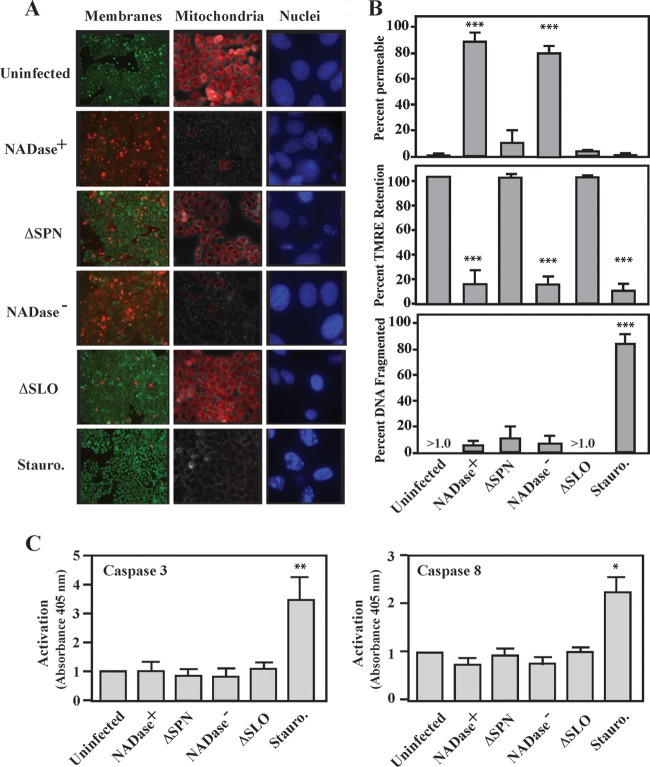
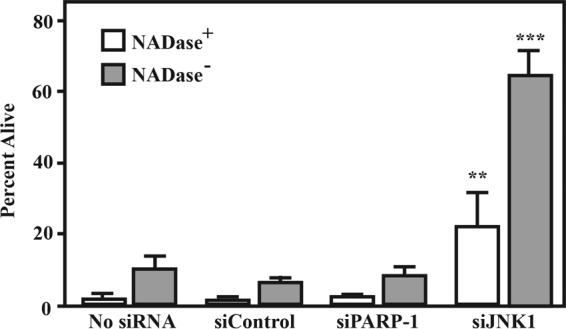
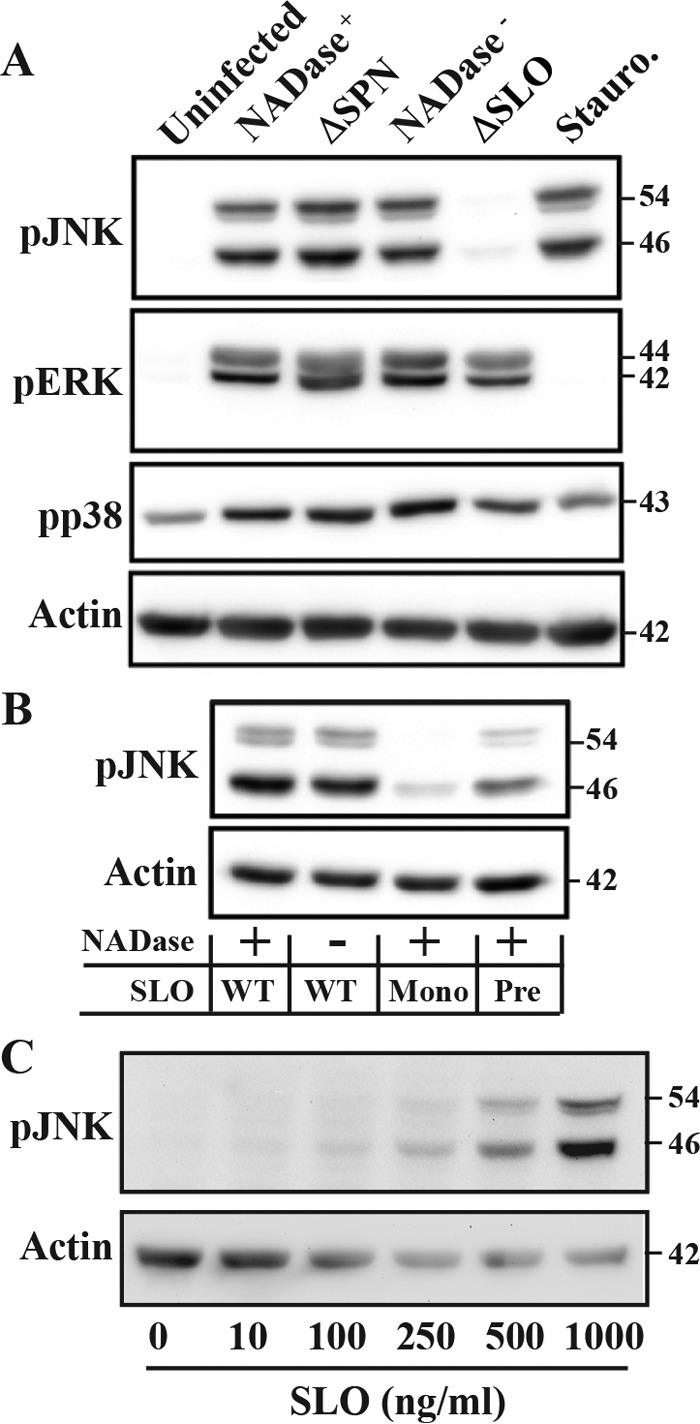
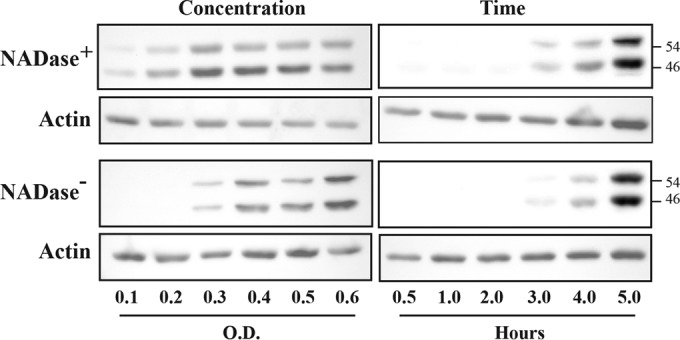
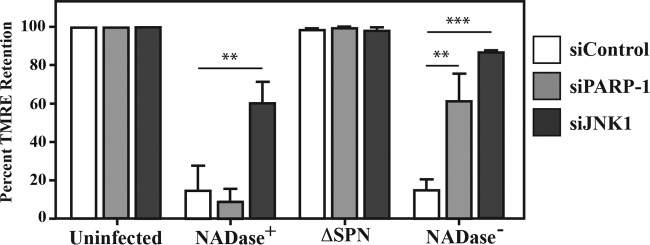
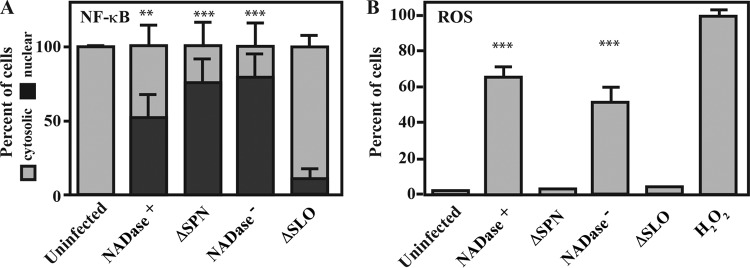
Virulence factors are often multifunctional and contribute to pathogenesis through synergistic mechanisms. For the human pathogen Streptococcus pyogenes, two factors that act synergistically are the S. pyogenes NAD(+) glycohydrolase (SPN) and streptolysin O (SLO). Through distinct mechanisms, SLO forms pores in host cell membranes and translocates SPN into the host cell cytosol. Two natural variants of SPN exist, one that exhibits NADase activity and one that lacks this function, and both versions are translocated and act in concert with SLO to cause an accelerated death response in epithelial cells. While NADase(+) SPN is known to trigger a metabolic form of necrosis through the depletion of NAD(+), the mechanism by which NADase(-) SPN induces cell death was unknown. In the studies described here, we examined the pathway of NADase(-) cell death through analysis of activation patterns of mitogen-activated protein kinases (MAPKs). S. pyogenes infection resulted in activation of members of three MAPK subfamilies (p38, ERK, and JNK). However, only JNK was activated in an SLO-specific manner. NADase(-) SPN induced necrosis in HeLa epithelial cells associated with depolarization of mitochondrial membranes, activation of NF-κB, and the generation of reactive oxygen species. Remarkably, RNA interference (RNAi) silencing of JNK protected cells from NADase(-)-SPN-mediated necrosis, suggesting that NADase(-) SPN triggers a form of programmed necrosis dependent on JNK signaling. Taken together, these data demonstrate that SPN acts with SLO to elicit necrosis through two different mechanisms depending on its NADase activity, i.e., metabolic (NADase(+)) or programmed (NADase(-)), leading to distinct inflammatory profiles.
Many bacterial pathogens produce toxins that alter how infected host cells interact with the immune system. For Streptococcus pyogenes, two toxins, a NAD(+) glycohydrolase (SPN) and streptolysin O (SLO), act in combination to cause infected cells to die. However, there are two natural forms of SPN, and these variants cause dying cells to produce different types of signaling molecules. The NADase(+) form of SPN kills cells by depleting reserves of NAD(+) and cellular energy. The other form of SPN lacks this activity (NADase(-)); thus, the mechanism by which this variant induces toxicity was unknown. Here, we show that infected cells recognize NADase(-) SPN through a specific signaling molecule called JNK, which causes these cells to undergo a form of cellular suicide known as programmed necrosis. This helps us to understand how different forms of toxins alter host cell signaling to help S. pyogenes cause different types of diseases.
毒力因子通常具有多种功能,并通过协同机制促进发病机制。对于人类病原体化脓性链球菌而言,两种协同作用的因子是化脓性链球菌NAD⁺糖水解酶(SPN)和链球菌溶血素O(SLO)。通过不同机制,SLO在宿主细胞膜上形成孔道,并将SPN转运至宿主细胞胞质溶胶中。SPN存在两种天然变体,一种具有NAD酶活性,另一种缺乏该功能,两种变体均被转运并与SLO协同作用,导致上皮细胞加速死亡反应。虽然已知具有NAD酶活性的SPN通过消耗NAD⁺引发一种代谢性坏死,但缺乏NAD酶活性的SPN诱导细胞死亡的机制尚不清楚。在本文所述研究中,我们通过分析丝裂原活化蛋白激酶(MAPK)的激活模式,研究了缺乏NAD酶活性的细胞死亡途径。化脓性链球菌感染导致三个MAPK亚家族(p38、ERK和JNK)的成员激活。然而,只有JNK以SLO特异性方式被激活。缺乏NAD酶活性的SPN在HeLa上皮细胞中诱导坏死,这与线粒体膜去极化、NF-κB激活和活性氧的产生有关。值得注意的是,JNK的RNA干扰(RNAi)沉默保护细胞免受缺乏NAD酶活性的SPN介导的坏死,这表明缺乏NAD酶活性的SPN触发了一种依赖JNK信号传导的程序性坏死形式。综上所述,这些数据表明,SPN根据其NAD酶活性,通过两种不同机制与SLO共同引发坏死,即代谢性(具有NAD酶活性)或程序性(缺乏NAD酶活性),导致不同的炎症特征。
许多细菌病原体产生毒素,改变受感染宿主细胞与免疫系统相互作用的方式。对于化脓性链球菌而言,两种毒素,即NAD⁺糖水解酶(SPN)和链球菌溶血素O(SLO),共同作用导致受感染细胞死亡。然而,SPN有两种天然形式,这些变体导致死亡细胞产生不同类型的信号分子。具有NAD酶活性的SPN形式通过消耗NAD⁺储备和细胞能量杀死细胞。SPN的另一种形式缺乏这种活性(缺乏NAD酶活性);因此,这种变体诱导毒性的机制尚不清楚。在这里,我们表明受感染细胞通过一种名为JNK的特定信号分子识别缺乏NAD酶活性的SPN,这导致这些细胞经历一种称为程序性坏死的细胞自杀形式。这有助于我们理解不同形式的毒素如何改变宿主细胞信号传导,以帮助化脓性链球菌引起不同类型的疾病。