Riddle Matthew C, Bolli Geremia B, Home Philip D, Bergenstal Richard M, Ziemen Monika, Muehlen-Bartmer Isabel, Wardecki Marek, Vinet Laetitia, Jeandidier Nathalie, Yki-Järvinen Hannele
1 Division of Endocrinology, Diabetes and Clinical Nutrition, Oregon Health & Science University , Portland, Oregon.
2 University of Perugia , Perugia, Italy .
Diabetes Technol Ther. 2016 Apr;18(4):252-7. doi: 10.1089/dia.2015.0290. Epub 2016 Feb 3.
Insulin glargine 300 U/mL (Gla-300) has a more constant and prolonged action profile than insulin glargine 100 U/mL and in clinical studies is associated with similar glycemic control but less hypoglycemia. Whether its effects are altered by variability of injection time was examined in two 3-month substudies.
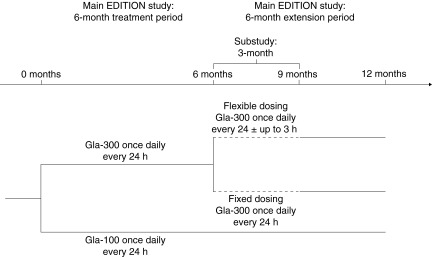
Eligible participants completing 6 months of optimized treatment with Gla-300 in EDITION 1 (n = 109) and EDITION 2 (n = 89), having a mean hemoglobin A1c (HbA1c) level of 7.3 % (SD 1.0 %), were randomized (1:1) to groups advised to increase variability of between-injection intervals to 24 ± up to 3 h or to maintain fixed 24-h intervals for 3 months. Changes of HbA1c level and other efficacy and safety measures were assessed.
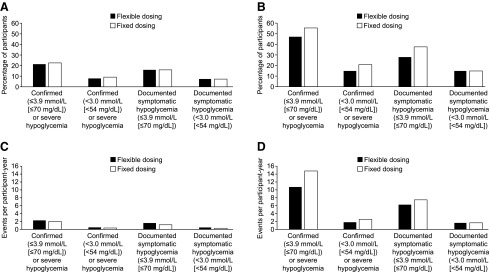
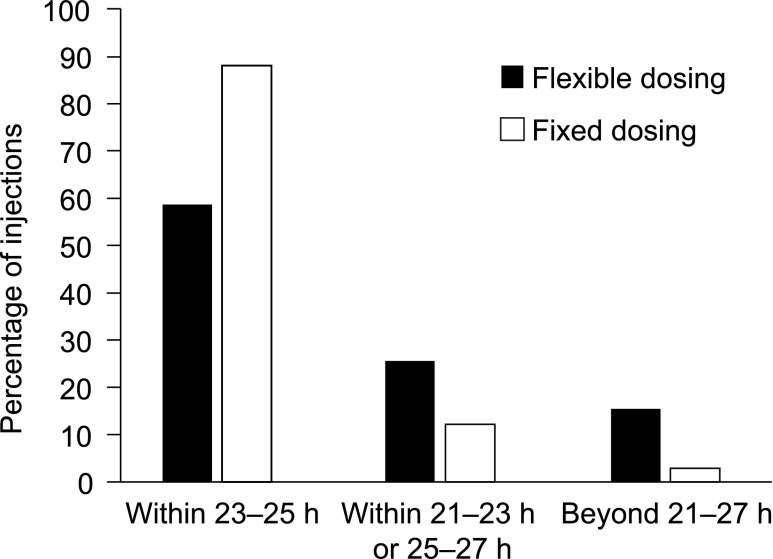
In the fixed-dosing group, 64% of participants reported all intervals within the 23-25-h range, compared with 15% of those advised flexible dosing. In the fixed- and flexible-dosing groups, 12% and 41%, respectively, of between-injection intervals were outside the 23-25-h range, and 2% and 16%, respectively, were outside the 21-27-h range. Least squares mean between-group difference in HbA1c change from baseline was 0.05 % (95% confidence interval [CI], -0.13 to 0.23); for fasting plasma glucose, 2.7 mg/dL (95% CI, -9.0 to 14.4); and for daily basal insulin dose, 0.00 U/kg (95% CI, -0.02 to 0.03). Frequencies of hypoglycemia and adverse events did not differ between groups.
The efficacy and safety of Gla-300 demonstrated in EDITION 1 and EDITION 2 are maintained in substudies when the insulin was injected up to 3 h before or after the usual time of administration.
与100 U/mL的甘精胰岛素相比,300 U/mL的甘精胰岛素(Gla-300)作用更持久且恒定,在临床研究中,二者血糖控制效果相似,但Gla-300导致低血糖的情况较少。在两项为期3个月的子研究中,对注射时间的变异性是否会改变其效果进行了研究。
在第1版(n = 109)和第2版(n = 89)中,符合条件的参与者完成了6个月的Gla-300优化治疗,平均糖化血红蛋白(HbA1c)水平为7.3%(标准差1.0%),被随机(1:1)分为两组,一组被建议将注射间隔时间的变异性增加到24±最多3小时,另一组被建议保持固定的24小时间隔,为期3个月。评估HbA1c水平及其他疗效和安全性指标的变化。
在固定给药组中,64%的参与者报告所有间隔时间在23至25小时范围内,而建议灵活给药的参与者中这一比例为15%。在固定给药组和灵活给药组中,分别有12%和41%的注射间隔时间超出23至25小时范围,分别有2%和16%超出21至27小时范围。两组间HbA1c自基线变化的最小二乘均值差异为0.05%(95%置信区间[CI],-0.13至0.23);空腹血糖为2.7mg/dL(95%CI,-9.0至14.4);每日基础胰岛素剂量为0.00U/kg(95%CI,-0.02至0.03)。两组间低血糖和不良事件的发生率无差异。
在第1版和第2版中证明的Gla-300的疗效和安全性在子研究中得以维持,即胰岛素在通常给药时间前后3小时内注射。