Zhao Liandong, Chen Tingting, Wang Chonghui, Li Guoxi, Zhi Wenhui, Yin Jun, Wan Qi, Chen Ling
Department of Neurology, The First Affiliated Hospital of Nanjing Medical University, 300 Guangzhou Road, Nanjing, Jiangsu, 210029, China.
Department of Neurology, The Second Hospital of Huaian, Huaian, Jiangsu, 223002, China.
BMC Neurol. 2016 Feb 4;16:18. doi: 10.1186/s12883-016-0533-3.
The production of inflammatory cytokines resulting from amyloid β (Aβ) is associated with the initiation of Alzheimer's disease (AD). Atorvastatin (ATV) has been reported to improve AD, however, it is unclear how the anti-inflammatory mechanism is linked with its protection against the impairment of spatial cognitive function in AD. The present study was designed to explore what mechanism was possibly involved in the anti-inflammatory pathway in regard to the ATV treatment of AD.
We used an AD model induced by the administration of Aβ(25-35) in male C57BL/6 mice and an in vitro culture system to study the protective effects of ATV on the spatial cognitive deficits, hippocampal long-term potentiation (LTP) impairment and inflammatory reaction.
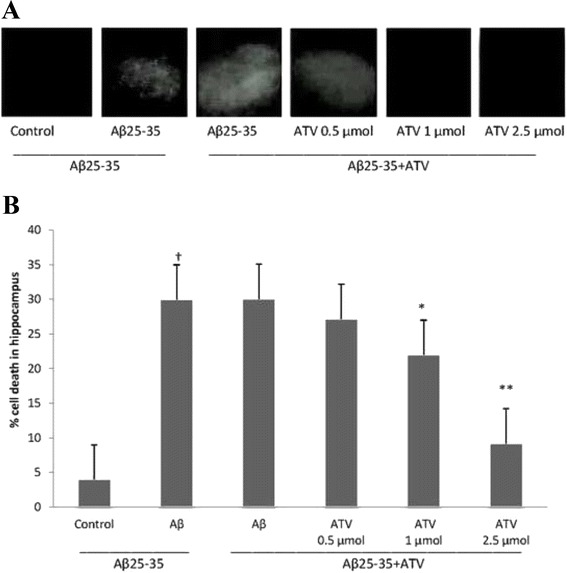
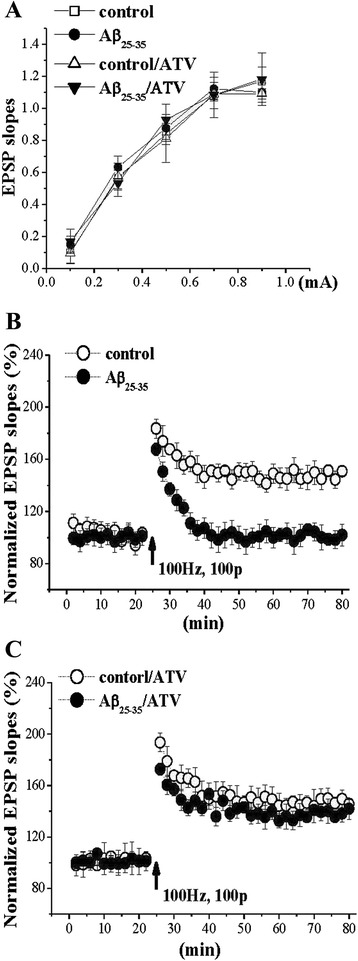
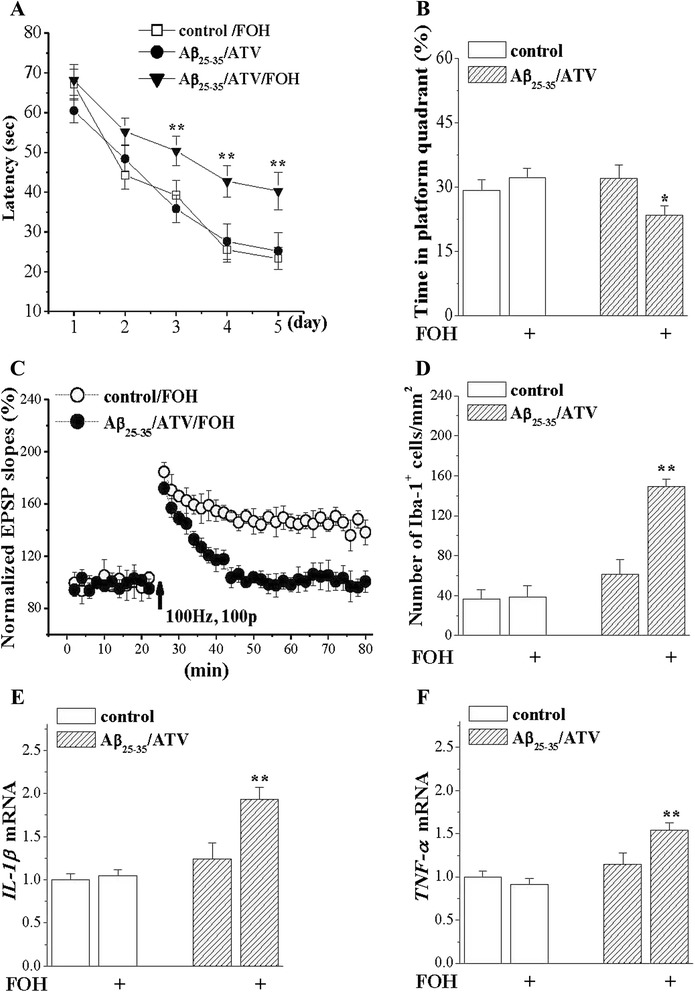
The intragastric administration of ATV (5 mg/kg) in Aβ(25-35)-treated mice significantly ameliorated the spatial cognitive deficits and prevented the LTP impairment in hippocampal CA1. The increased Iba-1 positive cells and inflammatory components in the hippocampus were reduced after the ATV treatment. The anti-inflammatory and LTP protection of ATV were abolished using the replenishment of farnesyl pyrophosphate by the administration of farnesol (FOH). The hippocampal slices culture showed Aβ(25-35)-induced neurotoxicity in the absence of the presence of ATV. Treatment with ATV (0.5, 1, 2.5 μmol/L) dose-dependently prevented the cell damage in hippocampus induced by Aβ25-35.
The administration of ATV ameliorated the cognitive deficits, depressed the inflammatory responses, improved the LTP impairment, and prevents Aβ25-35-induced neurotoxicity in cultured hippocampal neurons. These protective functions of ATV involved the pathway of reducing farnesyl pyrophosphate (FPP).
淀粉样β蛋白(Aβ)产生的炎性细胞因子与阿尔茨海默病(AD)的发病相关。据报道,阿托伐他汀(ATV)可改善AD,但尚不清楚其抗炎机制如何与其对AD中空间认知功能损害的保护作用相关联。本研究旨在探讨ATV治疗AD时抗炎途径可能涉及的机制。
我们使用雄性C57BL/6小鼠经给予Aβ(25-35)诱导的AD模型和体外培养系统,研究ATV对空间认知缺陷、海马长时程增强(LTP)损害及炎症反应的保护作用。
对经Aβ(25-35)处理的小鼠灌胃给予ATV(5mg/kg)可显著改善空间认知缺陷,并预防海马CA1区的LTP损害。ATV治疗后,海马中Iba-1阳性细胞和炎性成分增加的情况减少。通过给予法尼醇(FOH)补充法尼焦磷酸后,ATV的抗炎和LTP保护作用被消除。海马脑片培养显示,无论有无ATV存在,Aβ(25-35)均可诱导神经毒性。用ATV(0.5、1、2.5μmol/L)处理可剂量依赖性地预防Aβ25-35诱导的海马细胞损伤。
给予ATV可改善认知缺陷、抑制炎症反应、改善LTP损害,并预防培养的海马神经元中Aβ25-35诱导的神经毒性。ATV的这些保护作用涉及减少法尼焦磷酸(FPP)的途径。