Fournet N, Koedijk F D H, van Leeuwen A P, van Rooijen M S, van der Sande M A B, van Veen M G
Epidemiology and Surveillance Unit, Centre for Infectious Diseases Control, National Institute for Public Health and the Environment (RIVM), P.O. Box 1, 3720 BA, Bilthoven, The Netherlands.
European Programme for Intervention Epidemiology Training (EPIET), European Centre for Disease Prevention and Control (ECDC), Stockholm, Sweden.
BMC Infect Dis. 2016 Feb 4;16:63. doi: 10.1186/s12879-016-1388-3.
Male sex workers (MSW) are particularly exposed to sexually transmitted infections (STI) including HIV. In the Netherlands, data about STI among MSW are scarce. We estimated chlamydia, gonorrhoea, syphilis and HIV diagnoses among MSW attending STI clinics and determined associated factors to guide prevention policies.
Using 2006-2012 cross-sectional national surveillance data from Dutch STI clinics, we calculated the proportion of consultations with a positive test for any of three bacterial STI or HIV among MSW. Associated factors were determined by using Poisson logistic regression with robust variance.
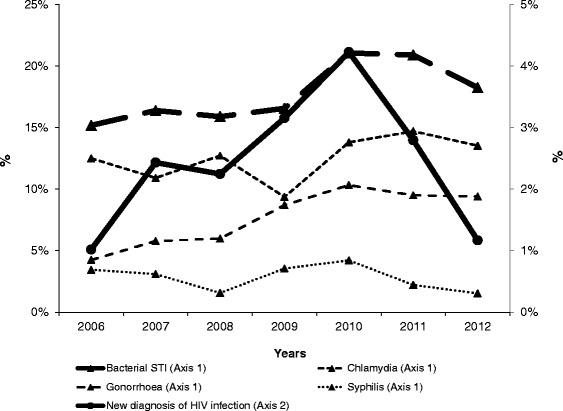
We identified 3,053 consultations involving MSW, of which 18.1 % included at least one positive bacterial STI test and 2.5 % a positive HIV test. Factors associated with bacterial STI and/or HIV diagnoses were respectively age groups < 35 y.o. and self-reporting homo- or bisexual preferences (aRR = 1.6; 95 % CI: 1.3-2.1), and age group 25-34 y.o. (aRR = 2.7; 95 % CI: 1.2-6.5) and self-reporting homo- or bisexual preferences (aRR = 24.4; 95 % CI: 3.4-176.9). Newly diagnosed and pre-existing HIV infection were associated with an increased risk for bacterial STI (aRR = 2.7, 95 % CI: 1.7-2.6 and aRR = 2.1, 95 % CI: 2.2-3.4 respectively). MSW with no history of HIV screening were more likely to be tested positive for HIV compared to those with a previous HIV-negative test (aRR = 2.6, 95 % CI: 1.6-4.3).
Health promotion activities should target MSW who are young, homo- or bisexual, those who are HIV-infected or who have never been tested for HIV, to increase early diagnosis, prevention and treatment.
男性性工作者(MSW)特别容易感染包括艾滋病毒在内的性传播感染(STI)。在荷兰,关于男性性工作者中性传播感染的数据很少。我们估计了到性传播感染诊所就诊的男性性工作者中衣原体、淋病、梅毒和艾滋病毒的诊断情况,并确定相关因素以指导预防政策。
利用荷兰性传播感染诊所2006 - 2012年的横断面全国监测数据,我们计算了男性性工作者中三种细菌性性传播感染或艾滋病毒检测呈阳性的咨询比例。相关因素通过使用具有稳健方差的泊松逻辑回归来确定。
我们确定了3053次涉及男性性工作者的咨询,其中18.1%至少有一项细菌性性传播感染检测呈阳性,2.5%艾滋病毒检测呈阳性。与细菌性性传播感染和/或艾滋病毒诊断相关的因素分别是年龄小于35岁以及自我报告为同性恋或双性恋倾向(调整风险比[aRR]=1.6;95%置信区间[CI]:1.3 - 2.1),以及年龄组25 - 34岁(aRR = 2.7;95% CI:1.2 - 6.5)和自我报告为同性恋或双性恋倾向(aRR = 24.4;95% CI:3.4 - 176.9)。新诊断的艾滋病毒感染和既往存在的艾滋病毒感染与细菌性性传播感染风险增加相关(分别为aRR = 2.7,95% CI:1.7 - 2.6和aRR = 2.1,95% CI:2.2 - 3.4)。与之前艾滋病毒检测呈阴性的男性性工作者相比,没有艾滋病毒筛查史的男性性工作者艾滋病毒检测呈阳性的可能性更大(aRR = 2.6,95% CI:1.6 -