Winkler Anderson M, Webster Matthew A, Brooks Jonathan C, Tracey Irene, Smith Stephen M, Nichols Thomas E
Oxford Centre for Functional MRI of the Brain, University of Oxford, Oxford, United Kingdom.
Clinical Research and Imaging Centre, University of Bristol, Bristol, United Kingdom.
Hum Brain Mapp. 2016 Apr;37(4):1486-511. doi: 10.1002/hbm.23115. Epub 2016 Feb 5.
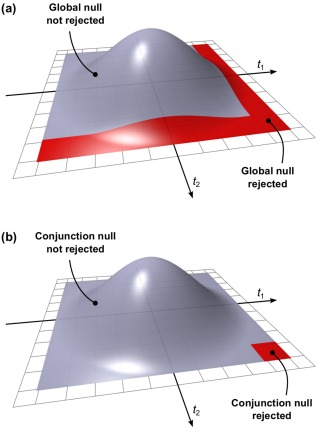
In this work, we show how permutation methods can be applied to combination analyses such as those that include multiple imaging modalities, multiple data acquisitions of the same modality, or simply multiple hypotheses on the same data. Using the well-known definition of union-intersection tests and closed testing procedures, we use synchronized permutations to correct for such multiplicity of tests, allowing flexibility to integrate imaging data with different spatial resolutions, surface and/or volume-based representations of the brain, including non-imaging data. For the problem of joint inference, we propose and evaluate a modification of the recently introduced non-parametric combination (NPC) methodology, such that instead of a two-phase algorithm and large data storage requirements, the inference can be performed in a single phase, with reasonable computational demands. The method compares favorably to classical multivariate tests (such as MANCOVA), even when the latter is assessed using permutations. We also evaluate, in the context of permutation tests, various combining methods that have been proposed in the past decades, and identify those that provide the best control over error rate and power across a range of situations. We show that one of these, the method of Tippett, provides a link between correction for the multiplicity of tests and their combination. Finally, we discuss how the correction can solve certain problems of multiple comparisons in one-way ANOVA designs, and how the combination is distinguished from conjunctions, even though both can be assessed using permutation tests. We also provide a common algorithm that accommodates combination and correction.
在这项工作中,我们展示了如何将置换方法应用于组合分析,例如那些包含多种成像模态、同一模态的多次数据采集,或者仅仅是关于同一数据的多个假设的分析。利用并集交集检验和封闭检验程序的著名定义,我们使用同步置换来校正这种检验的多重性,从而能够灵活地将具有不同空间分辨率、基于大脑表面和/或体积表示的成像数据(包括非成像数据)进行整合。对于联合推断问题,我们提出并评估了对最近引入的非参数组合(NPC)方法的一种改进,使得推断可以在单个阶段进行,而不是采用两阶段算法且无需大量数据存储,同时计算需求合理。即使在使用置换评估经典多元检验(如MANCOVA)时,该方法也表现出色。我们还在置换检验的背景下评估了过去几十年中提出的各种组合方法,并确定了在一系列情况下能对错误率和功效提供最佳控制的方法。我们表明,其中一种方法,即蒂皮特方法,在检验多重性校正及其组合之间建立了联系。最后,我们讨论了这种校正如何解决单因素方差分析设计中的某些多重比较问题,以及组合与联合如何区分,尽管两者都可以使用置换检验进行评估。我们还提供了一种通用算法,该算法兼顾了组合和校正。