Gajan Ambikai, Barnes Valerie L, Liu Mengying, Saha Nirmalya, Pile Lori A
Department of Biological Sciences, Wayne State University, Detroit, MI USA.
Epigenetics Chromatin. 2016 Feb 3;9:4. doi: 10.1186/s13072-016-0053-9. eCollection 2016.
Regulation of gene expression by histone-modifying enzymes is essential to control cell fate decisions and developmental processes. Two histone-modifying enzymes, RPD3, a deacetylase, and dKDM5/LID, a demethylase, are present in a single complex, coordinated through the SIN3 scaffold protein. While the SIN3 complex has been demonstrated to have functional histone deacetylase activity, the role of the demethylase dKDM5/LID as part of the complex has not been investigated.
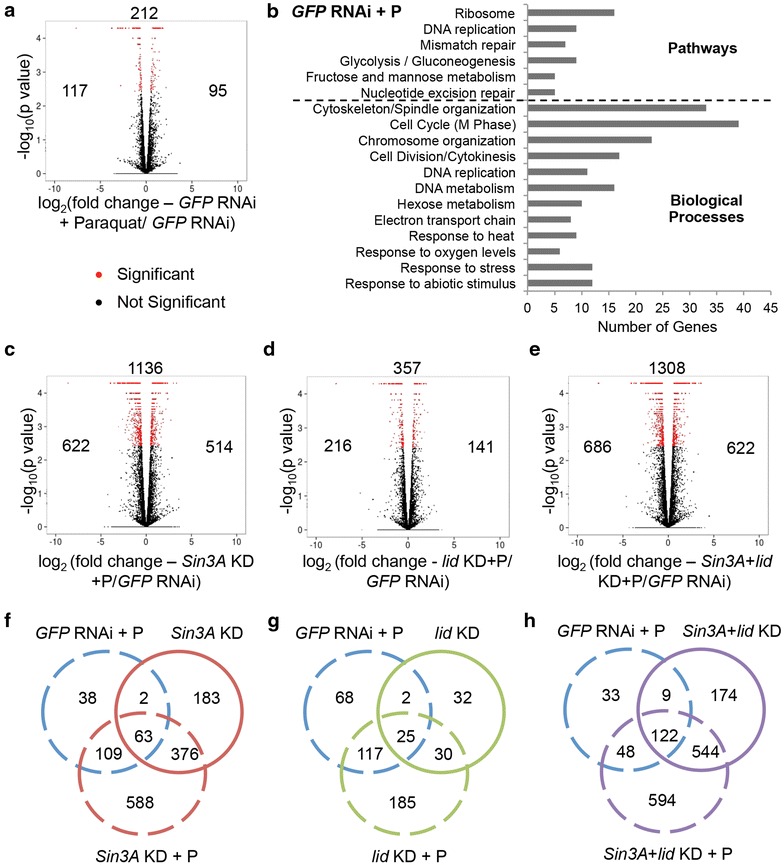
Here, we analyzed the developmental and transcriptional activities of dKDM5/LID in relation to SIN3. Knockdown of either Sin3A or lid resulted in decreased cell proliferation in S2 cells and wing imaginal discs. Conditional knockdown of either Sin3A or lid resulted in flies that displayed wing developmental defects. Interestingly, overexpression of dKDM5/LID rescued the wing developmental defect due to reduced levels of SIN3 in female flies, indicating a major role for dKDM5/LID in cooperation with SIN3 during development. Together, these observed phenotypes strongly suggest that dKDM5/LID as part of the SIN3 complex can impact previously uncharacterized transcriptional networks. Transcriptome analysis revealed that SIN3 and dKDM5/LID regulate many common genes. While several genes implicated in cell cycle and wing developmental pathways were affected upon altering the level of these chromatin factors, a significant affect was also observed on genes required to mount an effective stress response. Further, under conditions of induced oxidative stress, reduction of SIN3 and/or dKDM5/LID altered the expression of a greater number of genes involved in cell cycle-related processes relative to normal conditions. This highlights an important role for SIN3 and dKDM5/LID proteins to maintain proper progression through the cell cycle in environments of cellular stress. Further, we find that target genes are bound by both SIN3 and dKDM5/LID, however, histone acetylation, not methylation, plays a predominant role in gene regulation by the SIN3 complex.
We have provided genetic evidence to demonstrate functional cooperation between the histone demethylase dKDM5/LID and SIN3. Biochemical and transcriptome data further support functional links between these proteins. Together, the data provide a solid framework for analyzing the gene regulatory pathways through which SIN3 and dKDM5/LID control diverse biological processes in the organism.
组蛋白修饰酶对基因表达的调控对于控制细胞命运决定和发育过程至关重要。两种组蛋白修饰酶,脱乙酰酶RPD3和去甲基酶dKDM5/LID,存在于一个单一复合物中,通过SIN3支架蛋白进行协调。虽然已证明SIN3复合物具有功能性组蛋白脱乙酰酶活性,但作为该复合物一部分的去甲基酶dKDM5/LID的作用尚未得到研究。
在此,我们分析了dKDM5/LID与SIN3相关的发育和转录活性。敲低Sin3A或lid会导致S2细胞和翅成虫盘的细胞增殖减少。条件性敲低Sin3A或lid会导致果蝇出现翅发育缺陷。有趣的是,dKDM5/LID的过表达挽救了由于雌性果蝇中SIN3水平降低而导致的翅发育缺陷,表明dKDM5/LID在发育过程中与SIN3协同发挥主要作用。总之,这些观察到的表型强烈表明,作为SIN3复合物一部分的dKDM5/LID可以影响以前未被表征的转录网络。转录组分析表明,SIN3和dKDM5/LID调节许多共同的基因。虽然改变这些染色质因子的水平会影响一些与细胞周期和翅发育途径相关的基因,但对有效应激反应所需基因也有显著影响。此外,在诱导氧化应激的条件下,相对于正常条件,SIN3和/或dKDM5/LID的减少改变了更多参与细胞周期相关过程的基因的表达。这突出了SIN3和dKDM5/LID蛋白在细胞应激环境中维持细胞周期正常进程的重要作用。此外,我们发现靶基因同时被SIN3和dKDM5/LID结合,然而,组蛋白乙酰化而非甲基化在SIN3复合物对基因的调控中起主要作用。
我们提供了遗传学证据来证明组蛋白去甲基酶dKDM5/LID与SIN3之间的功能协同作用。生化和转录组数据进一步支持了这些蛋白之间的功能联系。总之,这些数据为分析SIN3和dKDM5/LID控制生物体中各种生物学过程的基因调控途径提供了坚实的框架。