Howland Mariann A, Sandman Curt A, Glynn Laura M, Crippen Cheryl, Davis Elysia Poggi
Department of Psychiatry and Human Behavior, University of California, Irvine, CA, USA.
Department of Psychiatry and Human Behavior, University of California, Irvine, CA, USA.
Psychoneuroendocrinology. 2016 May;67:10-7. doi: 10.1016/j.psyneuen.2016.01.023. Epub 2016 Feb 4.
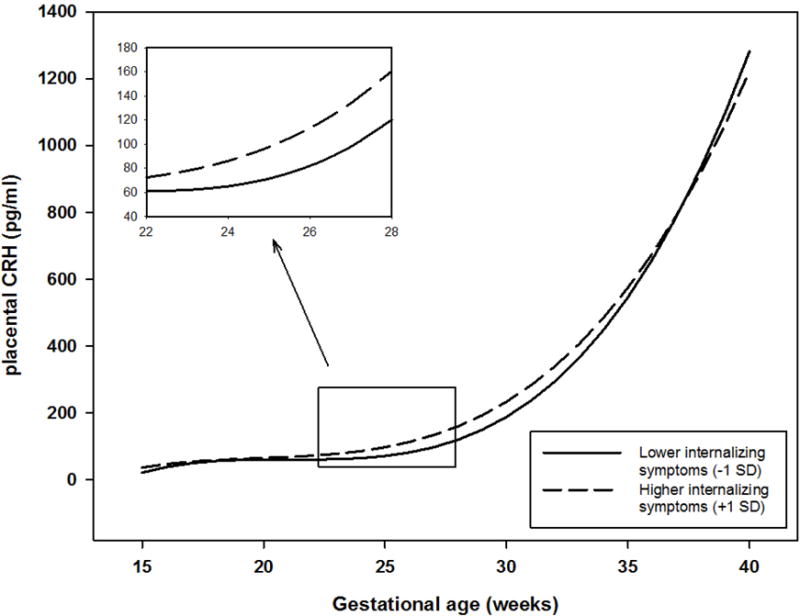
Fetal exposure to maternal prenatal stress hormones such as cortisol exerts influences on the developing nervous system that persist and include risk for internalizing symptoms later in life. Placental corticotropin-releasing hormone (pCRH) is a feto-placental stress signal that also shapes fetal neurodevelopment and may be a more direct indicator of the fetal experience than maternal stress hormones. The programming effects of pCRH on child development are unknown. The current investigation examined associations between prenatal maternal and placental stress hormone exposures (maternal cortisol and pCRH) and child self-reported internalizing symptoms at age 5.
Maternal plasma cortisol and pCRH levels were measured at 15, 19, 25, 31, and 36 weeks' gestation in a sample of 83 women and their 91 children (8 sibling pairs from separate pregnancies), who were born full-term. Child self-reported internalizing symptoms at age 5 were obtained using scales of the Berkeley Puppet Interview.
Placental CRH profiles (including elevations in mid-gestation) were associated with higher levels of internalizing symptoms at age 5. This effect was not explained by critical prenatal or postnatal influences, including obstetric risk, concurrent maternal psychological state, and family socio-economic status. Prenatal maternal cortisol was not significantly associated with child self-reported internalizing symptoms.
Findings suggest that elevated exposures to the feto-placental stress signal pCRH exert programming effects on the developing fetal central nervous system, with lasting consequences for child mental health.
胎儿暴露于母体产前应激激素(如皮质醇)会对发育中的神经系统产生影响,这些影响会持续存在,并包括日后出现内化症状的风险。胎盘促肾上腺皮质激素释放激素(pCRH)是一种胎儿 - 胎盘应激信号,它也会影响胎儿神经发育,并且可能比母体应激激素更直接地反映胎儿的经历。pCRH对儿童发育的编程作用尚不清楚。本研究调查了产前母体和胎盘应激激素暴露(母体皮质醇和pCRH)与5岁儿童自我报告的内化症状之间的关联。
对83名妇女及其91名足月出生的孩子(来自不同妊娠的8对兄弟姐妹)进行研究,在妊娠15、19、25、31和36周时测量母体血浆皮质醇和pCRH水平。使用伯克利木偶访谈量表获取5岁儿童自我报告的内化症状。
胎盘CRH水平(包括妊娠中期升高)与5岁时较高水平的内化症状相关。这种影响不能用关键的产前或产后影响来解释,包括产科风险、同时期母体心理状态和家庭社会经济地位。产前母体皮质醇与儿童自我报告的内化症状无显著关联。
研究结果表明,胎儿 - 胎盘应激信号pCRH的暴露增加对发育中的胎儿中枢神经系统产生编程作用,对儿童心理健康有持久影响。