Brasa Sarah, Mueller Arne, Jacquemont Sébastien, Hahne Florian, Rozenberg Izabela, Peters Thomas, He Yunsheng, McCormack Christine, Gasparini Fabrizio, Chibout Salah-Dine, Grenet Olivier, Moggs Jonathan, Gomez-Mancilla Baltazar, Terranova Rémi
Preclinical Safety, Translational Medicine, Novartis Institutes for Biomedical Research, Novartis Pharma AG, CH-4057 Basel, Switzerland.
Service de Génétique Médicale, Centre Hospitalier Universitaire Vaudois, CH-1011 Lausanne, Switzerland.
Clin Epigenetics. 2016 Feb 5;8:15. doi: 10.1186/s13148-016-0181-x. eCollection 2016.
Fragile X syndrome (FXS) is the most common form of inherited intellectual disability, resulting from the loss of function of the fragile X mental retardation 1 (FMR1) gene. The molecular pathways associated with FMR1 epigenetic silencing are still elusive, and their characterization may enhance the discovery of novel therapeutic targets as well as the development of novel clinical biomarkers for disease status.
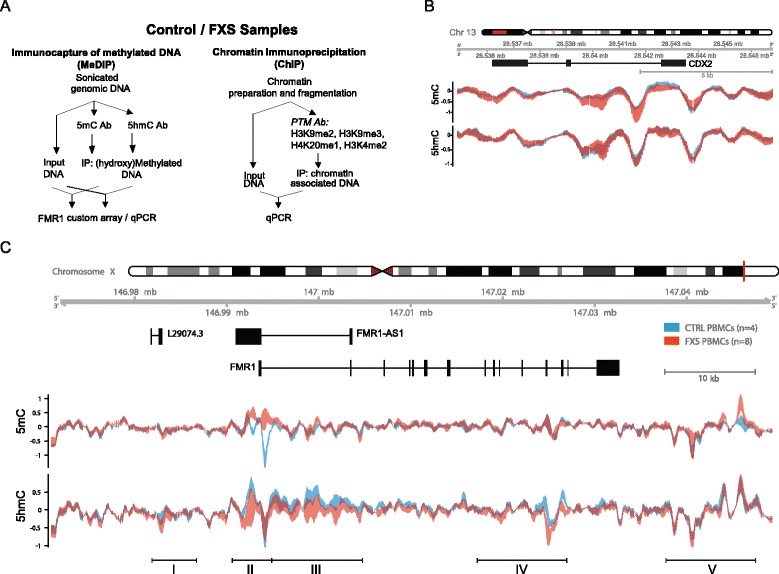
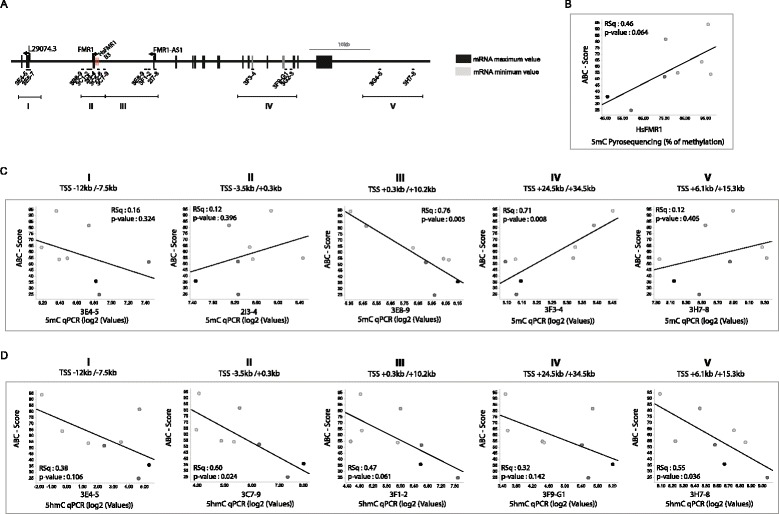
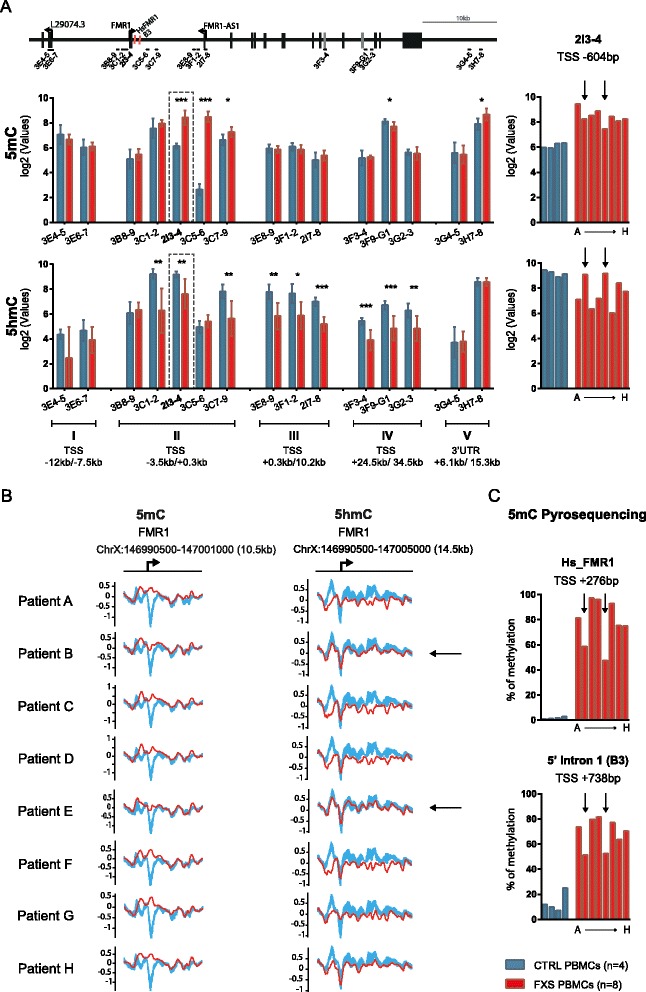
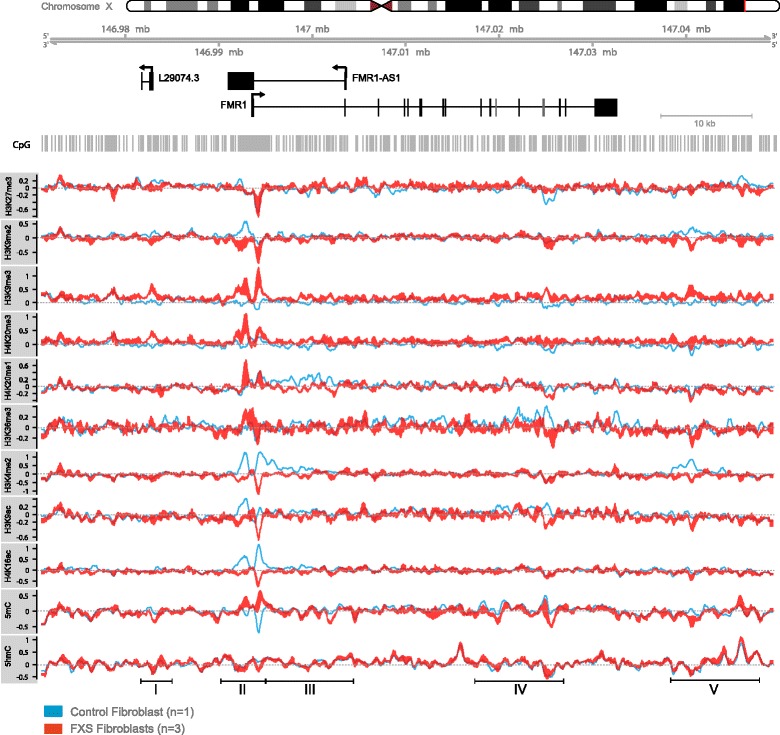
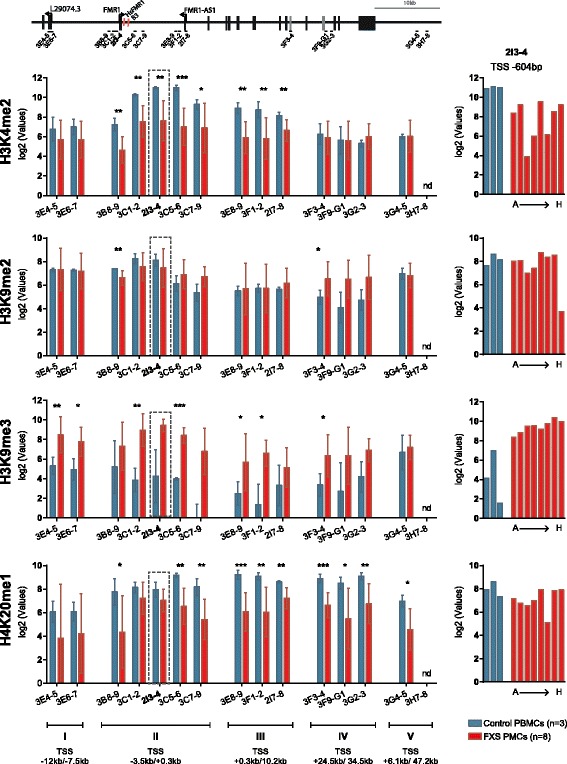
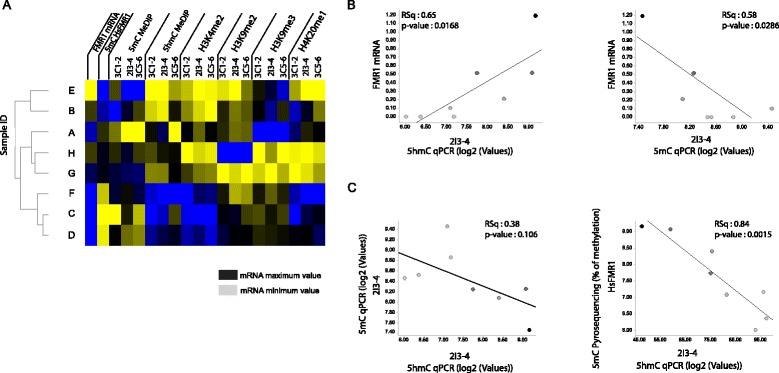
We have deployed customized epigenomic profiling assays to comprehensively map the FMR1 locus chromatin landscape in peripheral mononuclear blood cells (PBMCs) from eight FXS patients and in fibroblast cell lines derived from three FXS patient. Deoxyribonucleic acid (DNA) methylation (5-methylcytosine (5mC)) and hydroxymethylation (5-hydroxymethylcytosine (5hmC)) profiling using methylated DNA immunoprecipitation (MeDIP) combined with a custom FMR1 microarray identifies novel regions of DNA (hydroxy)methylation changes within the FMR1 gene body as well as in proximal flanking regions. At the region surrounding the FMR1 transcriptional start sites, increased levels of 5mC were associated to reciprocal changes in 5hmC, representing a novel molecular feature of FXS disease. Locus-specific validation of FMR1 5mC and 5hmC changes highlighted inter-individual differences that may account for the expected DNA methylation mosaicism observed at the FMR1 locus in FXS patients. Chromatin immunoprecipitation (ChIP) profiling of FMR1 histone modifications, together with 5mC/5hmC and gene expression analyses, support a functional relationship between 5hmC levels and FMR1 transcriptional activation and reveal cell-type specific differences in FMR1 epigenetic regulation. Furthermore, whilst 5mC FMR1 levels positively correlated with FXS disease severity (clinical scores of aberrant behavior), our data reveal for the first time an inverse correlation between 5hmC FMR1 levels and FXS disease severity.
We identify novel, cell-type specific, regions of FMR1 epigenetic changes in FXS patient cells, providing new insights into the molecular mechanisms of FXS. We propose that the combined measurement of 5mC and 5hmC at selected regions of the FMR1 locus may significantly enhance FXS clinical diagnostics and patient stratification.
脆性X综合征(FXS)是遗传性智力残疾最常见的形式,由脆性X智力低下1(FMR1)基因功能丧失所致。与FMR1表观遗传沉默相关的分子途径仍不明确,对其进行表征可能会促进新型治疗靶点的发现以及疾病状态新型临床生物标志物的开发。
我们已采用定制的表观基因组分析方法,全面绘制了8例FXS患者外周血单个核细胞(PBMC)以及3例FXS患者来源的成纤维细胞系中FMR1基因座的染色质图谱。使用甲基化DNA免疫沉淀(MeDIP)结合定制的FMR1微阵列进行脱氧核糖核酸(DNA)甲基化(5-甲基胞嘧啶(5mC))和羟甲基化(5-羟甲基胞嘧啶(5hmC))分析,确定了FMR1基因体内以及近端侧翼区域内DNA(羟基)甲基化变化的新区域。在FMR1转录起始位点周围区域,5mC水平升高与5hmC的反向变化相关,这代表了FXS疾病的一种新分子特征。FMR1 5mC和5hmC变化的基因座特异性验证突出了个体间差异可能解释了在FXS患者FMR1基因座观察到的预期DNA甲基化镶嵌现象。FMR1组蛋白修饰的染色质免疫沉淀(ChIP)分析,连同5mC/5hmC和基因表达分析,支持5hmC水平与FMR1转录激活之间的功能关系,并揭示了FMR1表观遗传调控中的细胞类型特异性差异。此外,虽然5mC FMR1水平与FXS疾病严重程度(异常行为临床评分)呈正相关,但我们的数据首次揭示了5hmC FMR1水平与FXS疾病严重程度呈负相关。
我们在FXS患者细胞中确定了FMR1表观遗传变化的新的、细胞类型特异性区域,为FXS的分子机制提供了新见解。我们提出,在FMR1基因座选定区域联合测量5mC和5hmC可能会显著改善FXS的临床诊断和患者分层。