Delcambre Gretchen H, Liu Junjie, Herrington Jenna M, Vallario Kelsey, Long Maureen T
Department of Biomedical Sciencess/College of Veterinary Medicine and Biomedical Sciences, Colorado State University, Fort Collins, Colorado, USA.
Department of Infectious Diseases and Pathology/College of Veterinary Medicine, University of Florida, Gainesville, Florida, USA.
PeerJ. 2016 Jan 25;4:e1601. doi: 10.7717/peerj.1601. eCollection 2016.
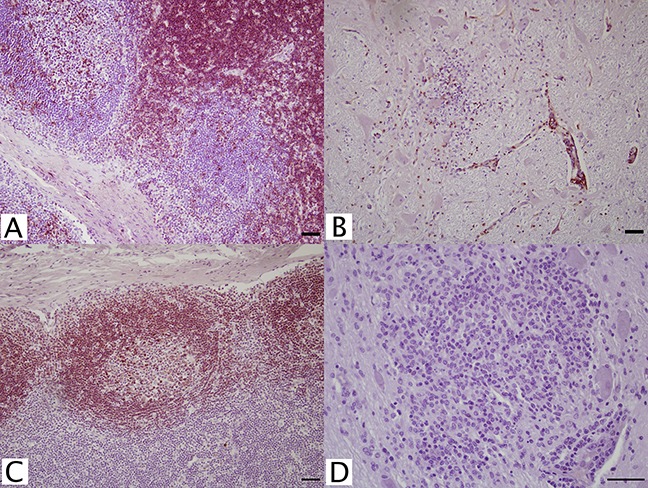
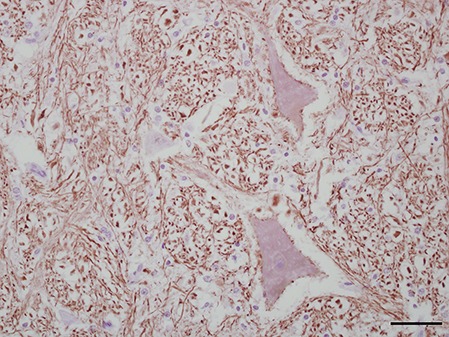
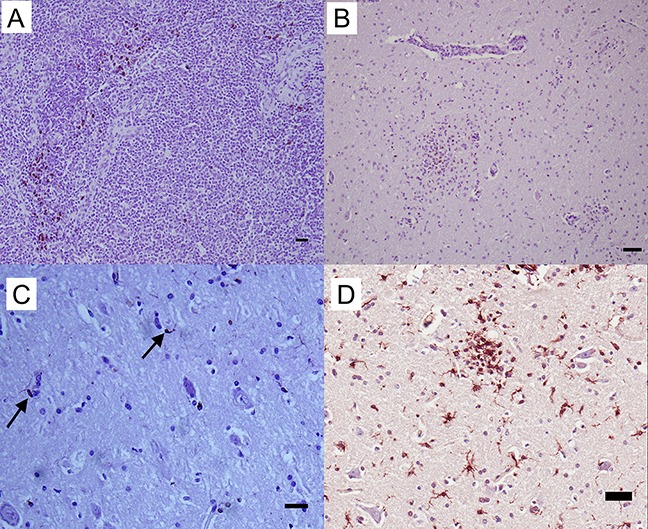
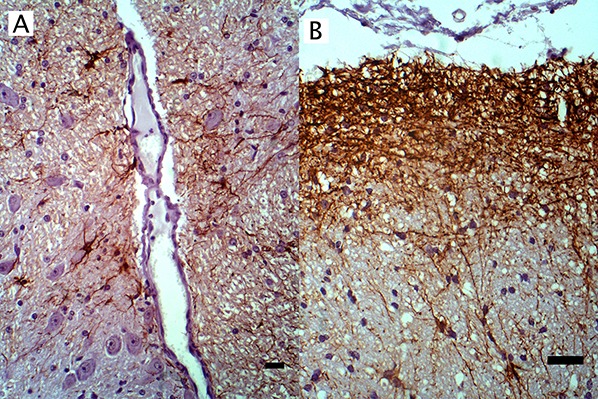
Phenotypic characterization of cellular responses in equine infectious encephalitides has had limited description of both peripheral and resident cell populations in central nervous system (CNS) tissues due to limited species-specific reagents that react with formalin-fixed, paraffin embedded tissue (FFPE). This study identified a set of antibodies for investigating the immunopathology of infectious CNS diseases in horses. Multiple commercially available staining reagents and antibodies derived from antigens of various species for manual immunohistochemistry (IHC) were screened. Several techniques and reagents for heat-induced antigen retrieval, non-specific protein blocking, endogenous peroxidase blocking, and visualization-detection systems were tested during IHC protocol development. Boiling of slides in a low pH, citrate-based buffer solution in a double-boiler system was most consistent for epitope retrieval. Pressure-cooking, microwaving, high pH buffers, and proteinase K solutions often resulted in tissue disruption or no reactivity. Optimal blocking reagents and concentrations of each working antibody were determined. Ultimately, a set of monoclonal (mAb) and polyclonal antibodies (pAb) were identified for CD3(+) (pAb A0452, Dako) T-lymphocytes, CD79αcy(+) B-lymphocytes (mAb HM57, Dako), macrophages (mAb MAC387, Leica), NF-H(+) neurons (mAb NAP4, EnCor Biotechnology), microglia/macrophage (pAb Iba-1, Wako), and GFAP(+) astrocytes (mAb 5C10, EnCor Biotechnology). In paraffin embedded tissues, mAbs and pAbs derived from human and swine antigens were very successful at binding equine tissue targets. Individual, optimized protocols are provided for each positively reactive antibody for analyzing equine neuroinflammatory disease histopathology.
由于与福尔马林固定、石蜡包埋组织(FFPE)反应的物种特异性试剂有限,马传染性脑脊髓炎细胞反应的表型特征对中枢神经系统(CNS)组织中的外周细胞群和驻留细胞群的描述都很有限。本研究鉴定了一组用于研究马传染性中枢神经系统疾病免疫病理学的抗体。筛选了多种市售的染色试剂和源自各种物种抗原的抗体用于手动免疫组织化学(IHC)。在IHC方案开发过程中,测试了几种热诱导抗原修复、非特异性蛋白封闭、内源性过氧化物酶封闭和可视化检测系统的技术和试剂。在双蒸水系统中于低pH值的柠檬酸盐缓冲溶液中煮沸玻片进行表位修复最为稳定。高压蒸煮、微波处理、高pH值缓冲液和蛋白酶K溶液常常导致组织破坏或无反应性。确定了每种工作抗体的最佳封闭试剂和浓度。最终,鉴定出一组针对CD3(+)(多克隆抗体A0452,Dako)T淋巴细胞、CD79αcy(+) B淋巴细胞(单克隆抗体HM57,Dako)、巨噬细胞(单克隆抗体MAC387,Leica)、NF-H(+)神经元(单克隆抗体NAP4,EnCor Biotechnology)、小胶质细胞/巨噬细胞(多克隆抗体Iba-1,Wako)和GFAP(+)星形胶质细胞(单克隆抗体5C10,EnCor Biotechnology)的单克隆抗体(mAb)和多克隆抗体(pAb)。在石蜡包埋组织中,源自人和猪抗原的单克隆抗体和多克隆抗体在结合马组织靶点方面非常成功。为每种阳性反应抗体提供了单独的优化方案,用于分析马神经炎性疾病组织病理学。