Gega Arjet, Kozal Michael J, Chiarella Jennifer, Lee Evelyn, Peterson Julia, Hecht Frederick M, Liegler Teri, St John Elizabeth P, Simen Birgitte B, Price Richard W, Spudich Serena S
Department of Medicine, School of Medicine, Yale University, New Haven, CT, USA.
Department of Neurology, University of California San Francisco, CA, USA.
J Virus Erad. 2015;1(4):264-268. doi: 10.1016/S2055-6640(20)30926-2.
Limited data exist comparing viral quasispecies between cerebrospinal fluid (CSF) and plasma compartments during primary HIV infection. Deep sequencing is a new method to examine the HIV plasma and CSF quasispecies.
In this pilot study, deep sequencing of protease (PR) and reverse transcriptase (RT) was performed in plasma and CSF from participants during primary HIV infection. Estimated mutational load was calculated by mutant variant frequency multiplied by HIV-RNA level.
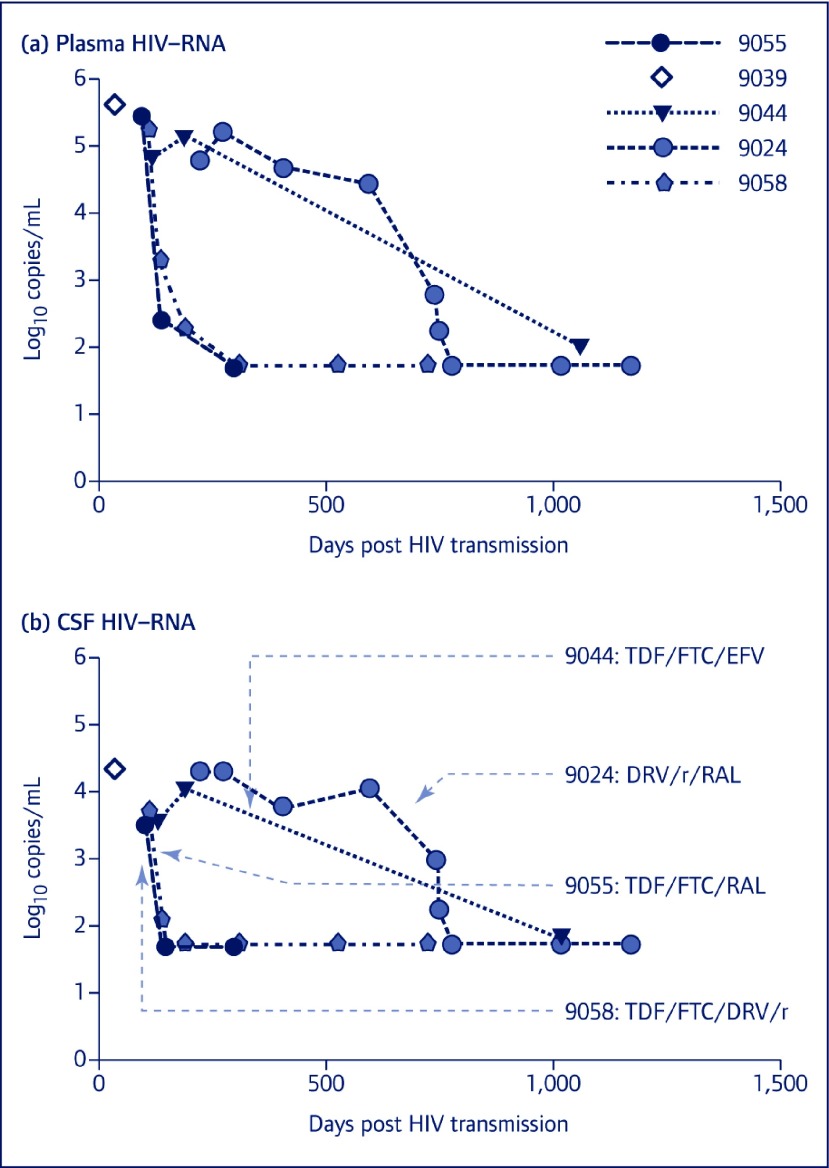
Paired plasma and CSF samples were studied from five antiretroviral therapy-naïve male participants with median 109 days post estimated transmission, age 32 years, CD4 cell count 580 cells/μL, HIV-RNA 5.18 log copies/mL in plasma and 3.67 log copies/mL in CSF. Plasma samples averaged 7,124 reads of PR and 2,448 reads of RT, whereas CSF samples averaged 7,082 and 2,792 reads, respectively. A distinct drug-resistance pattern with linked mutations present at significant levels (5-10%) was detected in one participant in CSF. Other low abundance variants (>0.2%) were detected in plasma and CSF of four out of five participants.
Deep sequencing of CSF HIV is technically possible with sufficient HIV-RNA levels. Differences between the quasispecies in the two compartments detected in one participant, which were present with a high mutational load in CSF at an estimated 3.6 months after HIV infection, suggest that early CNS compartmentalisation may be revealed by sensitive deep-sequencing methods. The presence of distinct low abundance (<1%) resistance variants in plasma and CSF of three other subjects may be significant, but further investigation is needed.
关于原发性HIV感染期间脑脊液(CSF)和血浆区室之间病毒准种的比较数据有限。深度测序是一种检测HIV血浆和脑脊液准种的新方法。
在这项初步研究中,对原发性HIV感染参与者的血浆和脑脊液进行蛋白酶(PR)和逆转录酶(RT)的深度测序。通过突变体变体频率乘以HIV-RNA水平来计算估计的突变负荷。
研究了5名未接受抗逆转录病毒治疗的男性参与者的配对血浆和脑脊液样本,估计传播后中位时间为109天,年龄32岁,CD4细胞计数为580个/μL,血浆中HIV-RNA为5.18 log拷贝/mL,脑脊液中为3.67 log拷贝/mL。血浆样本中PR平均读取7124次,RT平均读取2448次,而脑脊液样本中PR和RT分别平均读取7082次和2792次。在一名参与者的脑脊液中检测到一种具有显著水平(5-10%)连锁突变的独特耐药模式。在五名参与者中的四名参与者的血浆和脑脊液中检测到其他低丰度变体(>0.2%)。
在HIV-RNA水平足够的情况下,对脑脊液HIV进行深度测序在技术上是可行的。一名参与者检测到的两个区室的准种差异,在HIV感染后估计3.6个月时脑脊液中具有高突变负荷,这表明敏感的深度测序方法可能揭示早期中枢神经系统区室化。其他三名受试者的血浆和脑脊液中存在独特的低丰度(<1%)耐药变体可能具有重要意义,但需要进一步研究。