Gu Haiping, Lou Jun, Wang Haizhen, Yang Yu, Wu Laosheng, Wu Jianjun, Xu Jianming
Institute of Soil and Water Resources and Environmental Science, Zhejiang Provincial Key Laboratory of Subtropical Soil and Plant Nutrition, Zhejiang University Hangzhou, China.
Department of Civil and Environmental Engineering, University of Nevada, Reno NV, USA.
Front Microbiol. 2016 Jan 29;7:38. doi: 10.3389/fmicb.2016.00038. eCollection 2016.
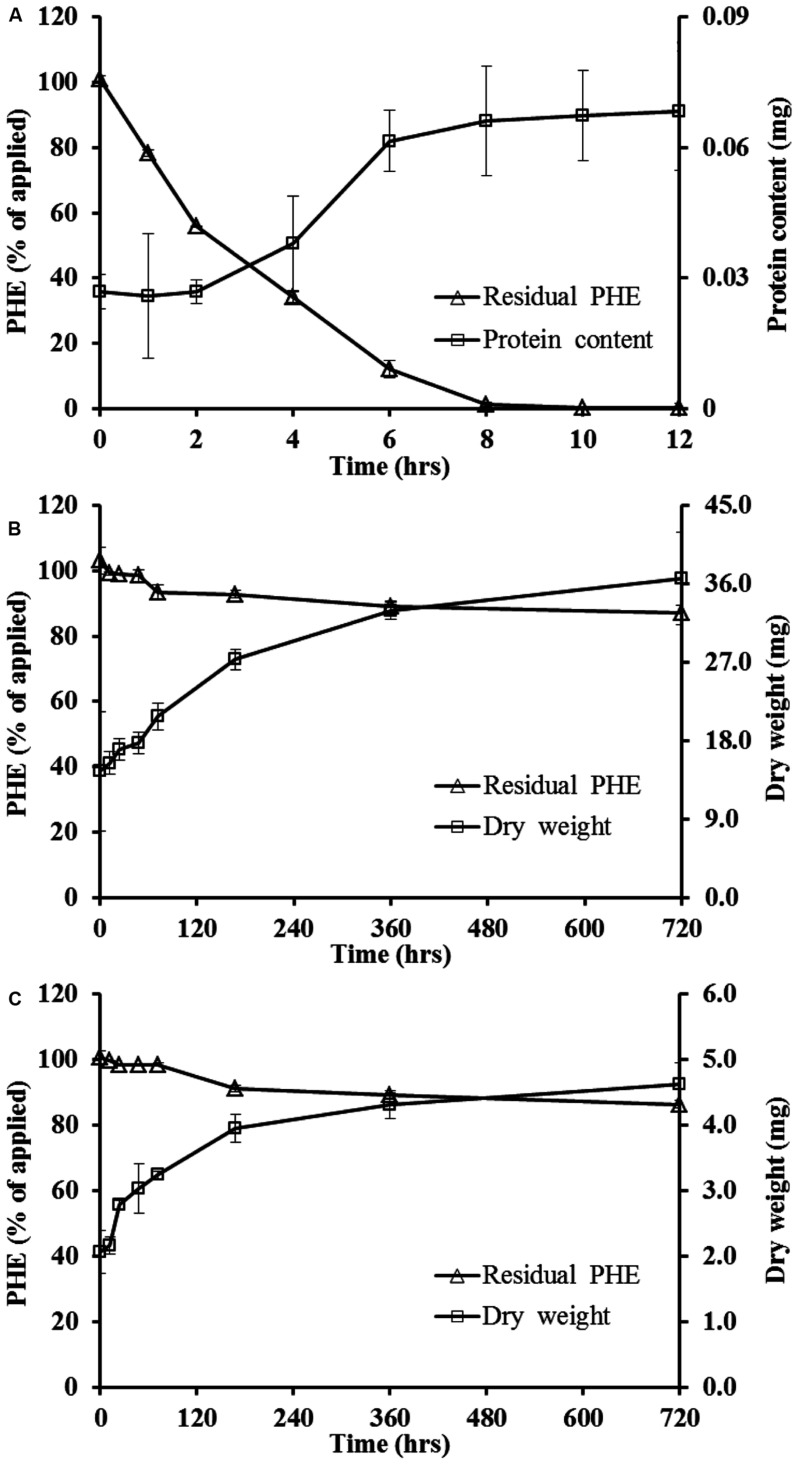
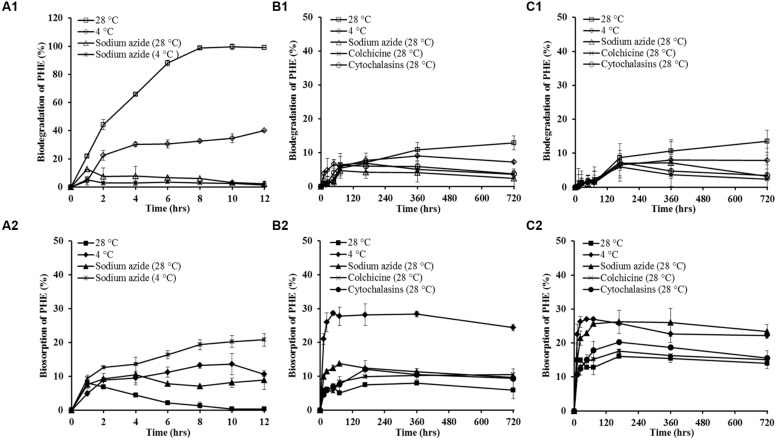
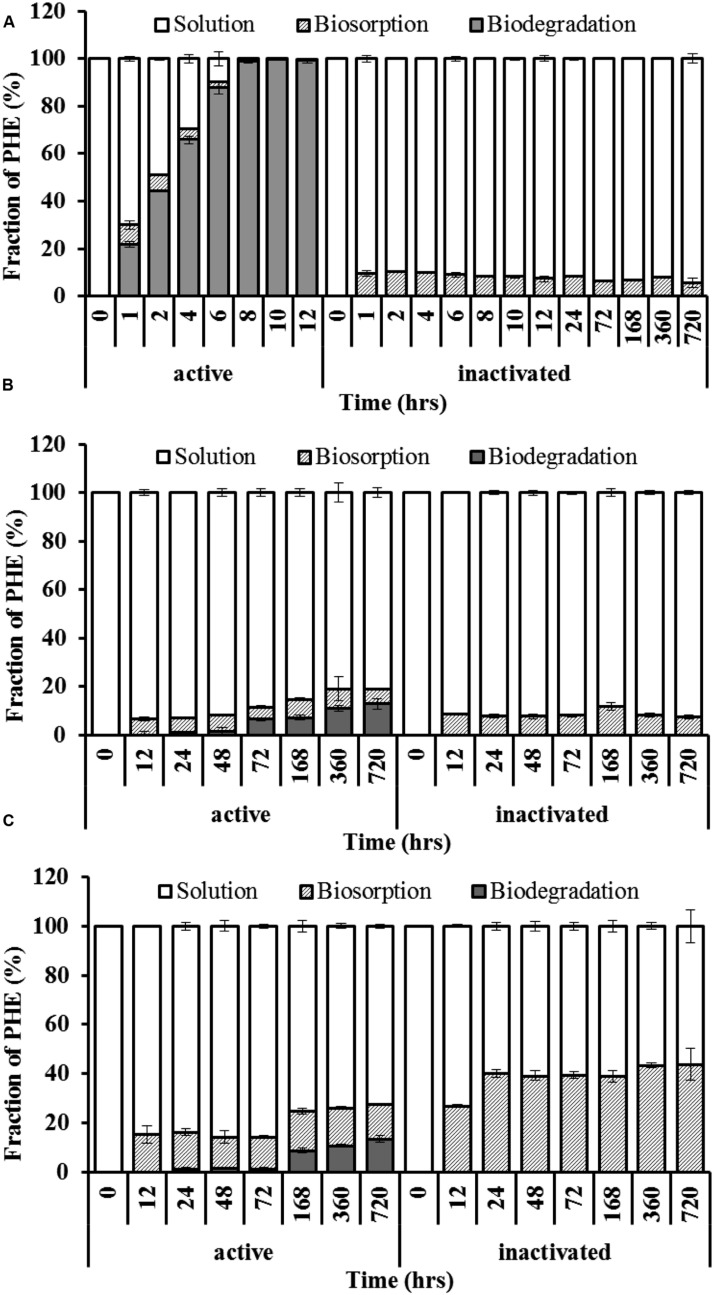
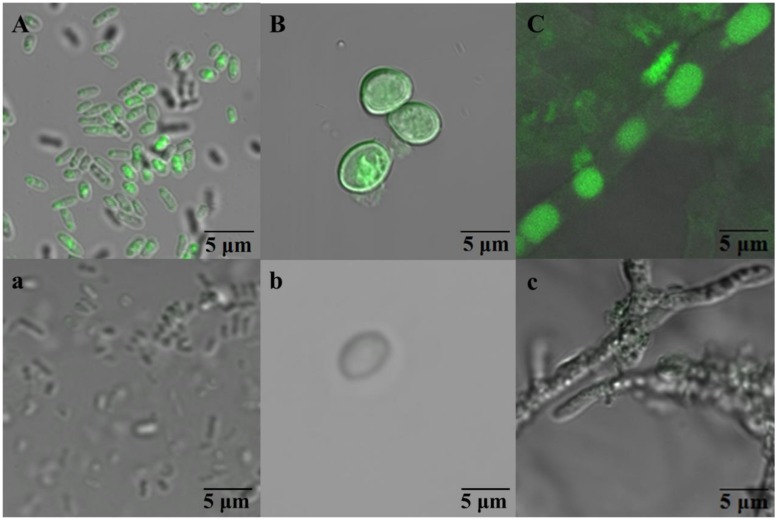
Reducing phenanthrene (PHE) in the environment is critical to ecosystem and human health. Biodegradation, biosorption, and the trans-membrane transport mechanism of PHE by a novel strain, Massilia sp. WF1, and an extensively researched model fungus, Phanerochaete chrysosporium were investigated in aqueous solutions. Results showed that the PHE residual concentration decreased with incubation time and the data fitted well to a first-order kinetic equation, and the t 1/2 of PHE degradation by WF1, spores, and mycelial pellets of P. chrysosporium were about 2 h, 87 days, and 87 days, respectively. The biosorbed PHE was higher in P. Chrysosporium than that in WF1, and it increased after microorganisms were inactivated and inhibited, especially in mycelial pellets. The detected intracellular auto-fluorescence of PHE by two-photon excitation microscopy also proved that PHE indeed entered into the cells. Based on regression, the intracellular (K din) and extracellular (K dout) dissipation rate constants of PHE by WF1 were higher than those by spores and mycelial pellets. In addition, the transport rate constant of PHE from outside solution into cells (KinS/Vout ) for WF1 were higher than the efflux rate constant of PHE from cells to outside solution (KoutS/Vin ), while the opposite phenomena were observed for spores and mycelial pellets. The amount of PHE that transported from outside solution into cells was attributed to the rapid degradation and active PHE efflux in the cells of WF1 and P. Chrysosporium, respectively. Besides, the results under the inhibition treatments of 4°C, and the presence of sodium azide, colchicine, and cytochalasin B demonstrated that a passive trans-membrane transport mechanism was involved in PHE entering into the cells of WF1 and P. Chrysosporium.
降低环境中的菲(PHE)对生态系统和人类健康至关重要。研究了新型菌株马赛菌属WF1和广泛研究的模式真菌黄孢原毛平革菌对菲的生物降解、生物吸附及其跨膜运输机制。结果表明,菲的残留浓度随培养时间降低,数据与一级动力学方程拟合良好,WF1、黄孢原毛平革菌的孢子和菌丝球对菲的降解半衰期分别约为2小时、87天和87天。黄孢原毛平革菌对菲的生物吸附量高于WF1,微生物失活和受抑制后生物吸附量增加,尤其是在菌丝球中。通过双光子激发显微镜检测到的细胞内菲的自发荧光也证明菲确实进入了细胞。基于回归分析,WF1对菲的细胞内(Kdin)和细胞外(Kdout)消散速率常数高于孢子和菌丝球。此外,WF1的菲从外部溶液进入细胞的运输速率常数(KinS/Vout)高于菲从细胞到外部溶液的流出速率常数(KoutS/Vin),而孢子和菌丝球则观察到相反的现象。从外部溶液运输到细胞内的菲的量分别归因于WF1和黄孢原毛平革菌细胞内的快速降解和活跃的菲流出。此外,在4°C以及存在叠氮化钠、秋水仙碱和细胞松弛素B的抑制处理下的结果表明,被动跨膜运输机制参与了菲进入WF1和黄孢原毛平革菌细胞的过程。