Tian Dan, Mitchell Isaiah, Kreeger Pamela K
Department of Biomedical Engineering, 4553 WI Institute Medical Research, University of Wisconsin-Madison, 1111 Highland Ave, Madison, WI, 53705, USA.
University of Wisconsin Carbone Cancer Center, 600 Highland Ave, Madison, WI, 53792, USA.
BMC Syst Biol. 2016 Feb 9;10:15. doi: 10.1186/s12918-016-0263-6.
The insulin-like growth factor (IGF) system impacts cellular development by regulating proliferation, differentiation, and apoptosis, and is an attractive therapeutic target in cancer. The IGF system is complex, with two ligands (IGF1, IGF2), two receptors (IGF1R, IGF2R), and at least six high affinity IGF-binding proteins (IGFBPs) that regulate IGF ligand bioavailability. While the individual components of the IGF system are well studied, the question of how these different components integrate as a system to regulate cell behavior is less clear.
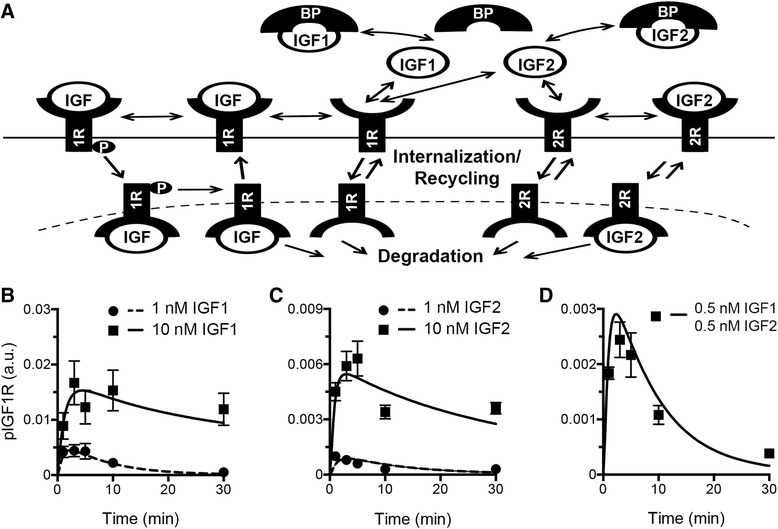
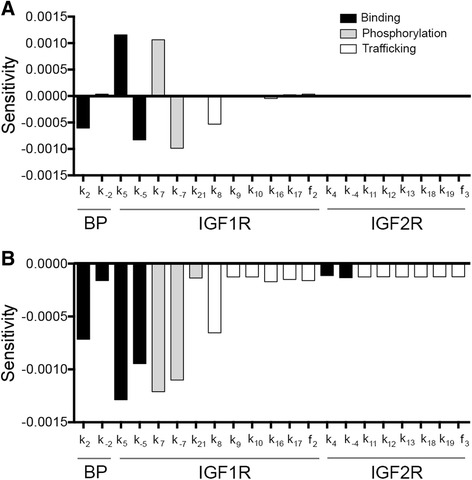
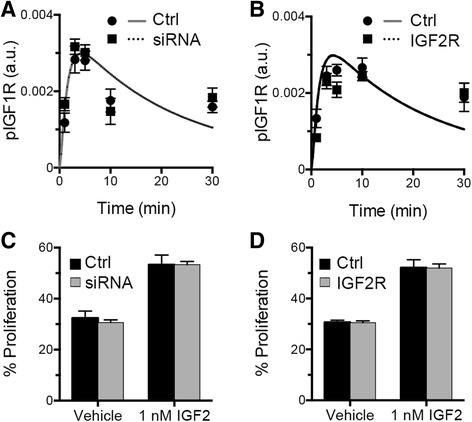
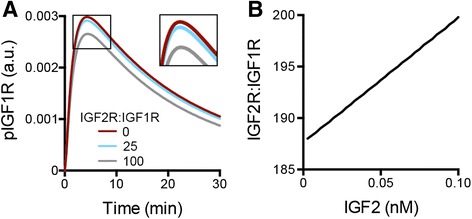
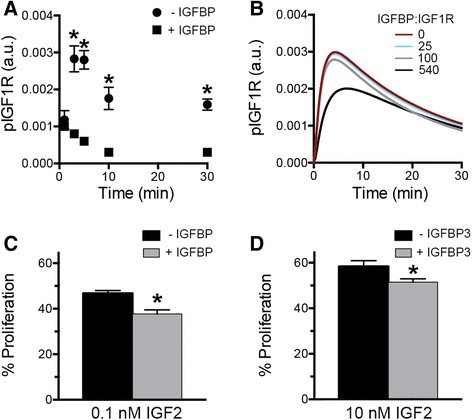
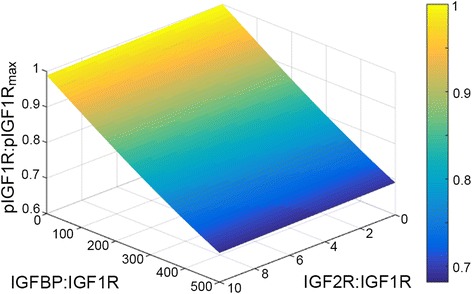
To analyze the relative importance of different mechanisms that control IGF network activity, we developed a mass-action kinetic model incorporating cell surface binding, phosphorylation, and intracellular trafficking events. The model was calibrated and validated using experimental data collected from OVCAR5, an immortalized ovarian cancer cell line. We then performed model analysis to examine the ability of IGF2R or IGFBPs to counteract phosphorylation of IGF1R, a critical step for IGF network activation. This analysis suggested that IGF2R levels would need to be 320-fold greater than IGF1R in order to decrease pIGF1R by 25 %, while IGFBP levels would need to be 390-fold greater. Analysis of The Cancer Genome Atlas (TCGA) data set suggested that this level of overexpression is unlikely for IGF2R in ovarian, breast, and colon cancer. In contrast, IGFBPs can likely reach these levels, suggesting that IGFBPs are the more critical regulator of IGF1R network activity. Levels of phosphorylated IGF1R were insensitive to changes in parameters regulating the IGF2R arm of the network.
Using a mass-action kinetic model, we determined that IGF2R plays a minor role in regulating the activity of IGF1R under a variety of conditions and that due to their high expression levels, IGFBPs are the dominant mechanism to regulating IGF network activation.
胰岛素样生长因子(IGF)系统通过调节细胞增殖、分化和凋亡来影响细胞发育,是癌症中一个有吸引力的治疗靶点。IGF系统很复杂,有两种配体(IGF1、IGF2)、两种受体(IGF1R、IGF2R)以及至少六种高亲和力的IGF结合蛋白(IGFBPs),这些结合蛋白可调节IGF配体的生物利用度。虽然IGF系统的各个组成部分已得到充分研究,但这些不同组成部分如何作为一个系统整合起来调节细胞行为的问题尚不清楚。
为了分析控制IGF网络活性的不同机制的相对重要性,我们开发了一个包含细胞表面结合、磷酸化和细胞内运输事件的质量作用动力学模型。该模型使用从永生化卵巢癌细胞系OVCAR5收集的实验数据进行了校准和验证。然后,我们进行了模型分析,以研究IGF2R或IGFBPs抵消IGF1R磷酸化的能力,而IGF1R磷酸化是IGF网络激活的关键步骤。该分析表明,为了使磷酸化IGF1R降低25%,IGF2R的水平需要比IGF1R高320倍,而IGFBP的水平则需要高390倍。对癌症基因组图谱(TCGA)数据集的分析表明,在卵巢癌、乳腺癌和结肠癌中,IGF2R不太可能出现这种过表达水平。相比之下,IGFBPs可能达到这些水平,这表明IGFBPs是IGF1R网络活性更关键的调节因子。磷酸化IGF1R的水平对调节网络中IGF2R臂的参数变化不敏感。
使用质量作用动力学模型,我们确定在各种条件下IGF2R在调节IGF1R活性中起次要作用,并且由于其高表达水平,IGFBPs是调节IGF网络激活的主要机制。