
豚草过敏受试者在花粉季节之外,血清趋化因子CCL2、CCL3、CCL4和CCL5水平降低。
Ragweed-allergic subjects have decreased serum levels of chemokines CCL2, CCL3, CCL4 and CCL5 out of the pollen season.
作者信息
Kostova Zhivka, Batsalova Tsvetelina, Moten Dzhemal, Teneva Ivanka, Dzhambazov Balik
机构信息
Plovdiv University, Plovdiv, Bulgaria.
出版信息
Cent Eur J Immunol. 2015;40(4):442-6. doi: 10.5114/ceji.2015.56965. Epub 2016 Jan 15.
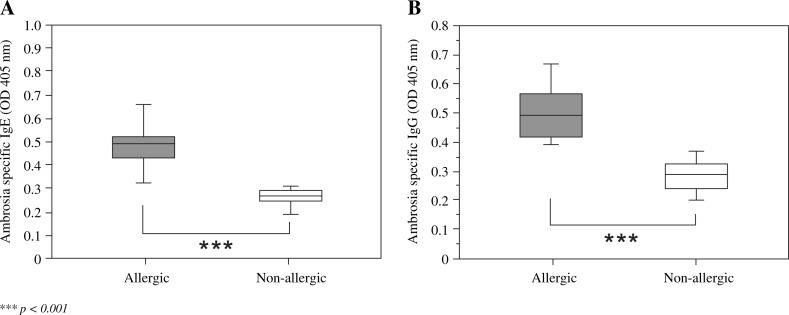
CC-chemokines are important mediators of the allergic responses and regulate the cell trafficking. The aim of this study was to examine the serum levels of CCL2/MCP-1, CCL3/MIP-1α, CCL4/MIP-1β and CCL5/RANTES, and to determine whether there are differences between ragweed-allergic subjects and healthy individuals out of the pollen season. Peripheral blood samples were collected from 24 subjects allergic to ragweed pollen and 12 healthy controls. Serum concentrations of chemokines/cytokines were measured by an enzyme-linked immunosorbent assay. We observed significantly decreased concentrations of CCL2/MCP-1, CCL3/MIP-1α, CCL4/MIP-1β and CCL5/RANTES in the sera of ragweed-allergic patients compared to the healthy individuals (32.2 vs. 106.4 pg/ml, 89.5 vs. 135.7 pg/ml, 63.4 vs. 119.2 pg/ml and 11.2 vs. 18.1 ng/ml, respectively, p < 0.01). In contrast to the CC-chemokines, the serum levels of IL-8/CXCL8 showed a significant increase (p < 0.05) in the allergic group compared to the non-allergic subjects. Interleukin 4 levels were similar in both groups. In the sera of allergic patients, we have also detected significantly elevated levels of ragweed-specific IgE and IgG. However, decreased serum concentrations of the four CC-chemokines and elevated levels of IL-8/CXCL8 can be used as biomarkers for more accurate evaluation of the allergic status of patients with pollen allergy out of the season, to study the mechanisms for activation/inhibition of the subclinical allergic responses and for development of therapeutic strategies.
CC趋化因子是过敏反应的重要介质,可调节细胞迁移。本研究旨在检测CCL2/MCP-1、CCL3/MIP-1α、CCL4/MIP-1β和CCL5/RANTES的血清水平,并确定豚草过敏患者与花粉季节之外的健康个体之间是否存在差异。采集了24名豚草花粉过敏受试者和12名健康对照者的外周血样本。采用酶联免疫吸附测定法测量趋化因子/细胞因子的血清浓度。我们观察到,与健康个体相比,豚草过敏患者血清中CCL2/MCP-1、CCL3/MIP-1α、CCL4/MIP-1β和CCL5/RANTES的浓度显著降低(分别为32.2 vs. 106.4 pg/ml、89.5 vs. 135.7 pg/ml、63.4 vs. 119.2 pg/ml和11.2 vs. 18.1 ng/ml,p < 0.01)。与CC趋化因子相反,过敏组血清中IL-8/CXCL8水平相比于非过敏受试者显著升高(p < 0.05)。两组的白细胞介素4水平相似。在过敏患者血清中,我们还检测到豚草特异性IgE和IgG水平显著升高。然而,四种CC趋化因子血清浓度降低和IL-8/CXCL8水平升高可作为生物标志物,用于更准确地评估花粉过敏患者在非花粉季节的过敏状态,研究亚临床过敏反应激活/抑制机制以及制定治疗策略。

 Zotero 插件