Levy W B, Wong N C, Dixon G H
Proc Natl Acad Sci U S A. 1977 Jul;74(7):2810-4. doi: 10.1073/pnas.74.7.2810.
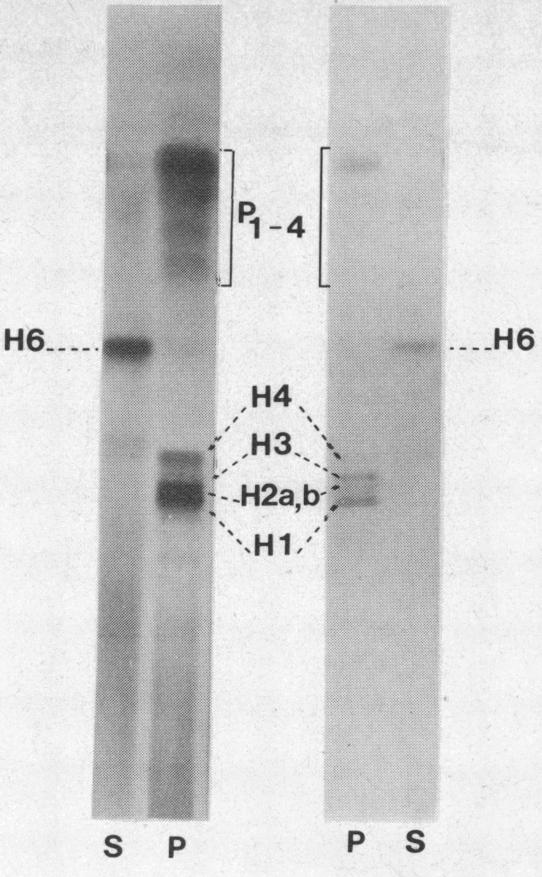
Nuclei and chromatin from trout testis cells were digested with three different nucleases (DNase I, DNase II, and micrococcal nuclease), and the acid-soluble proteins that were solubilized and those remaining bound to the nuclease-resistant DNA were compared electrophoretically. With the conditions described by H. Weintraub and M Groudine [(1976) science, 193, 848-856], which we previously found to be selective in digesting actively transcribed regions in trout testis chromatin, a single chromosomal protein, H6, was solubilized. The nucleosomal histones and H1 remained insoluble, bound to the resistant DNA. In contrast, digestion with micrococcal nuclease led to a preferential solubilization of a second protein, HMG-T, together with the release of some nucleosomal histones and H1 into the soluble fraction. DNase II also discriminated between "active" and "inactive" chromatins; when a DNase II-solubilized "active" chromatin fraction was prepared, it too was enriched in H6 and HMG-T. Thus, both H6 and HMG-T, the two major low-salt extractable chromosomal nonhistone the two major low-salt extractable chromosomal nonhistone proteins from trout testis, are associated with chromatin regions selectively sensitive to nucleases. The preferential solubilization of HMG-T by micrococcal nuclease action suggests that it might be located at the internucleosomal "spacer" region.
用三种不同的核酸酶(脱氧核糖核酸酶I、脱氧核糖核酸酶II和微球菌核酸酶)消化鳟鱼睾丸细胞的细胞核和染色质,并对溶解的酸溶性蛋白质以及那些仍与抗核酸酶的DNA结合的蛋白质进行电泳比较。按照H. 温特劳布和M. 格鲁丁([1976]《科学》,193, 848 - 856)所描述的条件(我们之前发现该条件在消化鳟鱼睾丸染色质中的活跃转录区域时具有选择性),一种单一的染色体蛋白H6被溶解。核小体组蛋白和H1仍不溶解,与抗性DNA结合。相比之下,用微球菌核酸酶消化导致第二种蛋白质HMG - T优先溶解,同时一些核小体组蛋白和H1释放到可溶部分。脱氧核糖核酸酶II也能区分“活跃”和“不活跃”染色质;当制备出脱氧核糖核酸酶II溶解的“活跃”染色质部分时,它同样富含H6和HMG - T。因此,H6和HMG - T这两种来自鳟鱼睾丸的主要低盐可提取染色体非组蛋白都与对核酸酶有选择性敏感的染色质区域相关。微球菌核酸酶作用使HMG - T优先溶解,这表明它可能位于核小体间的“间隔”区域。