Roos Carolyn M, Zhang Bin, Palmer Allyson K, Ogrodnik Mikolaj B, Pirtskhalava Tamar, Thalji Nassir M, Hagler Michael, Jurk Diana, Smith Leslie A, Casaclang-Verzosa Grace, Zhu Yi, Schafer Marissa J, Tchkonia Tamara, Kirkland James L, Miller Jordan D
Department of Surgery, Mayo Clinic, Rochester, MN, USA.
Kogod Center on Aging, Mayo Clinic, Rochester, MN, USA.
Aging Cell. 2016 Oct;15(5):973-7. doi: 10.1111/acel.12458. Epub 2016 Aug 5.
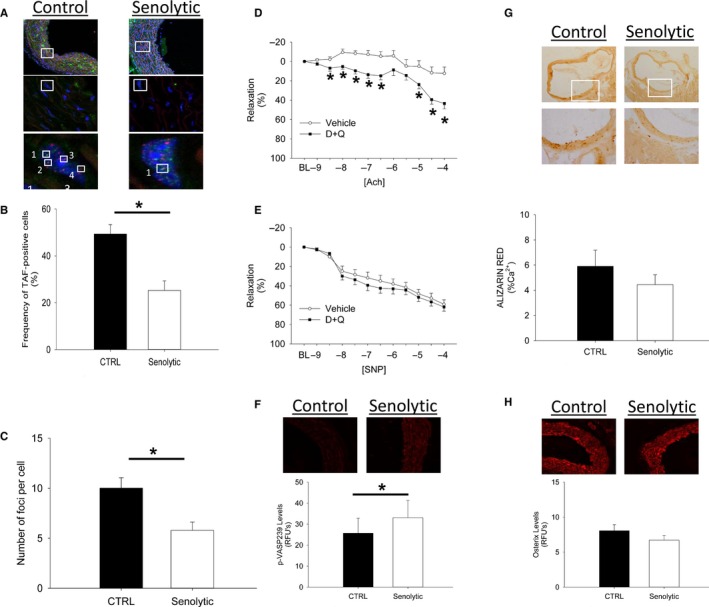
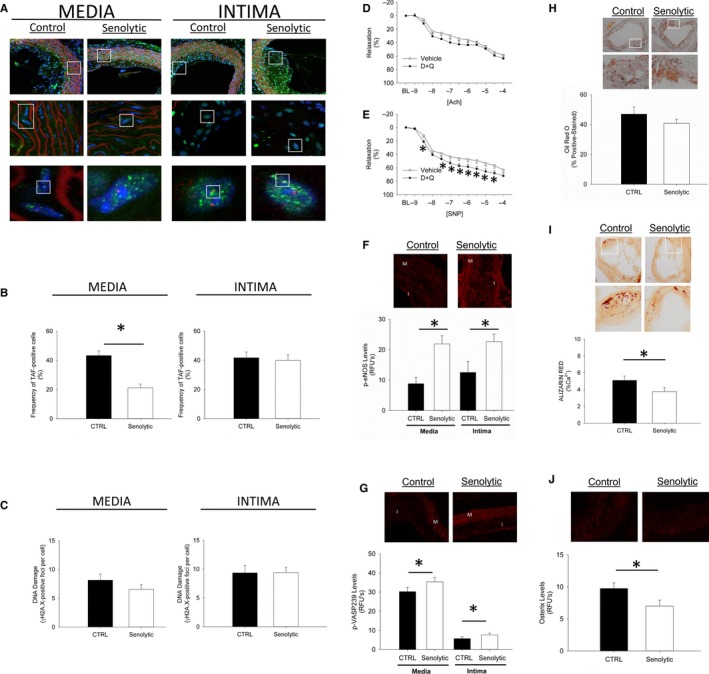
While reports suggest a single dose of senolytics may improve vasomotor function, the structural and functional impact of long-term senolytic treatment is unknown. To determine whether long-term senolytic treatment improves vasomotor function, vascular stiffness, and intimal plaque size and composition in aged or hypercholesterolemic mice with established disease. Senolytic treatment (intermittent treatment with Dasatinib + Quercetin via oral gavage) resulted in significant reductions in senescent cell markers (TAF(+) cells) in the medial layer of aorta from aged and hypercholesterolemic mice, but not in intimal atherosclerotic plaques. While senolytic treatment significantly improved vasomotor function (isolated organ chamber baths) in both groups of mice, this was due to increases in nitric oxide bioavailability in aged mice and increases in sensitivity to NO donors in hypercholesterolemic mice. Genetic clearance of senescent cells in aged normocholesterolemic INK-ATTAC mice phenocopied changes elicited by D+Q. Senolytics tended to reduce aortic calcification (alizarin red) and osteogenic signaling (qRT-PCR, immunohistochemistry) in aged mice, but both were significantly reduced by senolytic treatment in hypercholesterolemic mice. Intimal plaque fibrosis (picrosirius red) was not changed appreciably by chronic senolytic treatment. This is the first study to demonstrate that chronic clearance of senescent cells improves established vascular phenotypes associated with aging and chronic hypercholesterolemia, and may be a viable therapeutic intervention to reduce morbidity and mortality from cardiovascular diseases.
虽然报告表明单剂量的衰老细胞溶解剂可能改善血管舒缩功能,但长期衰老细胞溶解治疗对结构和功能的影响尚不清楚。为了确定长期衰老细胞溶解治疗是否能改善患有已确诊疾病的老年或高胆固醇血症小鼠的血管舒缩功能、血管僵硬度以及内膜斑块大小和组成。衰老细胞溶解治疗(通过口服灌胃间歇性给予达沙替尼+槲皮素)导致老年和高胆固醇血症小鼠主动脉中层衰老细胞标志物(TAF(+)细胞)显著减少,但内膜动脉粥样硬化斑块中没有减少。虽然衰老细胞溶解治疗在两组小鼠中均显著改善了血管舒缩功能(离体器官浴槽),但这是由于老年小鼠中一氧化氮生物利用度增加以及高胆固醇血症小鼠中对一氧化氮供体的敏感性增加。在正常胆固醇水平的老年INK-ATTAC小鼠中,衰老细胞的基因清除模拟了D+Q引起的变化。衰老细胞溶解剂倾向于减少老年小鼠的主动脉钙化(茜素红)和成骨信号(定量逆转录聚合酶链反应、免疫组织化学),但在高胆固醇血症小鼠中,衰老细胞溶解治疗使两者均显著减少。慢性衰老细胞溶解治疗对内膜斑块纤维化(天狼星红)没有明显影响。这是第一项证明长期清除衰老细胞可改善与衰老和慢性高胆固醇血症相关的既定血管表型的研究,并且可能是一种可行的治疗干预措施,以降低心血管疾病的发病率和死亡率。