Pfeiffer Susan, Heinrich Jarred, Beresheim Amy, Alblas Mandi
Department of Anthropology, University of Toronto, Toronto, M5S 2S2, Canada.
Department of Archaeology, University of Cape Town, Rondebosch, South Africa 7701.
Am J Phys Anthropol. 2016 May;160(1):137-47. doi: 10.1002/ajpa.22951. Epub 2016 Feb 11.
Normal human bone tissue changes predictably as adults get older, but substantial variability in pattern and pace remains unexplained. Information is needed regarding the characteristics of histological variables across diverse human populations.
Undecalcified thin sections from mid-thoracic ribs of 213 skeletons (138 M, 75 F, 17-82 years, mean age 48 years), are used to explore the efficacy of an established age-at-death estimation method and methodological approach (Cho et al.: J Forensic Sci 47 (2002) 12-18) and expand on it. The ribs are an age-balanced sample taken from skeletonized cadavers collected from 1967 to 1999 in South Africa, each with recorded sex, age, cause of death and government-defined population group (129 "Colored," 49 "Black," 35 "White").
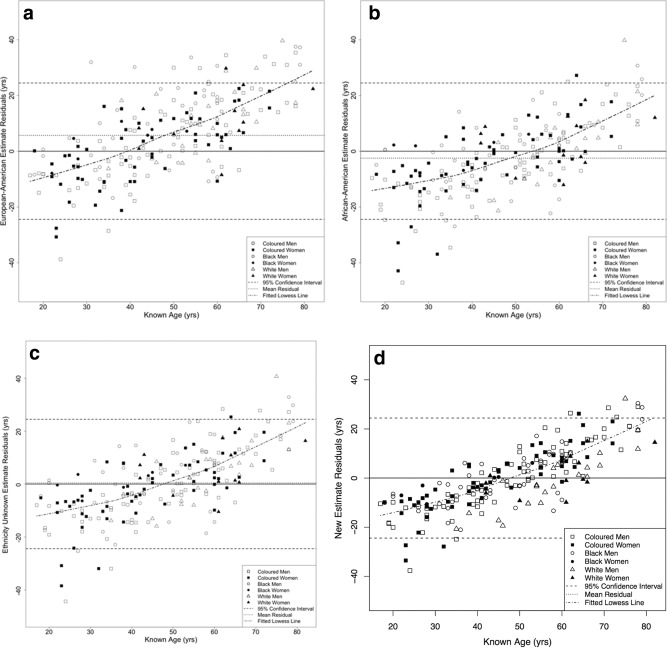
The Ethnicity Unknown equation performs better than those developed for European-Americans and African-Americans, in terms of accuracy and bias. A new equation based solely on the study sample does not improve accuracy. Osteon population densities (OPD) show predicted values, yet secondary osteon areas (On.Ar) are smaller than expected for non-Black subgroups. Relative cortical area (Ct.Ar/Tt.Ar) is low among non-Whites.
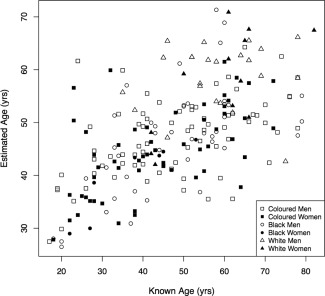
Results from this highly diverse sample show that population-specific equations do not increase estimate precision. While within the published range of error for the method (±24.44 years), results demonstrate a systematic under-aging of young adults and over-aging of older adults. The regression approach is inappropriate. The field needs fresh approaches to statistical treatment and to factors behind cortical bone remodeling.
随着成年人年龄增长,正常人体骨组织会发生可预测的变化,但在变化模式和速度方面仍存在很大差异,原因不明。需要了解不同人群中组织学变量的特征。
使用213具骨骼(138名男性,75名女性,年龄17 - 82岁,平均年龄48岁)中胸段肋骨的脱钙薄片,探讨一种既定的死亡年龄估计方法和方法学途径(Cho等人:《法医科学杂志》47(2002)12 - 18)的有效性并加以扩展。这些肋骨是从1967年至1999年在南非收集的白骨化尸体中选取的年龄均衡样本,每具尸体都记录了性别、年龄、死因和政府定义的人群组(129名“混血人种”,49名“黑人”,35名“白人”)。
在准确性和偏差方面,种族未知方程比为欧裔美国人和非裔美国人开发的方程表现更好。仅基于研究样本的新方程并未提高准确性。骨单位群体密度(OPD)显示出预测值,但非黑人亚组的继发性骨单位面积(On.Ar)小于预期。非白人的相对皮质面积(Ct.Ar/Tt.Ar)较低。
这个高度多样化样本的结果表明,针对特定人群的方程并不能提高估计精度。虽然在该方法公布的误差范围内(±24.44岁),结果显示年轻成年人存在系统性的年龄低估,而老年人存在年龄高估。回归方法不合适。该领域需要新的统计处理方法以及皮质骨重塑背后因素的研究方法。