Coetsee Carla, Terblanche Elmarie
Department of Sport Science, Faculty of Education, Stellenbosch University, Private Bag X1, Matieland, 7601 South Africa.
Eur Rev Aging Phys Act. 2015 Oct 29;12:7. doi: 10.1186/s11556-015-0153-8. eCollection 2015.
It is generally recognised that the physical functioning of older adults is enhanced with resistance exercise. The aim of this study was to investigate the time course of changes in upper and lower body muscle strength and physical function in older individuals following a 16 week resistance training (RT) programme and a similar duration detraining (DET) period.
Forty-one inactive individuals (55 to 75 years) were randomly allocated in a RT group (n = 22; three sessions per week) and a control (CON) group (n = 19). Muscle strength was assessed with 10RM leg and bench press tests, while the Timed-Up-and-Go (TUG) test was used to measure functional mobility. The Bruce treadmill test determined the participants' submaximal endurance capacity. Data were analysed using mixed model repeated measures ANOVA and P < 0.05 was considered statistically significant.
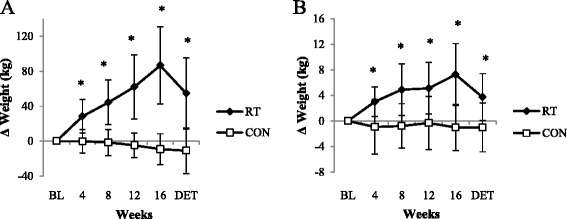
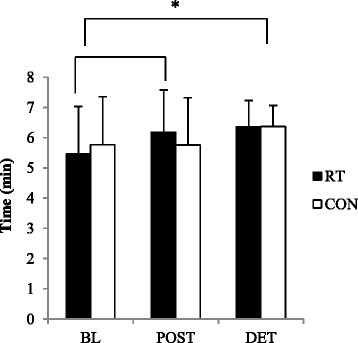
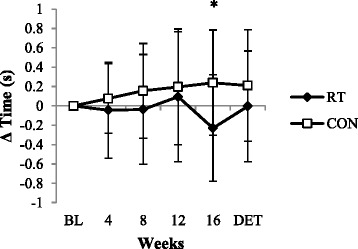
Main treatment effects were found for muscle strength (P < 0.001) and functional mobility (P < 0.05). Upper and lower body strength generally showed a statistically significant improvement after every 4 weeks in RT (the increase after 16 weeks being 7.3 ± 4.9 kg and 86.6 ± 44.4 kg, respectively; P < 0.001) while TUG performance (-0.2 ± 0.4 s; P < 0.05) and submaximal endurance capacity (0.7 ± 0.9 min; P < 0.001) only improved after 16 weeks. Although muscle strength decreased after DET, it was still better than at baseline. No significant improvements in any performance variable were observed in CON directly after the intervention period (0-16 weeks) (P > 0.05).
A 16-week RT programme has positive effects on both muscular and physical function in older adults, although the time course of these adaptations is different. While the gains in muscle strength and submaximal endurance capacity were not totally lost after DET, functional mobility was completely reversed. Older adults can be reassured that if the need arises to discontinue RT for a certain period they will still retain a large amount of their acquired muscle strength, as well as a degree of physical function such as submaximal endurance capacity. The association between leg strength and submaximal endurance capacity strengthens the notion that RT should be incorporated in training and rehabilitation programmes of ageing and frail older adults.
人们普遍认为,抗阻运动可增强老年人的身体机能。本研究旨在调查老年人在进行16周抗阻训练(RT)计划及类似时长的停训(DET)期后,上下肢肌肉力量和身体机能变化的时间进程。
41名不活跃个体(55至75岁)被随机分为RT组(n = 22;每周训练3次)和对照组(CON,n = 19)。通过10RM腿部和卧推测试评估肌肉力量,同时使用定时起立行走(TUG)测试来测量功能灵活性。布鲁斯跑步机测试确定参与者的次最大耐力能力。使用混合模型重复测量方差分析对数据进行分析,P < 0.05被认为具有统计学意义。
发现肌肉力量(P < 0.001)和功能灵活性(P < 0.05)存在主要治疗效果。RT组中,上下肢力量通常每4周显示出统计学上的显著改善(16周后的增加量分别为7.3±4.9千克和86.6±44.4千克;P < 0.001),而TUG表现(-0.2±0.4秒;P < 0.05)和次最大耐力能力(0.7±0.9分钟;P < 0.001)仅在16周后有所改善。尽管停训后肌肉力量下降,但仍优于基线水平。在干预期(0 - 16周)后,CON组在任何性能变量上均未观察到显著改善(P > 0.05)。
16周的RT计划对老年人的肌肉和身体机能均有积极影响,尽管这些适应的时间进程有所不同。虽然停训后肌肉力量和次最大耐力能力的提升并未完全丧失,但功能灵活性完全恢复到之前水平。老年人可以放心,如果需要在一段时间内停止RT训练,他们仍将保留大量已获得的肌肉力量,以及一定程度的身体机能,如次最大耐力能力。腿部力量与次最大耐力能力之间的关联强化了这样一种观念,即RT应纳入老年体弱老年人的训练和康复计划中。