Gregorini Marilena, Corradetti Valeria, Rocca Chiara, Pattonieri Eleonora Francesca, Valsania Teresa, Milanesi Samantha, Serpieri Nicoletta, Bedino Giulia, Esposito Pasquale, Libetta Carmelo, Avanzini Maria Antonietta, Mantelli Melissa, Ingo Daniela, Peressini Sabrina, Albertini Riccardo, Dal Canton Antonio, Rampino Teresa
Unit of Nephrology, Dialysis, Transplantation, Fondazione IRCCS Policlinico San Matteo and University of Pavia, Pavia, Italy.
Laboratory of Transplant Immunology/Cell Factory Fondazione IRCCS Policlinico S. Matteo, Pavia, Italy.
PLoS One. 2016 Feb 11;11(2):e0148542. doi: 10.1371/journal.pone.0148542. eCollection 2016.
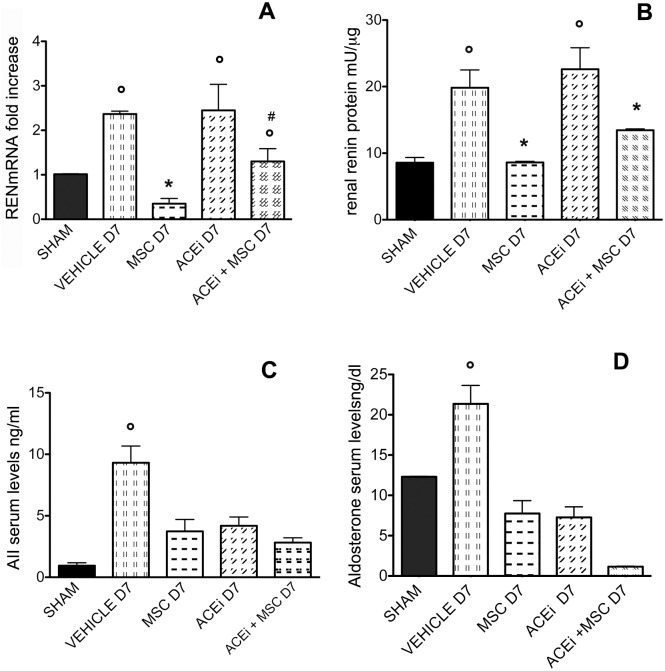
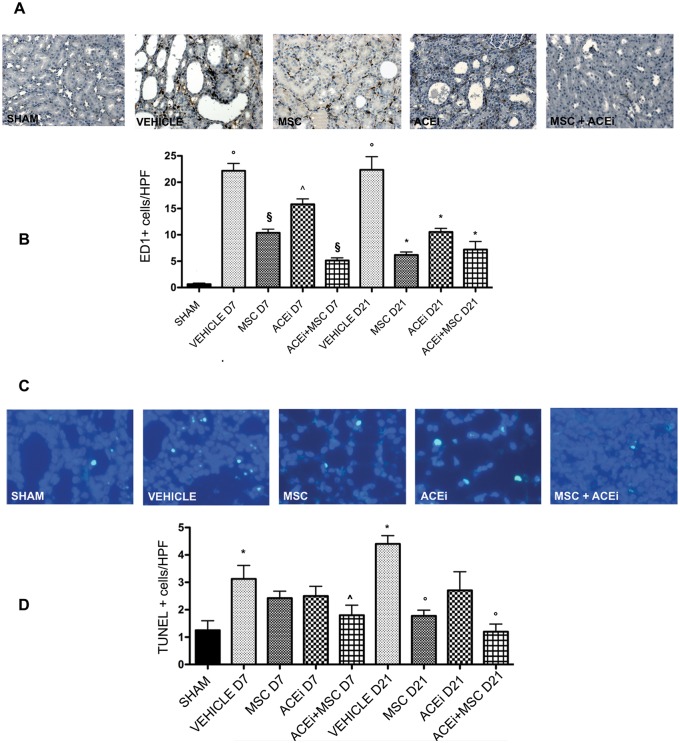
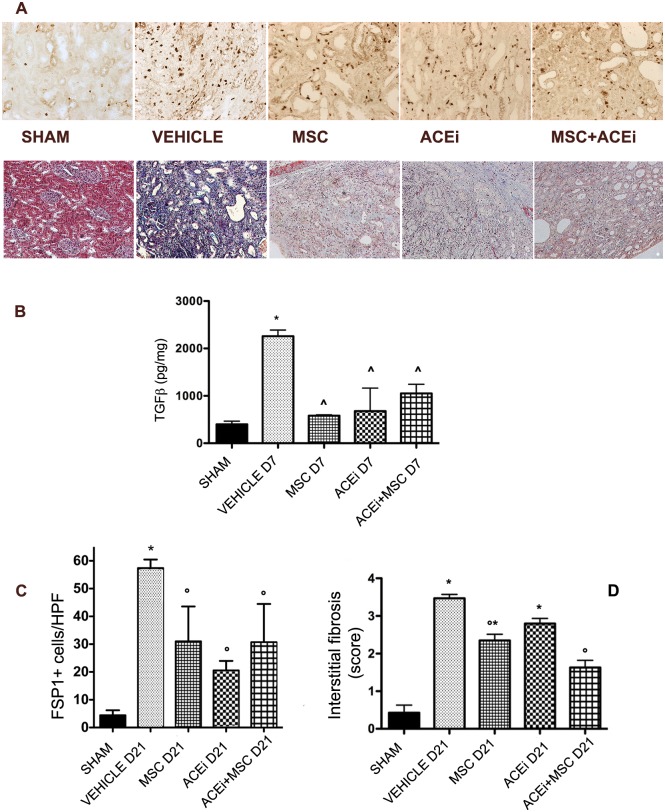
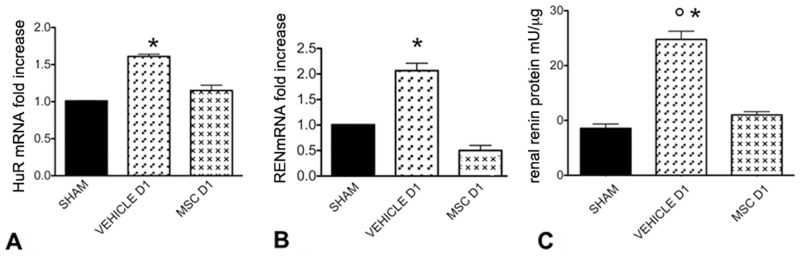
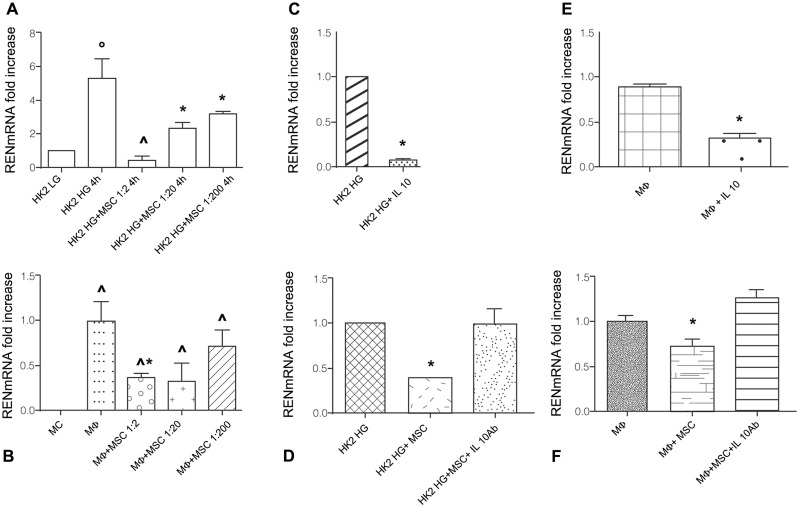
We studied Mesenchymal Stromal Cells (MSC) effects in experimental Unilateral Ureteral Obstruction (UUO), a fibrogenic renal disease. Rats were divided in 5 groups: sham, UUO, MSC treated-UUO, ACEi treated-UUO, MSC+ACEi treated- UUO. Data were collected at 1, 7, 21 days. UUO induced monocyte renal infiltration, tubular cell apoptosis, tubular atrophy, interstitial fibrosis and overexpression of TGFβ, Renin mRNA (RENmRNA), increase of Renin, Angiotensin II (AII) and aldosterone serum levels. Both lisinopril (ACEi) and MSC treatment prevented monocyte infiltration, reduced tubular cell apoptosis, renal fibrosis and TGFβ expression. Combined therapy provided a further suppression of monocyte infiltration and tubular injury. Lisinopril alone caused a rebound activation of Renin-Angiotensin System (RAS), while MSC suppressed RENmRNA and Renin synthesis and induced a decrease of AII and aldosterone serum levels. Furthermore, in in-vitro and in-vivo experiments, MSC inhibit Human antigen R (HuR) trascription, an enhancer of RENmRNA stability by IL10 release. In conclusion, we demonstrate that in UUO MSC prevent fibrosis, by decreasing HuR-dependent RENmRNA stability. Our findings give a clue to understand the molecular mechanism through which MSC may prevent fibrosis in a wide and heterogeneous number of diseases that share RAS activation as common upstream pathogenic mechanism.
我们研究了间充质基质细胞(MSC)在实验性单侧输尿管梗阻(UUO)这一纤维化肾病中的作用。将大鼠分为5组:假手术组、UUO组、MSC治疗的UUO组、ACEi治疗的UUO组、MSC+ACEi治疗的UUO组。在第1、7、21天收集数据。UUO诱导单核细胞肾浸润、肾小管细胞凋亡、肾小管萎缩、间质纤维化以及TGFβ、肾素mRNA(RENmRNA)的过表达,肾素、血管紧张素II(AII)和醛固酮血清水平升高。赖诺普利(ACEi)和MSC治疗均能防止单核细胞浸润,减少肾小管细胞凋亡、肾纤维化和TGFβ表达。联合治疗进一步抑制了单核细胞浸润和肾小管损伤。单独使用赖诺普利会导致肾素-血管紧张素系统(RAS)的反弹激活,而MSC抑制RENmRNA和肾素合成,并导致AII和醛固酮血清水平降低。此外,在体外和体内实验中,MSC通过释放IL10抑制人抗原R(HuR)转录,HuR是RENmRNA稳定性的增强子。总之,我们证明在UUO中,MSC通过降低HuR依赖性RENmRNA稳定性来预防纤维化。我们的发现为理解MSC在众多以RAS激活作为共同上游致病机制的广泛而异质性疾病中预防纤维化的分子机制提供了线索。