Poppe C, Curtiss R, Gulig P A, Gyles C L
Department of Veterinary Microbiology and Immunology, Ontario Veterinary College, University of Guelph.
Can J Vet Res. 1989 Oct;53(4):378-84.
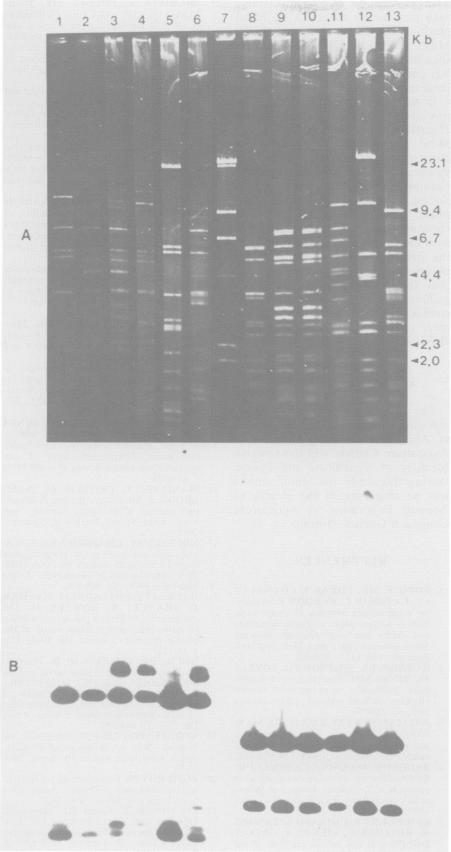
Plasmid DNA of 68 strains of Salmonella that belonged to 18 serovars and exhibited 48 different plasmid profiles was examined for hybridization with a 32P-labelled DNA probe which consisted of a 3750 base pairs (bp) HindIII-HindIII fragment derived from the virulence region of the 60 megadalton (Mdal) plasmid of Salmonella typhimurium. The 32 Mdal plasmid of S. cholerae-suis, the 50 Mdal plasmid of S. dublin, the 36 Mdal plasmid of S. enteritidis, the 60 Mdal plasmid of S. gallinarum, the 60 Mdal plasmid of S. pullorum, and the 60 Mdal plasmid of S. typhimurium, plasmids that have been associated with virulence, all hybridized with the probe. Digestion of plasmid DNA of these strains with PvuII and hybridization with the probe revealed that the plasmids of strains of all six serovars contained fragments of approximately 2520 and 1520 bp that hybridized with the probe. Similarly, hybridization with BglI digests of DNA of the virulence-associated plasmids of strains of these six serovars showed that all six plasmids contained a fragment of approximately 3690 bp that hybridized with the probe. No other plasmids of these strains nor any plasmids of 12 other Salmonella serovars hybridized with the probe. Chromosomal DNA did not hybridize with the probe. The 60 Mdal plasmids of S. gallinarum and S. pullorum showed similar digestion patterns with restriction endonucleases BglI, BglII and PvuII.
对属于18个血清型、呈现48种不同质粒图谱的68株沙门氏菌的质粒DNA进行检测,使其与一个用32P标记的DNA探针杂交,该探针由一个3750个碱基对(bp)的HindIII - HindIII片段组成,此片段源自鼠伤寒沙门氏菌60兆道尔顿(Mdal)质粒的毒力区。猪霍乱沙门氏菌的32 Mdal质粒、都柏林沙门氏菌的50 Mdal质粒、肠炎沙门氏菌的36 Mdal质粒、鸡沙门氏菌的60 Mdal质粒、鸡白痢沙门氏菌的60 Mdal质粒以及鼠伤寒沙门氏菌的60 Mdal质粒,这些与毒力相关的质粒,均与该探针杂交。用PvuII消化这些菌株的质粒DNA并与探针杂交,结果显示所有六个血清型菌株的质粒都含有与探针杂交的约2520和1520 bp的片段。同样,用BglI消化这六个血清型菌株与毒力相关质粒的DNA后进行杂交,结果表明所有六个质粒都含有一个与探针杂交的约3690 bp的片段。这些菌株的其他质粒以及另外12种沙门氏菌血清型的任何质粒均未与该探针杂交。染色体DNA也未与该探针杂交。鸡沙门氏菌和鸡白痢沙门氏菌的60 Mdal质粒在用限制性内切酶BglI、BglII和PvuII消化时显示出相似的消化模式。