Kudithipudi Dhireesha, Saleh Qutaiba, Merkel Cory, Thesing James, Wysocki Bryant
NanoComputing Research Laboratory, Department of Computer Engineering, Rochester Institute of Technology Rochester, NY, USA.
Information Directorate, Air Force Research Laboratory Rome, NY, USA.
Front Neurosci. 2016 Feb 1;9:502. doi: 10.3389/fnins.2015.00502. eCollection 2015.
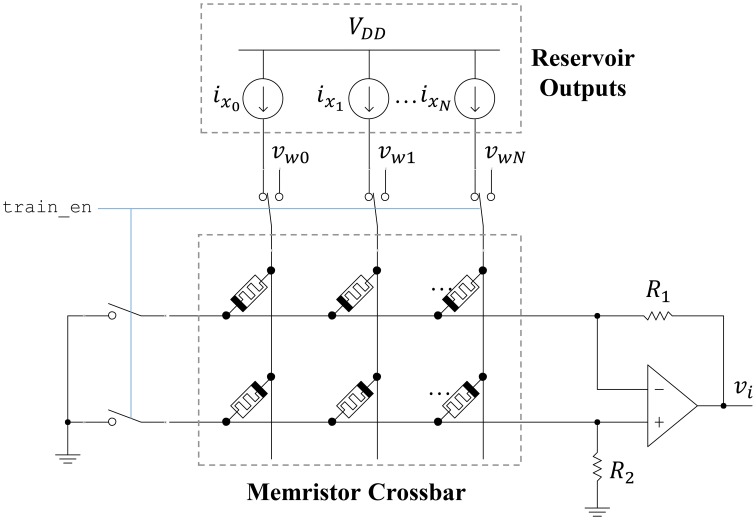
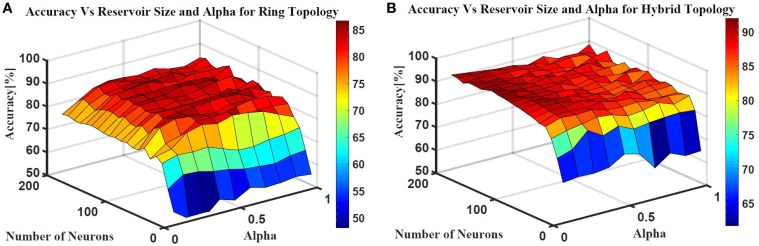
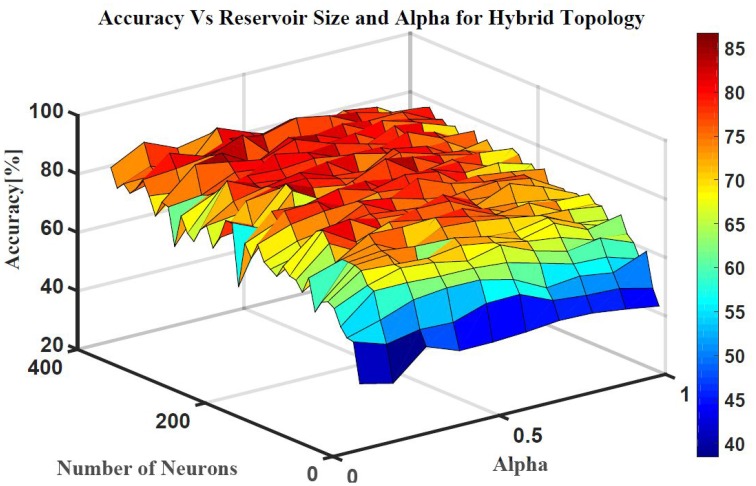
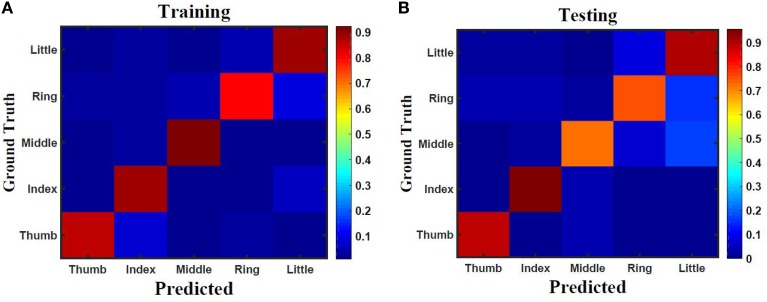
Reservoir computing (RC) is gaining traction in several signal processing domains, owing to its non-linear stateful computation, spatiotemporal encoding, and reduced training complexity over recurrent neural networks (RNNs). Previous studies have shown the effectiveness of software-based RCs for a wide spectrum of applications. A parallel body of work indicates that realizing RNN architectures using custom integrated circuits and reconfigurable hardware platforms yields significant improvements in power and latency. In this research, we propose a neuromemristive RC architecture, with doubly twisted toroidal structure, that is validated for biosignal processing applications. We exploit the device mismatch to implement the random weight distributions within the reservoir and propose mixed-signal subthreshold circuits for energy efficiency. A comprehensive analysis is performed to compare the efficiency of the neuromemristive RC architecture in both digital(reconfigurable) and subthreshold mixed-signal realizations. Both Electroencephalogram (EEG) and Electromyogram (EMG) biosignal benchmarks are used for validating the RC designs. The proposed RC architecture demonstrated an accuracy of 90 and 84% for epileptic seizure detection and EMG prosthetic finger control, respectively.
储层计算(RC)由于其非线性状态计算、时空编码以及相较于递归神经网络(RNN)降低的训练复杂度,正在多个信号处理领域受到关注。先前的研究表明基于软件的储层计算对于广泛的应用是有效的。另一项并行的工作表明,使用定制集成电路和可重构硬件平台实现RNN架构可在功耗和延迟方面带来显著改善。在本研究中,我们提出了一种具有双扭曲环形结构的神经忆阻器RC架构,并针对生物信号处理应用进行了验证。我们利用器件失配来实现储层内的随机权重分布,并提出用于提高能效的混合信号亚阈值电路。进行了全面分析以比较神经忆阻器RC架构在数字(可重构)和亚阈值混合信号实现中的效率。脑电图(EEG)和肌电图(EMG)生物信号基准均用于验证RC设计。所提出的RC架构在癫痫发作检测和EMG假肢手指控制方面分别展示了90%和84%的准确率。