Notbohm Annika, Kurths Jürgen, Herrmann Christoph S
Experimental Psychology Lab, Center for Excellence 'Hearing4all', European Medical School, University of Oldenburg Oldenburg, Germany.
Potsdam Institute for Climate Impact Research Potsdam, Germany.
Front Hum Neurosci. 2016 Feb 3;10:10. doi: 10.3389/fnhum.2016.00010. eCollection 2016.
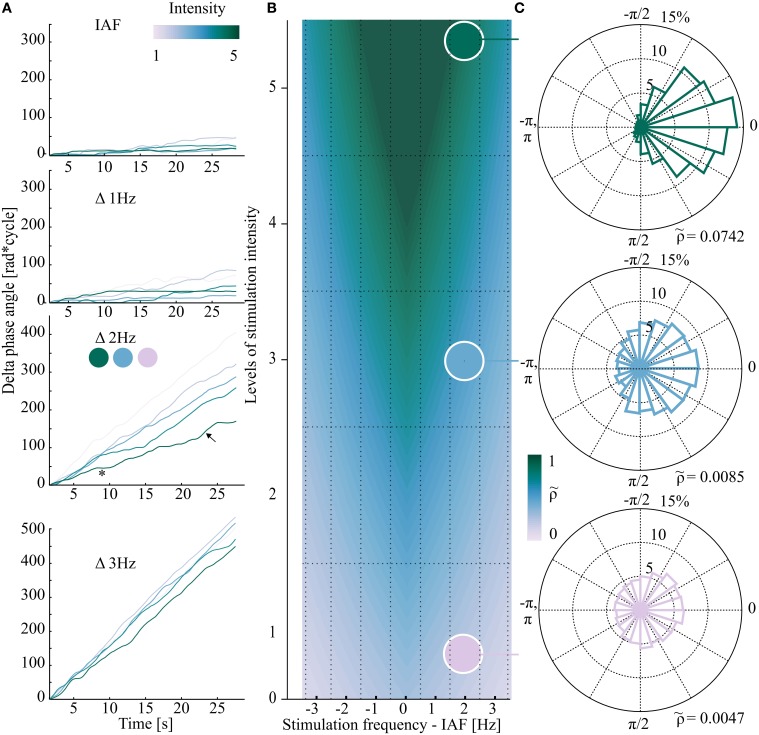
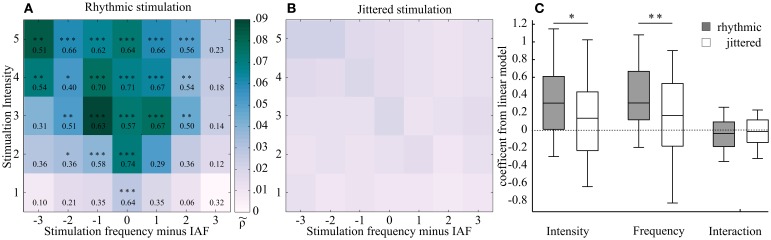
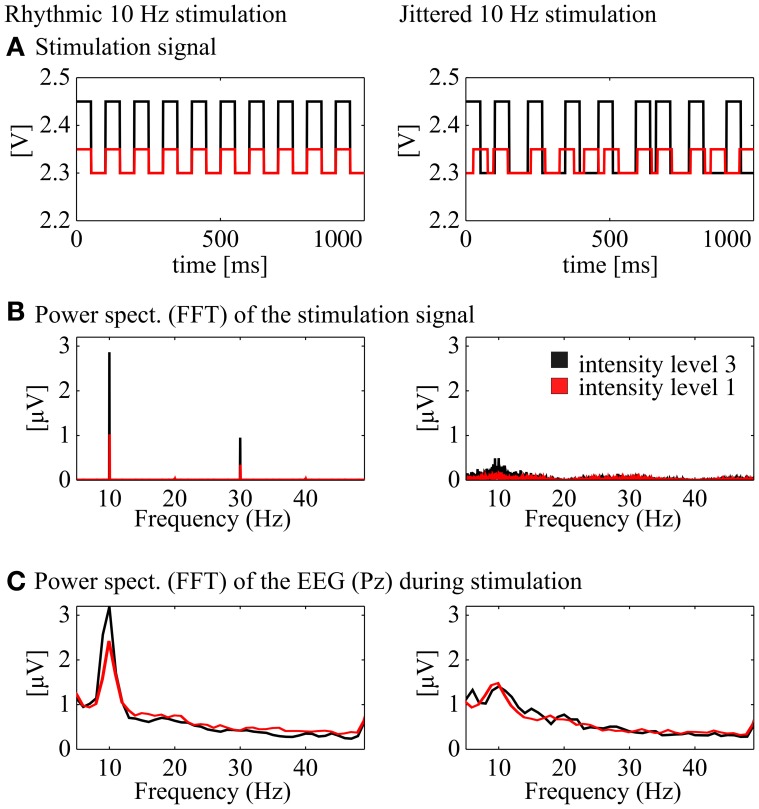
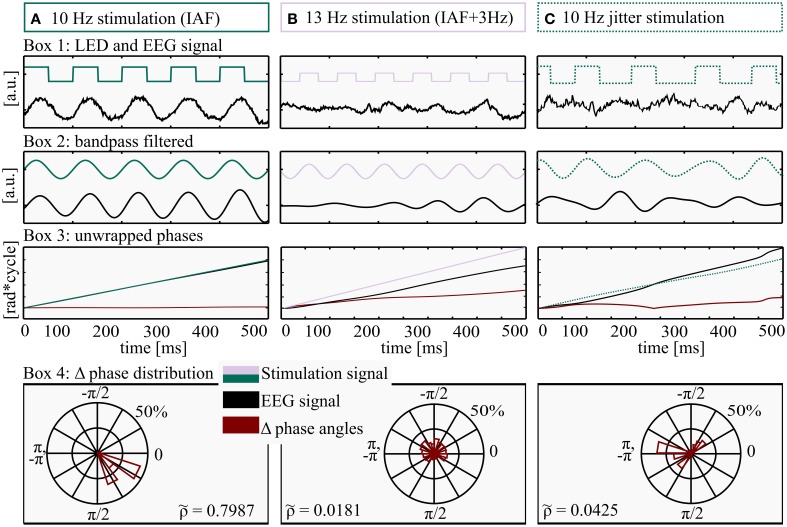
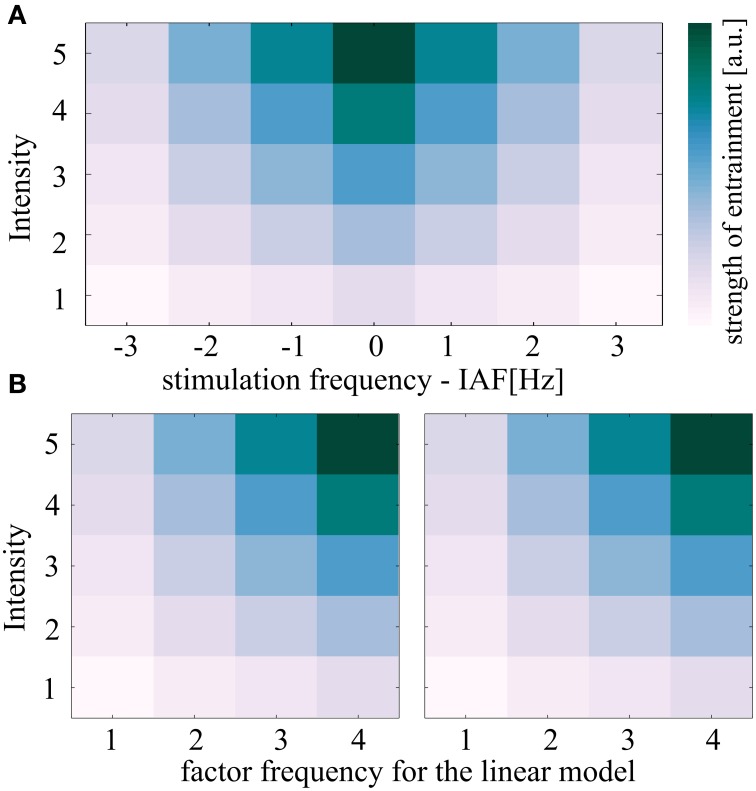
The functional relevance of brain oscillations in the alpha frequency range (8-13 Hz) has been repeatedly investigated through the use of rhythmic visual stimulation. The underlying mechanism of the steady-state visual evoked potential (SSVEP) measured in EEG during rhythmic stimulation, however, is not known. There are two hypotheses on the origin of SSVEPs: entrainment of brain oscillations and superposition of event-related responses (ERPs). The entrainment but not the superposition hypothesis justifies rhythmic visual stimulation as a means to manipulate brain oscillations, because superposition assumes a linear summation of single responses, independent from ongoing brain oscillations. Here, we stimulated participants with a rhythmic flickering light of different frequencies and intensities. We measured entrainment by comparing the phase coupling of brain oscillations stimulated by rhythmic visual flicker with the oscillations induced by arrhythmic jittered stimulation, varying the time, stimulation frequency, and intensity conditions. In line with a theoretical concept of entrainment (the so called Arnold tongue), we found the phase coupling to be more pronounced with increasing stimulation intensity as well as at stimulation frequencies closer to each participant's intrinsic frequency. Only inside the Arnold tongue did the conditions significantly differ from the jittered stimulation. Furthermore, even in a single sequence of an SSVEP, we found non-linear features (intermittency of phase locking) that contradict the linear summation of single responses, as assumed by the superposition hypothesis. Our findings provide unequivocal evidence that visual rhythmic stimulation entrains brain oscillations, thus validating the approach of rhythmic stimulation as a manipulation of brain oscillations.
通过使用节律性视觉刺激,人们反复研究了大脑在阿尔法频率范围(8-13赫兹)内振荡的功能相关性。然而,在节律性刺激期间脑电图中测量到的稳态视觉诱发电位(SSVEP)的潜在机制尚不清楚。关于SSVEP的起源有两种假设:大脑振荡的夹带和事件相关反应(ERP)的叠加。夹带假设而非叠加假设证明了节律性视觉刺激作为一种操纵大脑振荡的手段是合理的,因为叠加假设单个反应是线性相加的,与正在进行的大脑振荡无关。在这里,我们用不同频率和强度的节律性闪烁光刺激参与者。我们通过比较节律性视觉闪烁刺激引起的大脑振荡的相位耦合与无节律抖动刺激引起的振荡,改变时间、刺激频率和强度条件来测量夹带。与夹带的理论概念(所谓的阿诺德舌)一致,我们发现随着刺激强度的增加以及在更接近每个参与者固有频率的刺激频率下,相位耦合更为明显。只有在阿诺德舌内部,这些条件才与抖动刺激有显著差异。此外,即使在单个SSVEP序列中,我们也发现了与叠加假设所假定的单个反应线性相加相矛盾的非线性特征(锁相的间歇性)。我们的研究结果提供了明确的证据,表明视觉节律性刺激会夹带大脑振荡,从而验证了节律性刺激作为一种操纵大脑振荡的方法。