Entz Michael, George Sharon A, Zeitz Michael J, Raisch Tristan, Smyth James W, Poelzing Steven
Department of Biomedical Engineering and Mechanics, Virginia Polytechnic Institute and State UniversityBlacksburg, VA, USA; Virginia Tech Carilion Research Institute and Center for Heart and Regenerative Medicine, Virginia Polytechnic Institute and State UniversityRoanoke, VA, USA.
Virginia Tech Carilion Research Institute and Center for Heart and Regenerative Medicine, Virginia Polytechnic Institute and State University Roanoke, VA, USA.
Front Physiol. 2016 Feb 2;7:16. doi: 10.3389/fphys.2016.00016. eCollection 2016.
Recent studies suggested that cardiac conduction in murine hearts with narrow perinexi and 50% reduced connexin43 (Cx43) expression is more sensitive to relatively physiological changes of extracellular potassium ([K(+)]o) and sodium ([Na(+)]o).
Determine whether similar [K(+)]o and [Na(+)]o changes alter conduction velocity (CV) sensitivity to pharmacologic gap junction (GJ) uncoupling in guinea pigs.
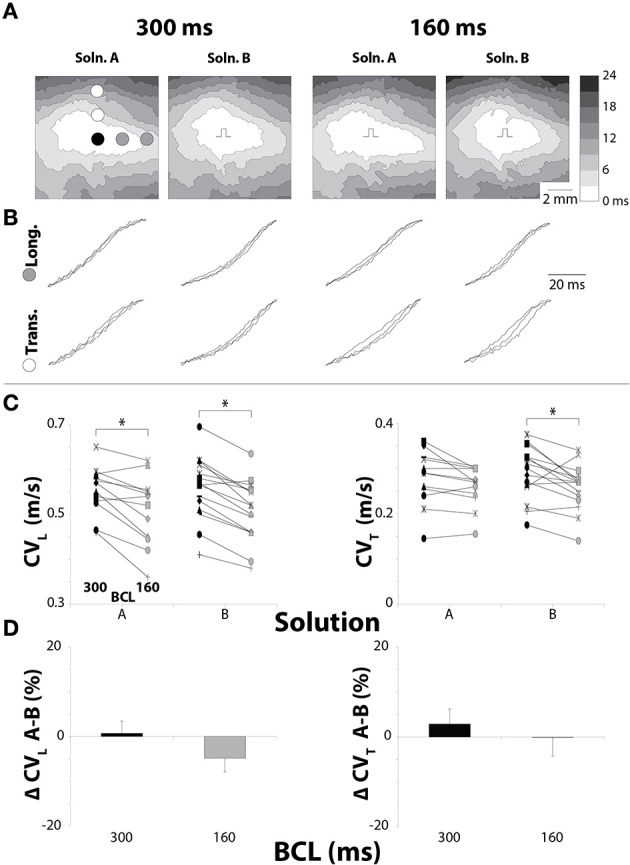
[K(+)]o and [Na(+)]o were varied in Langendorff perfused guinea pig ventricles (Solution A: [K(+)]o = 4.56 and [Na(+)]o = 153.3 mM. Solution B: [K(+)]o = 6.95 and [Na(+)]o = 145.5 mM). Gap junctions were inhibited with carbenoxolone (CBX) (15 and 30 μM). Epicardial CV was quantified by optical mapping. Perinexal width was measured with transmission electron microscopy. Total and phosphorylated Cx43 were evaluated by western blotting.
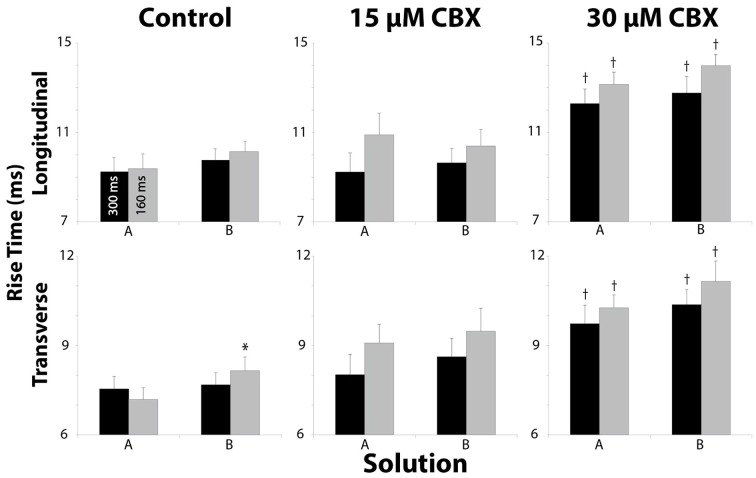
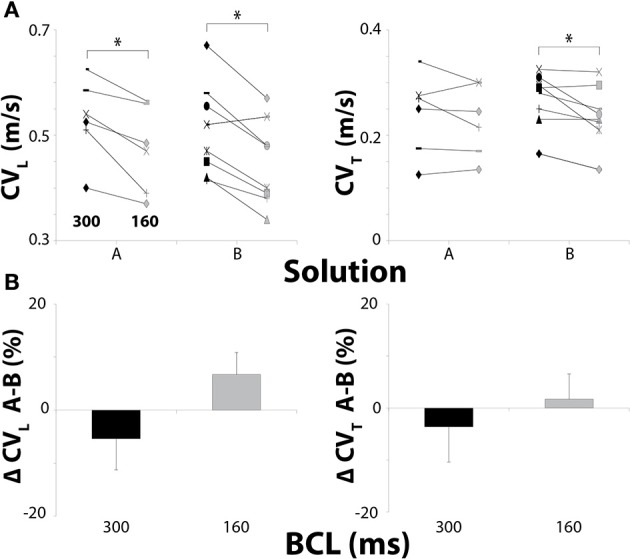
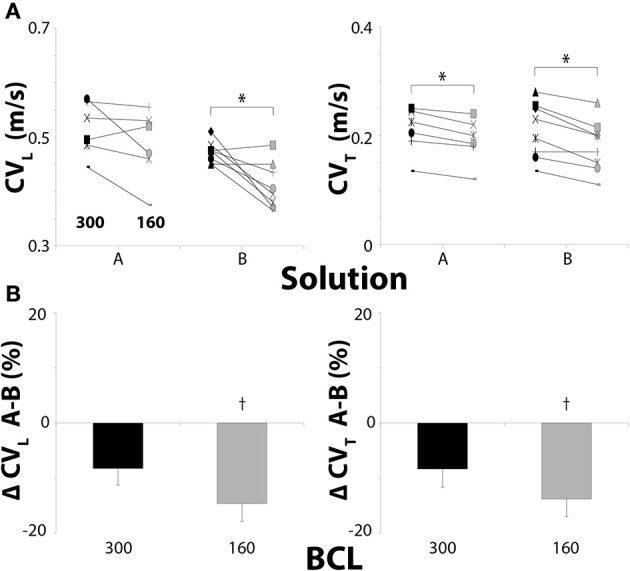
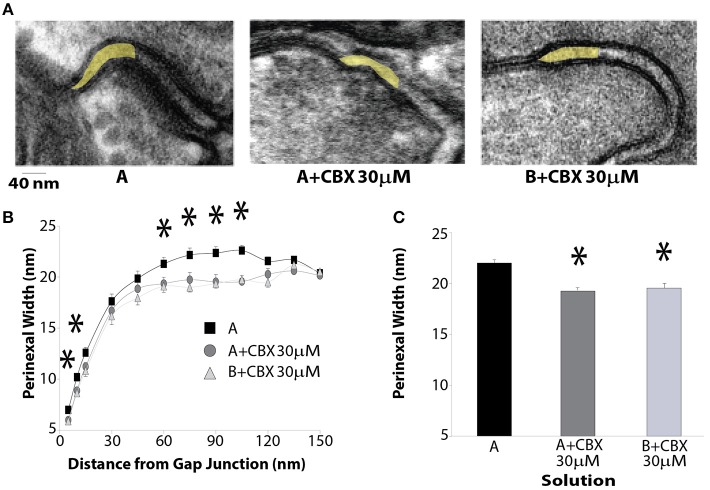
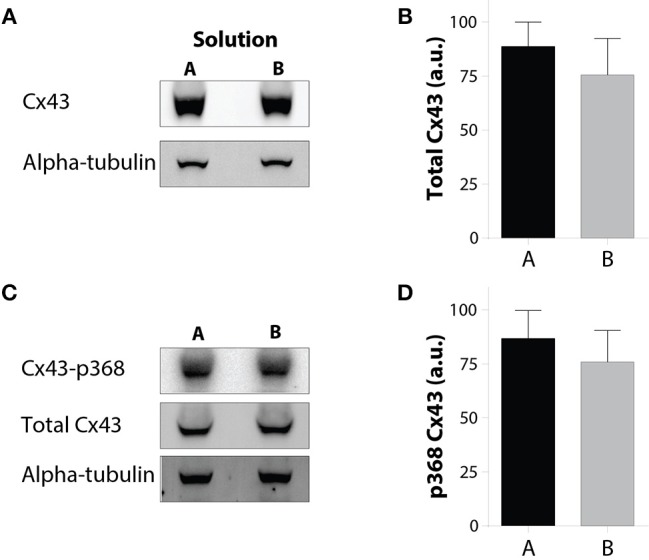
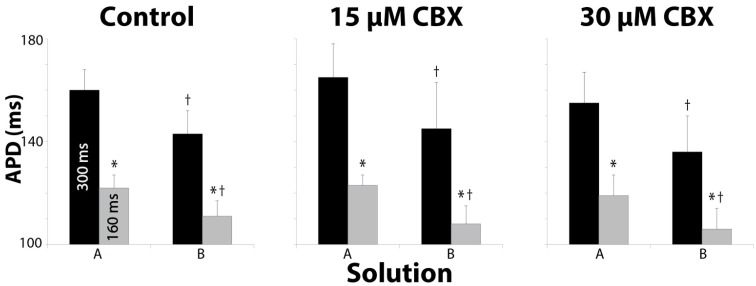
Solution composition did not alter CV under control conditions or with 15μM CBX. Decreasing the basic cycle length (BCL) of pacing from 300 to 160 ms decreased CV uniformly with both solutions. At 30 μM CBX, a change in solution did not alter CV either longitudinally or transversely at BCL = 300 ms. However, reducing BCL to 160 ms caused CV to decrease more in hearts perfused with Solution B than A. Solution composition did not alter perinexal width, nor did it change total or phosphorylated serine 368 Cx43 expression. These data suggest that the solution dependent CV changes were independent of altered perinexal width or GJ coupling. Action potential duration was always shorter in hearts perfused with Solution B than A, independent of pacing rate and/or CBX concentration.
Increased heart rate and GJ uncoupling can unmask small CV differences caused by changing [K(+)]o and [Na(+)]o. These data suggest that modulating extracellular ionic composition may be a novel anti-arrhythmic target in diseases with abnormal GJ coupling, particularly when heart rate cannot be controlled.
最近的研究表明,在心肌周隙狭窄且连接蛋白43(Cx43)表达降低50%的小鼠心脏中,心脏传导对细胞外钾离子([K(+)]o)和钠离子([Na(+)]o)相对生理性的变化更为敏感。
确定类似的[K(+)]o和[Na(+)]o变化是否会改变豚鼠心脏传导速度(CV)对药理学缝隙连接(GJ)解偶联的敏感性。
在Langendorff灌注的豚鼠心室中改变[K(+)]o和[Na(+)]o(溶液A:[K(+)]o = 4.56,[Na(+)]o = 153.3 mM。溶液B:[K(+)]o = 6.95,[Na(+)]o = 145.5 mM)。用羧苄青霉素(CBX)(15和30 μM)抑制缝隙连接。通过光学标测对心外膜CV进行定量。用透射电子显微镜测量心肌周隙宽度。通过蛋白质印迹法评估总Cx43和磷酸化Cx43。
在对照条件下或使用15μM CBX时,溶液成分不会改变CV。将起搏的基础周期长度(BCL)从300 ms缩短至160 ms时,两种溶液均使CV均匀降低。在30 μM CBX时,溶液变化在BCL = 300 ms时不会纵向或横向改变CV。然而,将BCL缩短至160 ms时,灌注溶液B的心脏中CV降低幅度比灌注溶液A的心脏更大。溶液成分不会改变心肌周隙宽度,也不会改变总Cx43或丝氨酸368磷酸化Cx43的表达。这些数据表明,溶液依赖性CV变化与心肌周隙宽度改变或GJ偶联无关。无论起搏频率和/或CBX浓度如何,灌注溶液B的心脏中动作电位持续时间总是比灌注溶液A的心脏短。
心率增加和GJ解偶联可揭示由[K(+)]o和[Na(+)]o变化引起的微小CV差异。这些数据表明,调节细胞外离子成分可能是GJ偶联异常疾病中的一种新型抗心律失常靶点,尤其是在心率无法控制时。