Department of Physiology, University of Bern, Bern, Switzerland.
J Physiol. 2021 Nov;599(21):4779-4811. doi: 10.1113/JP282105. Epub 2021 Oct 4.
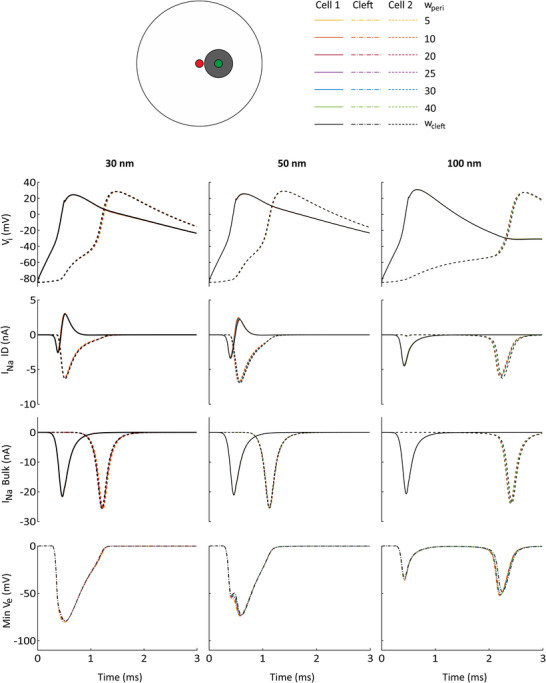
It has been proposed that when gap junctional coupling is reduced in cardiac tissue, action potential propagation can be supported via ephaptic coupling, a mechanism mediated by negative electric potentials occurring in narrow intercellular clefts of intercalated discs (IDs). Recent studies showed that sodium (Na ) channels form clusters near gap junction plaques in nanodomains called perinexi, where the ID cleft is even narrower. To examine the electrophysiological relevance of Na channel clusters being located in perinexi, we developed a 3D finite element model of two longitudinally abutting cardiomyocytes, with a central Na channel cluster on the ID membranes. When this cluster was located in the perinexus of a closely positioned gap junction plaque, varying perinexal width greatly modulated impulse transmission from one cell to the other, with narrow perinexi potentiating ephaptic coupling. This modulation occurred via the interplay of Na currents, extracellular potentials in the cleft and patterns of current flow within the cleft. In contrast, when the Na channel cluster was located remotely from the gap junction plaque, this modulation by perinexus width largely disappeared. Interestingly, the Na current in the ID membrane of the pre-junctional cell switched from inward to outward during excitation, thus contributing ions to the activating channels on the post-junctional ID membrane. In conclusion, these results indicate that the localization of Na channel clusters in the perinexi of gap junction plaques is crucial for ephaptic coupling, which is furthermore greatly modulated by perinexal width. These findings are relevant for a comprehensive understanding of cardiac excitation. KEY POINTS: Ephaptic coupling is a cardiac conduction mechanism involving nanoscale-level interactions between the sodium (Na ) current and the extracellular potential in narrow intercalated disc clefts. When gap junctional coupling is reduced, ephaptic coupling acts in conjunction with the classical cardiac conduction mechanism based on gap junctional current flow. In intercalated discs, Na channels form clusters that are preferentially located in the periphery of gap junction plaques, in nanodomains known as perinexi, but the electrophysiological role of these perinexi has never been examined. In our new 3D finite element model of two cardiac cells abutting each other with their intercalated discs, a Na channel cluster located inside a narrowed perinexus facilitated impulse transmission via ephaptic coupling. Our simulations demonstrate the role of narrowed perinexi as privileged sites for ephaptic coupling in pathological situations when gap junctional coupling is decreased.
有人提出,当心脏组织中的缝隙连接偶联减少时,动作电位的传播可以通过电突触连接来支持,这种机制是通过闰盘(IDs)狭窄的细胞间隙中发生的负电势介导的。最近的研究表明,钠离子(Na+)通道在纳米域(称为perinexi)中形成簇,这些簇靠近缝隙连接斑块,其中 ID 缝隙甚至更窄。为了研究 Na 通道簇位于 perinexi 中的电生理相关性,我们开发了一个由两个纵向相邻的心肌细胞组成的 3D 有限元模型,在 ID 膜上有一个中央 Na 通道簇。当这个簇位于紧密定位的缝隙连接斑块的 perinexus 中时,perinexal 宽度的变化极大地调节了从一个细胞到另一个细胞的冲动传递,狭窄的 perinexus 增强了电突触连接。这种调制是通过 Na 电流、缝隙中的细胞外电势以及缝隙内电流流动模式的相互作用来实现的。相比之下,当 Na 通道簇远离缝隙连接斑块定位时,这种 perinexus 宽度的调制在很大程度上消失了。有趣的是,在兴奋过程中,前突触细胞 ID 膜中的 Na 电流从内向转变为外向,从而为后突触 ID 膜上的激活通道提供离子。总之,这些结果表明,Na 通道簇在缝隙连接斑块的 perinexus 中的定位对于电突触连接至关重要,而 perinexal 宽度对此有很大的调节作用。这些发现对于全面理解心脏兴奋具有重要意义。关键点:电突触连接是一种涉及钠离子(Na+)电流和狭窄闰盘缝隙中的细胞外电势之间纳米级相互作用的心脏传导机制。当缝隙连接偶联减少时,电突触连接与基于缝隙连接电流流动的经典心脏传导机制协同作用。在闰盘中,Na 通道形成簇,这些簇优先位于缝隙连接斑块的外围,在纳米域中称为 perinexi,但这些 perinexi 的电生理作用从未被研究过。在我们的两个相邻心脏细胞的新 3D 有限元模型中,位于狭窄 perinexus 内部的 Na 通道簇通过电突触连接促进了冲动传递。我们的模拟表明,在缝隙连接偶联减少的病理情况下,狭窄的 perinexus 作为电突触连接的特权部位发挥作用。