Translational Biology, Medicine, and Health Graduate Program, Virginia Polytechnic Institute and State University, Blacksburg, VA, USA.
Center for Heart and Reparative Medicine Research, Fralin Biomedical Research Institute at Virginia Tech Carilion, Roanoke, VA, USA.
Pflugers Arch. 2021 Mar;473(3):557-571. doi: 10.1007/s00424-021-02537-y. Epub 2021 Mar 4.
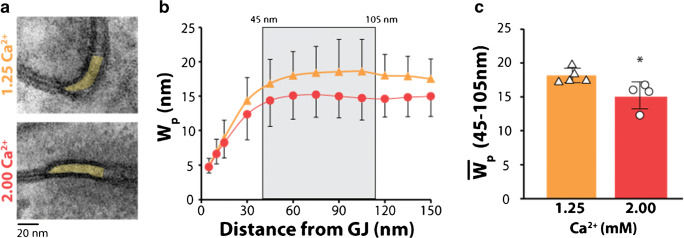
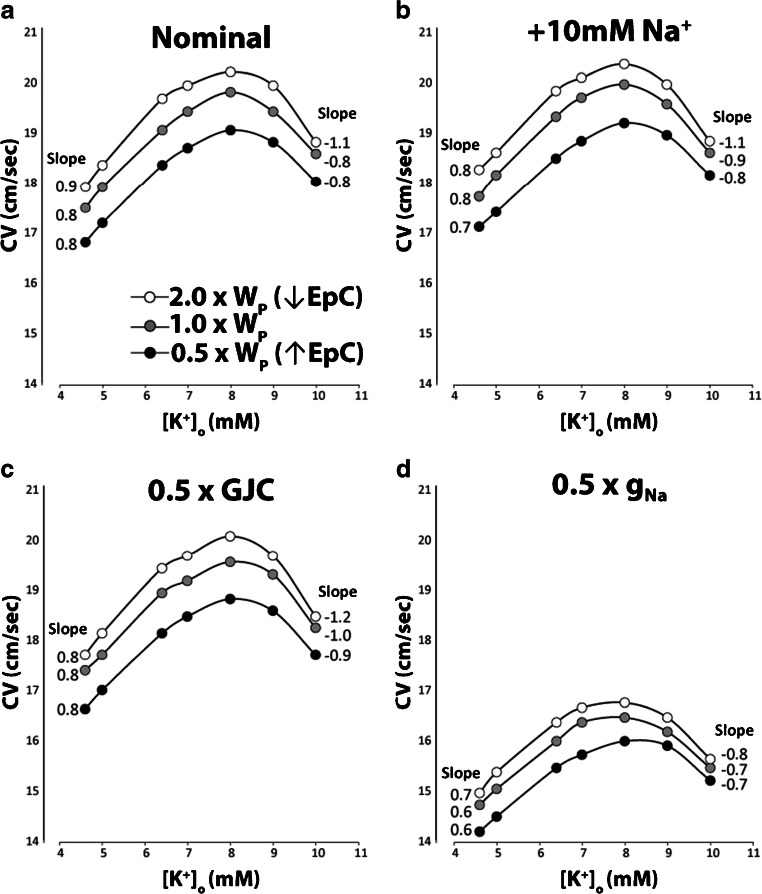
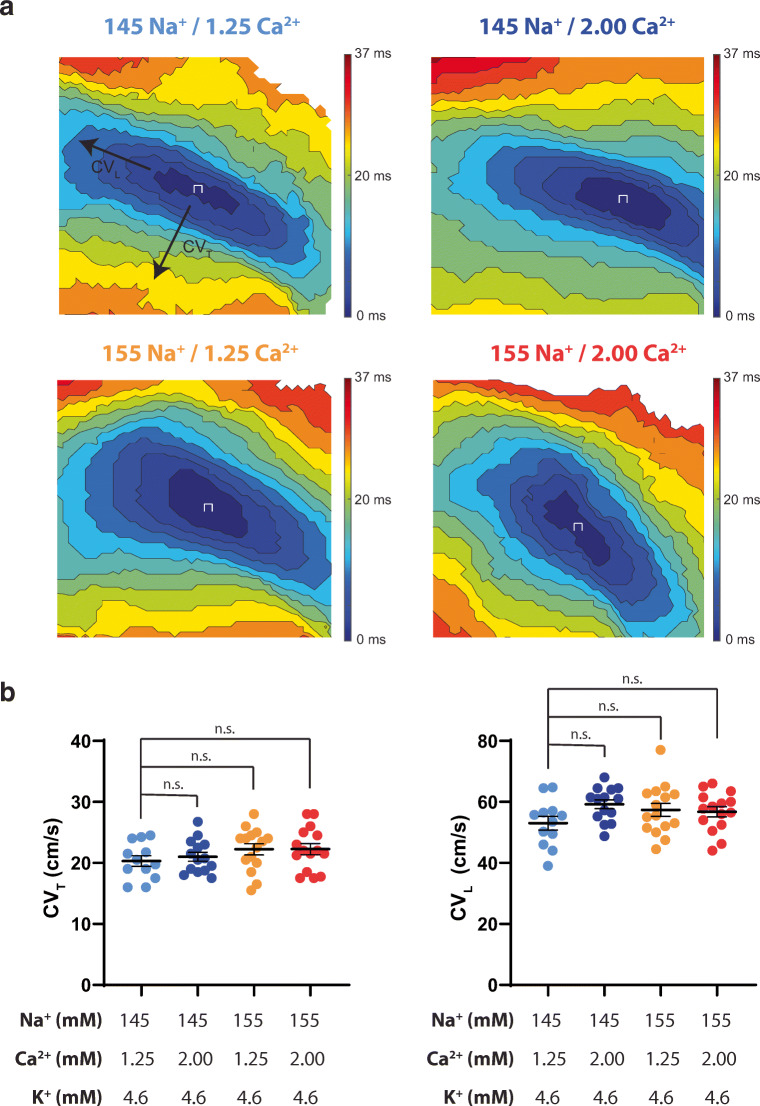
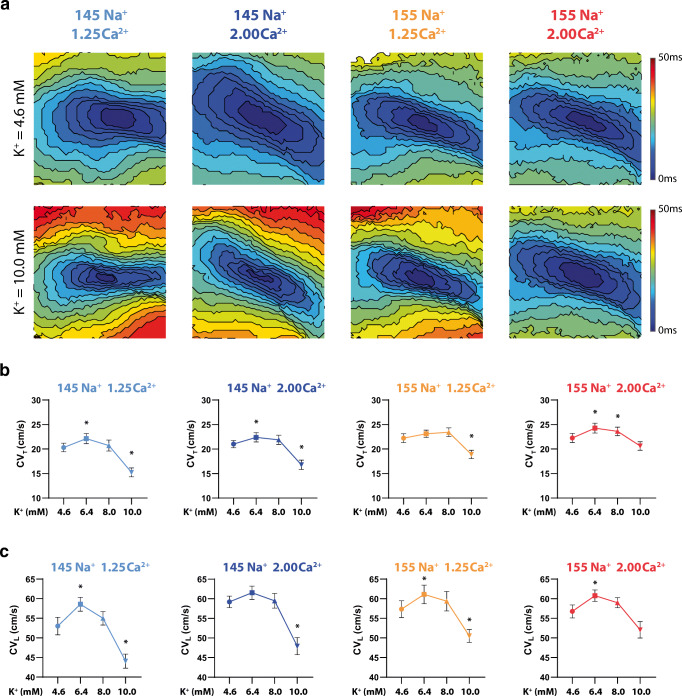
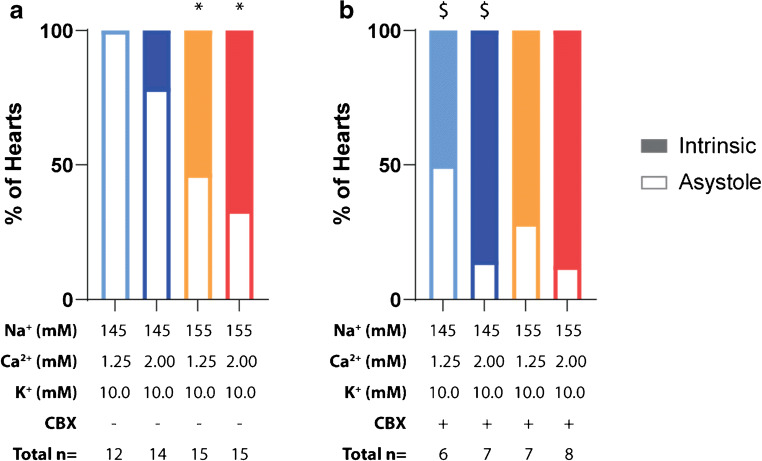
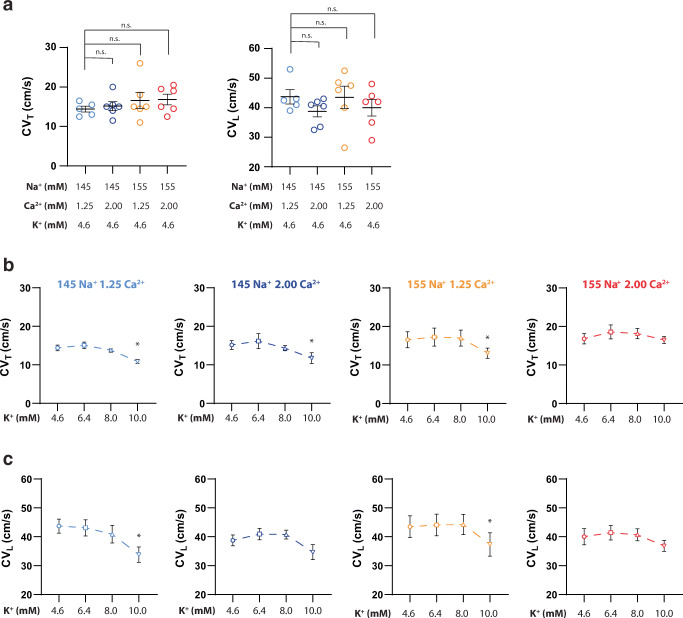
The relationship between cardiac conduction velocity (CV) and extracellular potassium (K) is biphasic, with modest hyperkalemia increasing CV and severe hyperkalemia slowing CV. Recent studies from our group suggest that elevating extracellular sodium (Na) and calcium (Ca) can enhance CV by an extracellular pathway parallel to gap junctional coupling (GJC) called ephaptic coupling that can occur in the gap junction adjacent perinexus. However, it remains unknown whether these same interventions modulate CV as a function of K. We hypothesize that Na, Ca, and GJC can attenuate conduction slowing consequent to severe hyperkalemia. Elevating Ca from 1.25 to 2.00 mM significantly narrowed perinexal width measured by transmission electron microscopy. Optically mapped, Langendorff-perfused guinea pig hearts perfused with increasing K revealed the expected biphasic CV-K relationship during perfusion with different Na and Ca concentrations. Neither elevating Na nor Ca alone consistently modulated the positive slope of CV-K or conduction slowing at 10-mM K; however, combined Na and Ca elevation significantly mitigated conduction slowing at 10-mM K. Pharmacologic GJC inhibition with 30-μM carbenoxolone slowed CV without changing the shape of CV-K curves. A computational model of CV predicted that elevating Na and narrowing clefts between myocytes, as occur with perinexal narrowing, reduces the positive and negative slopes of the CV-K relationship but do not support a primary role of GJC or sodium channel conductance. These data demonstrate that combinatorial effects of Na and Ca differentially modulate conduction during hyperkalemia, and enhancing determinants of ephaptic coupling may attenuate conduction changes in a variety of physiologic conditions.
心脏传导速度 (CV) 与细胞外钾 (K) 之间的关系呈双相性,轻度高钾血症会增加 CV,而严重高钾血症会减慢 CV。我们小组的最新研究表明,升高细胞外钠 (Na) 和钙 (Ca) 可以通过一种称为缝隙连接旁偶联 (ephasic coupling) 的细胞外途径增强 CV,这种途径与缝隙连接偶联 (GJC) 平行,可能发生在缝隙连接相邻的闰盘内。然而,目前尚不清楚这些相同的干预措施是否会随着 K 的变化调节 CV。我们假设 Na、Ca 和 GJC 可以减轻严重高钾血症引起的传导减慢。将 Ca 从 1.25 升高到 2.00 mM,通过透射电子显微镜测量的闰盘宽度明显变窄。用光学映射方法对 Langendorff 灌流的豚鼠心脏进行成像,用不同浓度的 Na 和 Ca 进行灌流,结果显示在不同浓度的 K 灌流时,CV 与 K 之间呈现出预期的双相关系。单独升高 Na 或 Ca 并不能一致调节 CV-K 关系的正斜率或在 10-mM K 时的传导减慢;然而,联合升高 Na 和 Ca 可显著减轻 10-mM K 时的传导减慢。用 30-μM carbenoxolone 抑制 GJC 可减慢 CV,而不改变 CV-K 曲线的形状。CV 的计算模型预测,升高 Na 和缩小细胞间的缝隙(闰盘变窄时发生的情况)会降低 CV-K 关系的正斜率和负斜率,但不支持 GJC 或钠通道电导的主要作用。这些数据表明,Na 和 Ca 的组合效应在高钾血症期间对传导有不同的调节作用,增强缝隙连接偶联的决定因素可能会减轻各种生理条件下的传导变化。