Blasco-Fontecilla Hilario, Fernández-Fernández Roberto, Colino Laura, Fajardo Lourdes, Perteguer-Barrio Rosa, de Leon Jose
Department of Psychiatry, Instituto de Investigación Sanitaria Puerta de Hierro (IDIPHIM), Puerta de Hierro University Hospital, Madrid, Spain; Centro de Investigación Biomédica en Red de Salud Mental (CIBERSAM), Madrid, Spain; Universidad Autónoma de Madrid, Madrid, Spain; Consulting Asistencial Sociosanitario (CAS), Madrid, Spain.
Department of Psychiatry, Instituto de Investigación Sanitaria Puerta de Hierro (IDIPHIM), Puerta de Hierro University Hospital , Madrid , Spain.
Front Psychiatry. 2016 Feb 1;7:8. doi: 10.3389/fpsyt.2016.00008. eCollection 2016.
Behavioral addictions such as gambling, sun-tanning, shopping, Internet use, work, exercise, or even love and sex are frequent, and share many characteristics and common neurobiological and genetic underpinnings with substance addictions (i.e., tolerance, withdrawal, and relapse). Recent literature suggests that both non-suicidal self-injury (NSSI) and suicidal behavior (SB) can also be conceptualized as addictions. The major aim of this mini review is to review the literature and explore the neurobiological and psychological mechanisms underlying the addiction to self-harming behaviors.
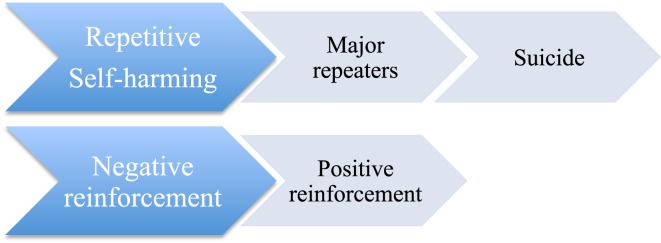
This is a narrative review. The authors performed literature searches in PubMed and Google for suicidal behavior, self-harming, addiction, and "major repeaters." Given the scarce literature on the topic, a subset of the most closely related studies was selected. The authors also focused on three empirical studies testing the hypothesis that major repeaters (individuals with ≥5 lifetime suicide attempts) represent a distinctive suicidal phenotype and are the individuals at risk of developing an addiction to SB.
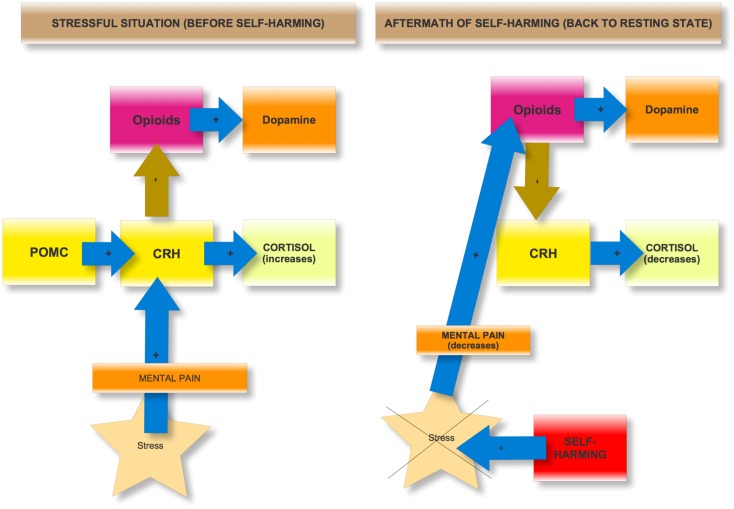
The authors reviewed the concept of behavioral addictions and major repeaters, current empirical evidence testing concerning whether or not NSSI and SB can be understood as "addictions," and the putative mechanisms underlying them.
Our review suggests that both NSSI and SB can be conceptualized as addictions. This is relevant because if some individual's self-harming behaviors are better conceptualized as an addiction, treatment approaches could be tailored to this addiction.
赌博、晒黑、购物、上网、工作、锻炼,甚至爱情和性行为等行为成瘾很常见,并且与物质成瘾(即耐受性、戒断和复发)具有许多共同特征以及神经生物学和遗传学基础。最近的文献表明,非自杀性自伤(NSSI)和自杀行为(SB)也可被视为成瘾行为。本综述的主要目的是回顾相关文献,并探讨自伤行为成瘾背后的神经生物学和心理机制。
这是一篇叙述性综述。作者在PubMed和谷歌上搜索了有关自杀行为、自伤、成瘾以及“重度复发者”的文献。鉴于该主题的文献稀缺,选取了一组最密切相关的研究。作者还重点关注了三项实证研究,这些研究检验了以下假设:重度复发者(一生中有≥5次自杀未遂的个体)代表一种独特的自杀表型,并且是有发展为自杀行为成瘾风险的个体。
作者回顾了行为成瘾和重度复发者的概念、关于NSSI和SB是否可被理解为“成瘾”的当前实证证据,以及其潜在机制。
我们的综述表明,NSSI和SB均可被视为成瘾行为。这很重要,因为如果将某些个体的自伤行为更好地理解为一种成瘾行为,那么治疗方法就可以针对这种成瘾进行调整。