Wojtyla Łukasz, Lechowska Katarzyna, Kubala Szymon, Garnczarska Małgorzata
Department of Plant Physiology, Institute of Experimental Biology, Adam Mickiewicz University in Poznan Poznan, Poland.
Front Plant Sci. 2016 Feb 4;7:66. doi: 10.3389/fpls.2016.00066. eCollection 2016.
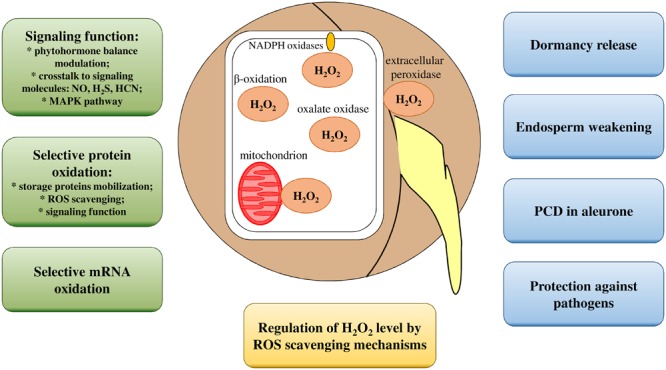
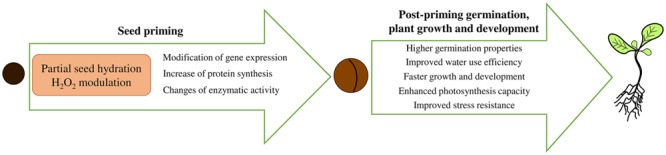
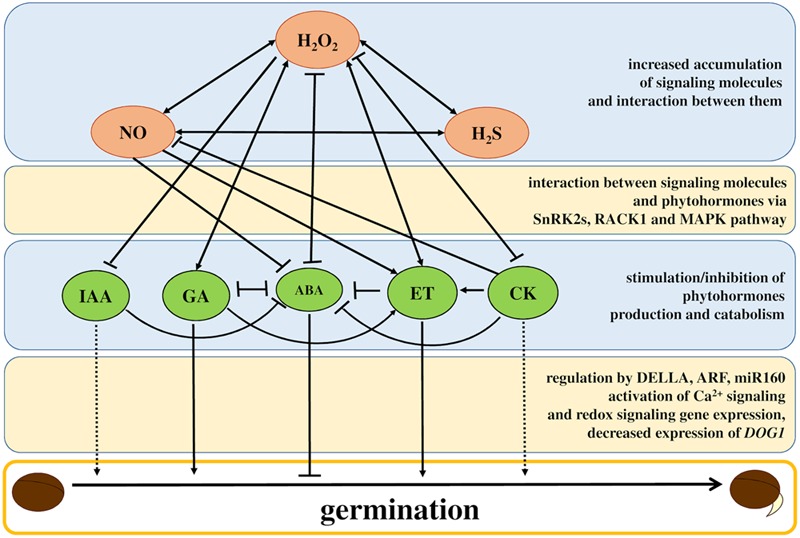
Hydrogen peroxide was initially recognized as a toxic molecule that causes damage at different levels of cell organization and thus losses in cell viability. From the 1990s, the role of hydrogen peroxide as a signaling molecule in plants has also been discussed. The beneficial role of H2O2 as a central hub integrating signaling network in response to biotic and abiotic stress and during developmental processes is now well established. Seed germination is the most pivotal phase of the plant life cycle, affecting plant growth and productivity. The function of hydrogen peroxide in seed germination and seed aging has been illustrated in numerous studies; however, the exact role of this molecule remains unknown. This review evaluates evidence that shows that H2O2 functions as a signaling molecule in seed physiology in accordance with the known biology and biochemistry of H2O2. The importance of crosstalk between hydrogen peroxide and a number of signaling molecules, including plant phytohormones such as abscisic acid, gibberellins, and ethylene, and reactive molecules such as nitric oxide and hydrogen sulfide acting on cell communication and signaling during seed germination, is highlighted. The current study also focuses on the detrimental effects of H2O2 on seed biology, i.e., seed aging that leads to a loss of germination efficiency. The dual nature of hydrogen peroxide as a toxic molecule on one hand and as a signal molecule on the other is made possible through the precise spatial and temporal control of its production and degradation. Levels of hydrogen peroxide in germinating seeds and young seedlings can be modulated via pre-sowing seed priming/conditioning. This rather simple method is shown to be a valuable tool for improving seed quality and for enhancing seed stress tolerance during post-priming germination. In this review, we outline how seed priming/conditioning affects the integrative role of hydrogen peroxide in seed germination and aging.
过氧化氢最初被认为是一种有毒分子,会在细胞组织的不同层面造成损伤,进而导致细胞活力丧失。自20世纪90年代起,过氧化氢作为植物信号分子的作用也受到了讨论。如今,过氧化氢作为整合信号网络的核心枢纽,在应对生物和非生物胁迫以及发育过程中的有益作用已得到充分证实。种子萌发是植物生命周期中最关键的阶段,影响着植物的生长和生产力。过氧化氢在种子萌发和种子老化中的作用已在众多研究中得到阐明;然而,该分子的确切作用仍不明确。本综述评估了相关证据,这些证据表明过氧化氢根据其已知的生物学和生物化学特性,在种子生理学中发挥信号分子的作用。文中强调了过氧化氢与多种信号分子之间相互作用的重要性,这些信号分子包括脱落酸、赤霉素和乙烯等植物激素,以及一氧化氮和硫化氢等活性分子,它们在种子萌发过程中作用于细胞通讯和信号传导。当前的研究还聚焦于过氧化氢对种子生物学的有害影响,即导致萌发效率丧失的种子老化。过氧化氢一方面作为有毒分子,另一方面作为信号分子的双重性质,是通过对其产生和降解进行精确的时空控制实现的。萌发种子和幼苗中的过氧化氢水平可通过播种前的种子引发/预处理进行调节。这种相当简单的方法被证明是提高种子质量以及增强引发后萌发期间种子胁迫耐受性的宝贵工具。在本综述中,我们概述了种子引发/预处理如何影响过氧化氢在种子萌发和老化中的整合作用。