Hossain Mohammad A, Bhattacharjee Soumen, Armin Saed-Moucheshi, Qian Pingping, Xin Wang, Li Hong-Yu, Burritt David J, Fujita Masayuki, Tran Lam-Son P
Department of Genetics and Plant Breeding, Bangladesh Agricultural University Mymensingh, Bangladesh.
Department of Botany, University of Burdwan Bardhaman, India.
Front Plant Sci. 2015 Jun 16;6:420. doi: 10.3389/fpls.2015.00420. eCollection 2015.
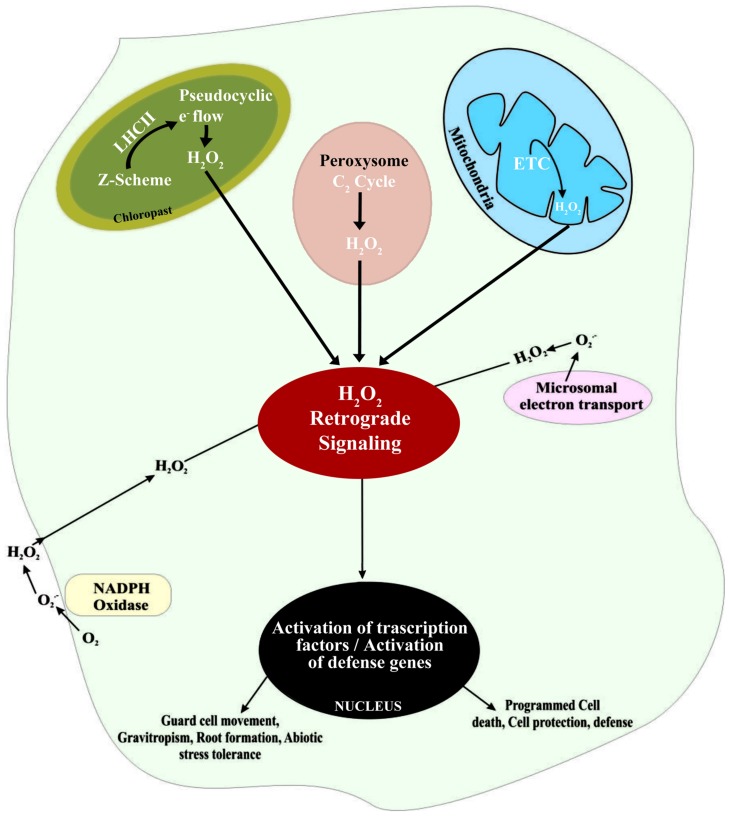
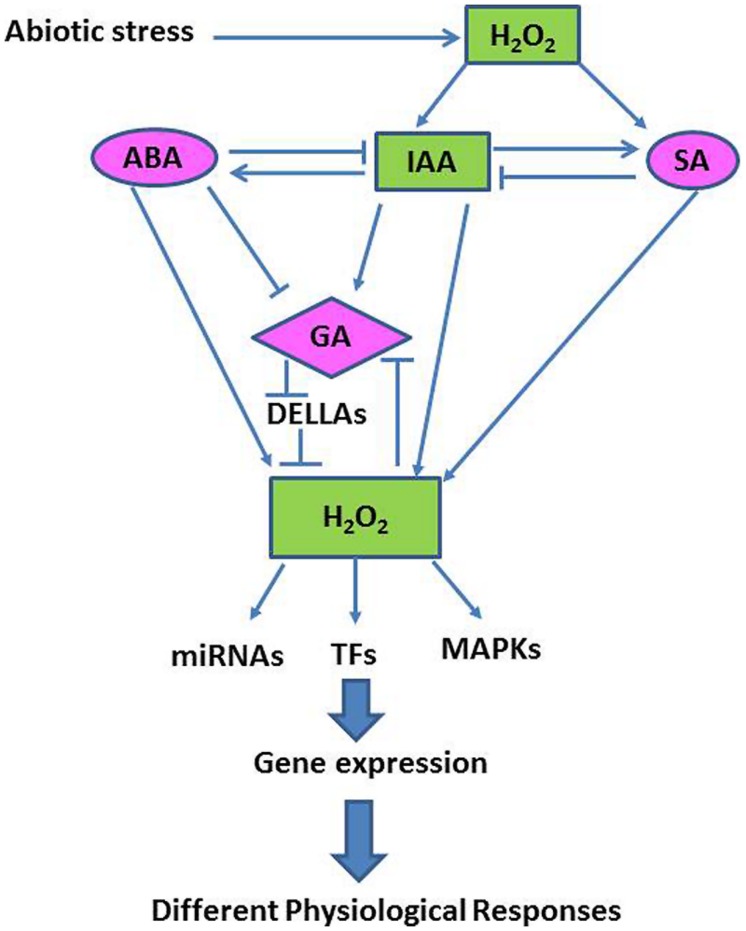
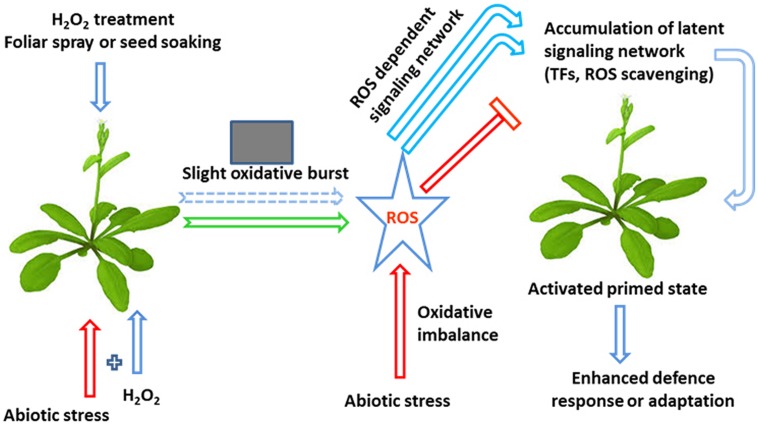
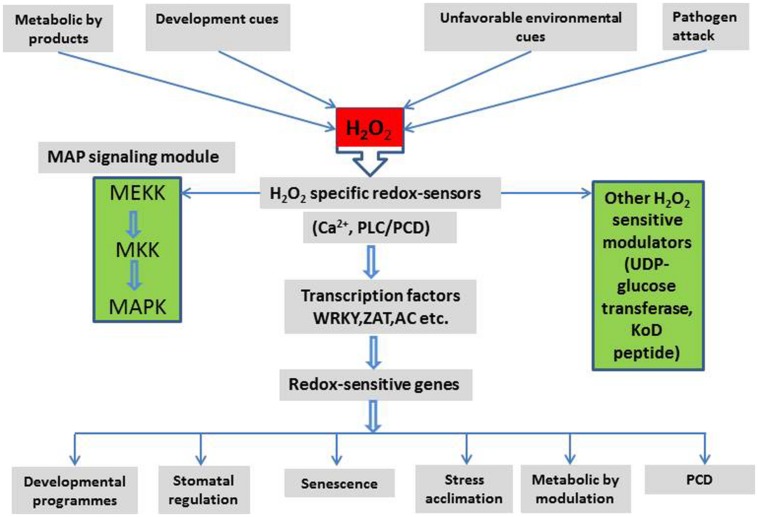
Plants are constantly challenged by various abiotic stresses that negatively affect growth and productivity worldwide. During the course of their evolution, plants have developed sophisticated mechanisms to recognize external signals allowing them to respond appropriately to environmental conditions, although the degree of adjustability or tolerance to specific stresses differs from species to species. Overproduction of reactive oxygen species (ROS; hydrogen peroxide, H2O2; superoxide, [Formula: see text]; hydroxyl radical, OH(⋅) and singlet oxygen, (1)O2) is enhanced under abiotic and/or biotic stresses, which can cause oxidative damage to plant macromolecules and cell structures, leading to inhibition of plant growth and development, or to death. Among the various ROS, freely diffusible and relatively long-lived H2O2 acts as a central player in stress signal transduction pathways. These pathways can then activate multiple acclamatory responses that reinforce resistance to various abiotic and biotic stressors. To utilize H2O2 as a signaling molecule, non-toxic levels must be maintained in a delicate balancing act between H2O2 production and scavenging. Several recent studies have demonstrated that the H2O2-priming can enhance abiotic stress tolerance by modulating ROS detoxification and by regulating multiple stress-responsive pathways and gene expression. Despite the importance of the H2O2-priming, little is known about how this process improves the tolerance of plants to stress. Understanding the mechanisms of H2O2-priming-induced abiotic stress tolerance will be valuable for identifying biotechnological strategies to improve abiotic stress tolerance in crop plants. This review is an overview of our current knowledge of the possible mechanisms associated with H2O2-induced abiotic oxidative stress tolerance in plants, with special reference to antioxidant metabolism.
植物不断受到各种非生物胁迫的挑战,这些胁迫对全球植物的生长和生产力产生负面影响。在进化过程中,植物已经形成了复杂的机制来识别外部信号,使其能够对环境条件做出适当反应,尽管不同物种对特定胁迫的可调节程度或耐受性有所不同。在非生物和/或生物胁迫下,活性氧(ROS;过氧化氢,H2O2;超氧阴离子,[化学式:见原文];羟基自由基,OH(⋅)和单线态氧,(1)O2)的过量产生会增强,这会对植物大分子和细胞结构造成氧化损伤,导致植物生长发育受到抑制甚至死亡。在各种ROS中,可自由扩散且相对寿命较长的H2O2在胁迫信号转导途径中起着核心作用。这些途径随后可激活多种适应性反应,增强对各种非生物和生物胁迫源的抗性。为了将H2O2用作信号分子,必须在H2O2产生和清除之间进行微妙的平衡,以维持无毒水平。最近的几项研究表明,H2O2引发可通过调节ROS解毒以及调控多种胁迫响应途径和基因表达来增强非生物胁迫耐受性。尽管H2O2引发很重要,但对于这一过程如何提高植物对胁迫的耐受性却知之甚少。了解H2O2引发诱导的非生物胁迫耐受性机制,对于确定提高作物植物非生物胁迫耐受性的生物技术策略具有重要价值。本综述概述了我们目前对植物中与H2O2诱导的非生物氧化胁迫耐受性相关的可能机制的认识,特别提及了抗氧化代谢。