Beavis Anna Louise, Levinson Kimberly L
The Kelly Gynecologic Oncology Service, Department of Gynecology and Obstetrics, Johns Hopkins Hospital , Baltimore, MD , USA.
Front Oncol. 2016 Feb 1;6:19. doi: 10.3389/fonc.2016.00019. eCollection 2016.
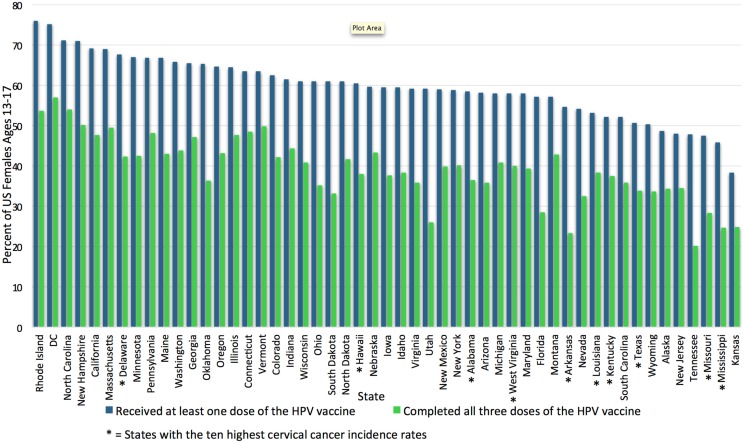
Human papillomavirus (HPV) vaccination rates for preadolescent and adolescent girls in the United States are far behind those of other developed nations. These rates differ substantially by region and state, socioeconomic status, and insurance status. In parents and young women, a lack of awareness and a misperception of the risk of this vaccine drive low vaccination rates. In physicians, lack of comfort with discussion of sexuality and the perception that the vaccine should be delayed to a later age contribute to low vaccination rates. Patient- and physician-targeted educational campaigns, systems-based interventions, and school-based vaccine clinics offer a variety of ways to address the barriers to HPV vaccination. A diverse and culturally appropriate approach to promoting vaccine uptake has the potential to significantly improve vaccination rates in order to reach the Healthy People 2020 goal of over 80% vaccination in adolescent girls. This article reviews the disparities in HPV vaccination rates in girls in the United States, the influences of patients', physicians', and parents' attitudes on vaccine uptake, and the proposed interventions that may help the United States reach its goal for vaccine coverage.
美国青春期前和青春期女孩的人乳头瘤病毒(HPV)疫苗接种率远远落后于其他发达国家。这些接种率在地区和州、社会经济地位以及保险状况方面存在很大差异。在家长和年轻女性中,对这种疫苗风险缺乏认识和存在误解导致疫苗接种率较低。在医生方面,对讨论性行为感到不自在以及认为疫苗应推迟到更晚年龄接种的观念也导致了较低的疫苗接种率。针对患者和医生的教育活动、基于系统的干预措施以及学校疫苗诊所提供了多种解决HPV疫苗接种障碍的方法。采用多样化且符合文化背景的方法来促进疫苗接种,有可能显著提高接种率,从而实现《健康人民2020》中青少年女孩接种率超过80%的目标。本文回顾了美国女孩HPV疫苗接种率的差异、患者、医生和家长态度对疫苗接种的影响,以及可能有助于美国实现疫苗接种覆盖率目标的建议干预措施。