Schütze Alexandra, Vogeley Christian, Gorges Tobias, Twarock Sören, Butschan Jonas, Babayan Anna, Klein Diana, Knauer Shirley K, Metzen Eric, Müller Volkmar, Jendrossek Verena, Pantel Klaus, Milde-Langosch Karin, Fischer Jens W, Röck Katharina
Institut für Pharmakologie und Klinische Pharmakologie, Universitätsklinikum der Heinrich-Heine-Universität, Düsseldorf, Germany.
Department of Tumor Biology, University Medical Center Hamburg-Eppendorf, Hamburg, Germany.
Oncotarget. 2016 Apr 19;7(16):21428-40. doi: 10.18632/oncotarget.7258.
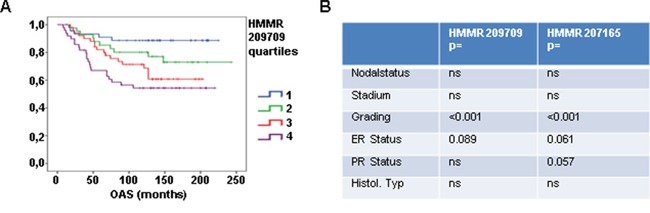
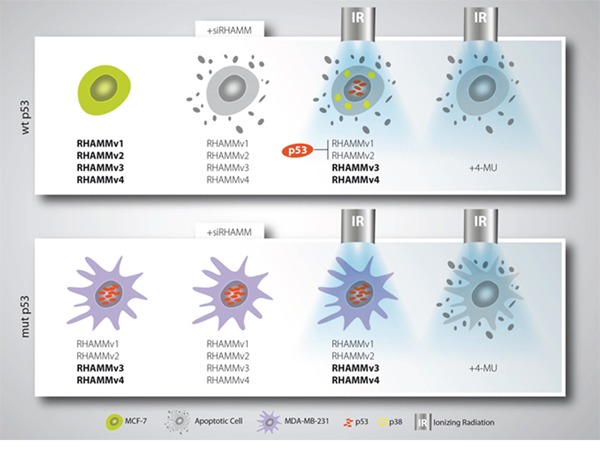
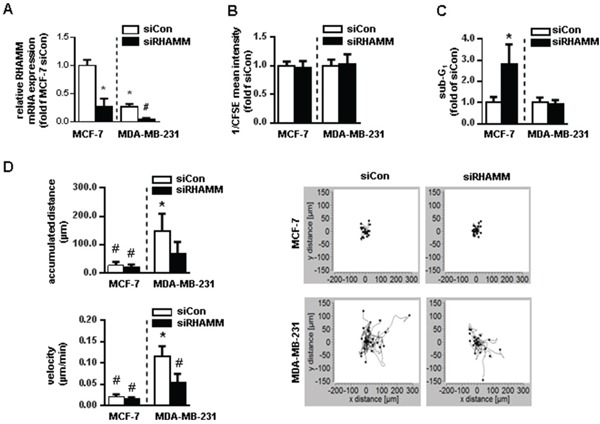
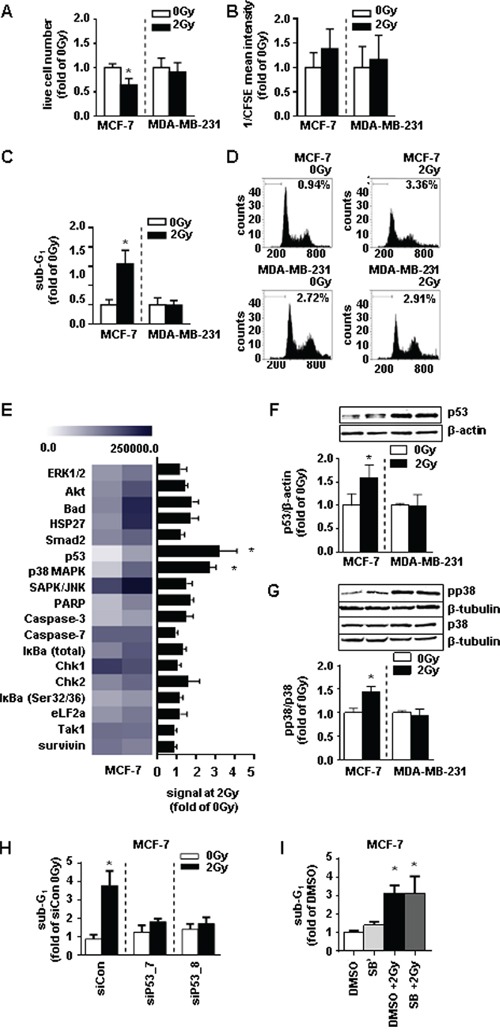
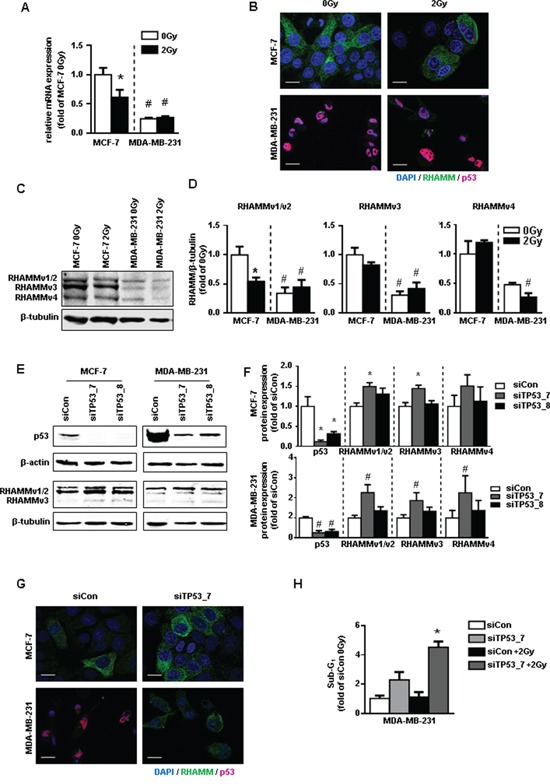
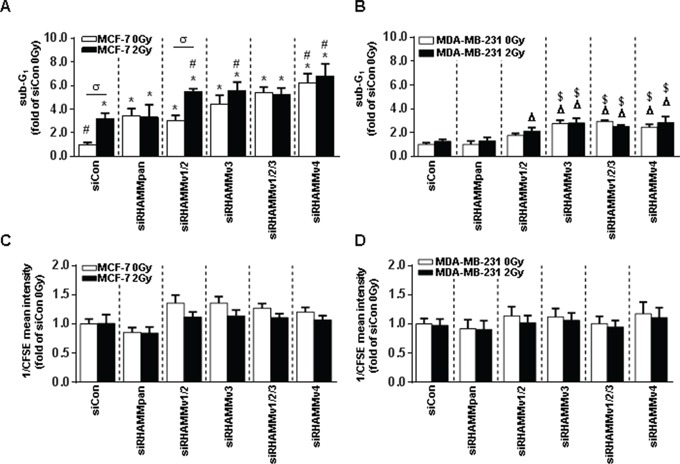
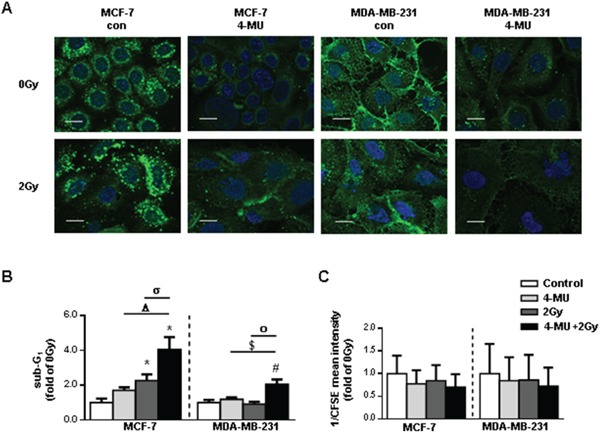
Biomarkers for prognosis in radiotherapy-treated breast cancer patients are urgently needed and important to stratify patients for adjuvant therapies. Recently, a role of the receptor of hyaluronan-mediated motility (RHAMM) has been suggested for tumor progression. Our aim was (i) to investigate the prognostic value of RHAMM in breast cancer and (ii) to unravel its potential function in the radiosusceptibility of breast cancer cells. We demonstrate that RHAMM mRNA expression in breast cancer biopsies is inversely correlated with tumor grade and overall survival. Radiosusceptibility in vitro was evaluated by sub-G1 analysis (apoptosis) and determination of the proliferation rate. The potential role of RHAMM was addressed by short interfering RNAs against RHAMM and its splice variants. High expression of RHAMMv1/v2 in p53 wild type cells (MCF-7) induced cellular apoptosis in response to ionizing radiation. In comparison, in p53 mutated cells (MDA-MB-231) RHAMMv1/v2 was expressed sparsely resulting in resistance towards irradiation induced apoptosis. Proliferation capacity was not altered by ionizing radiation in both cell lines. Importantly, pharmacological inhibition of the major ligand of RHAMM, hyaluronan, sensitized both cell lines towards radiation induced cell death. Based on the present data, we conclude that the detection of RHAMM splice variants in correlation with the p53 mutation status could help to predict the susceptibility of breast cancer cells to radiotherapy. Additionally, our studies raise the possibility that the response to radiotherapy in selected cohorts may be improved by pharmaceutical strategies against RHAMM and its ligand hyaluronan.
放疗治疗的乳腺癌患者的预后生物标志物亟待发现,对辅助治疗患者进行分层也很重要。最近,有人提出透明质酸介导的运动受体(RHAMM)在肿瘤进展中发挥作用。我们的目的是(i)研究RHAMM在乳腺癌中的预后价值,以及(ii)揭示其在乳腺癌细胞放射敏感性中的潜在功能。我们证明,乳腺癌活检组织中RHAMM mRNA表达与肿瘤分级和总生存期呈负相关。通过亚G1期分析(凋亡)和增殖率测定评估体外放射敏感性。通过针对RHAMM及其剪接变体的小干扰RNA来研究RHAMM的潜在作用。p53野生型细胞(MCF-7)中RHAMMv1/v2的高表达在电离辐射后诱导细胞凋亡。相比之下,在p53突变细胞(MDA-MB-231)中,RHAMMv1/v2表达稀少,导致对辐射诱导的凋亡具有抗性。两种细胞系中电离辐射均未改变增殖能力。重要的是,对RHAMM的主要配体透明质酸进行药理学抑制,可使两种细胞系对辐射诱导的细胞死亡敏感。基于目前的数据,我们得出结论,检测与p53突变状态相关的RHAMM剪接变体有助于预测乳腺癌细胞对放疗的敏感性。此外,我们的研究提出了一种可能性,即针对RHAMM及其配体透明质酸的药物策略可能会改善特定队列中患者对放疗的反应。