Gao Chunzi, Liu Shilong, Wang Yanli, Cha Geqi, Xu Xiangying
Department of Oncology Unit 2, The First Affiliated Hospital of Harbin Medical University, Harbin 150001, China.
Department of Radiation Oncology, The Affiliated Tumor Hospital of Harbin Medical University, Harbin 150040, China.
Transl Cancer Res. 2019 Apr;8(2):410-421. doi: 10.21037/tcr.2019.02.03.
Receptor for hyaluronan-mediated motility (RHAMM), one of the major hyaluronic acid (HA) receptors, is upregulated in several forms of cancer and is a poor prognostic factor for non-small cell lung cancer (NSCLC) adenocarcinoma. RHAMM is also a potential therapeutic target for inhibition of tumor metastasis in NSCLC. However, its role in the radiosensitivity of NSCLC has yet to be determined. The aim of this study was to examine the inhibitory effect of RHAMM on the radiosensitivity of lung adenocarcinoma cell line A549 and its potential mechanism.
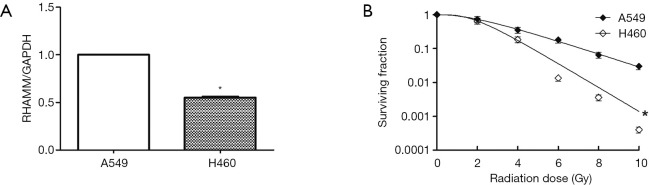
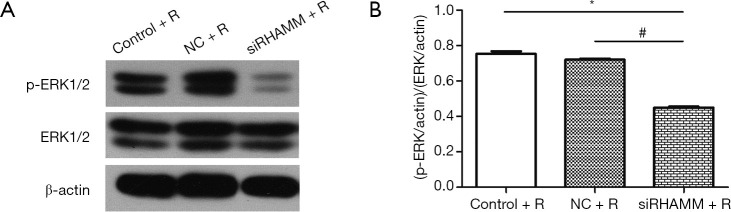
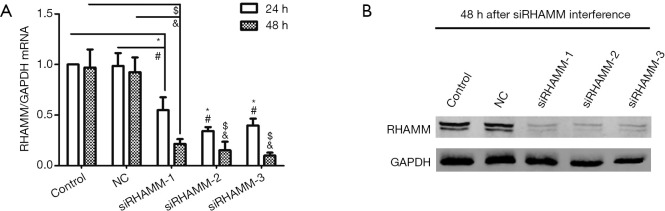
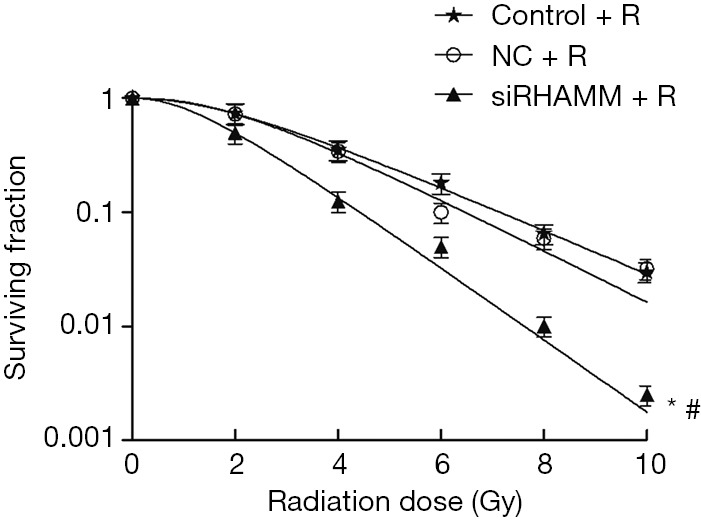
Expression of the gene in NSCLC cell lines A549 and H460 was detected using reverse transcription-quantitative polymerase chain reaction (RT-qPCR). Colony formation assays were used to analyze radiosensitivity of the two cell lines. Transfection with small interfering (si) RNA was used to inhibit expression of the gene in the A549 cell line. A cell counting kit assay was used to analyze the cell proliferation rate; flow cytometry was used to evaluate the cell apoptosis and cell cycle; and Western blot was used to investigate the expression of phosphorylated-extracellular signal-regulated kinase 1/2 (p-ERK1/2) and ERK1/2 proteins.
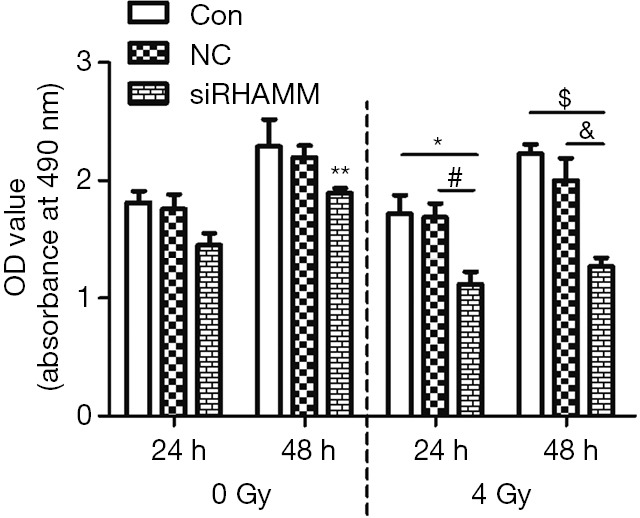
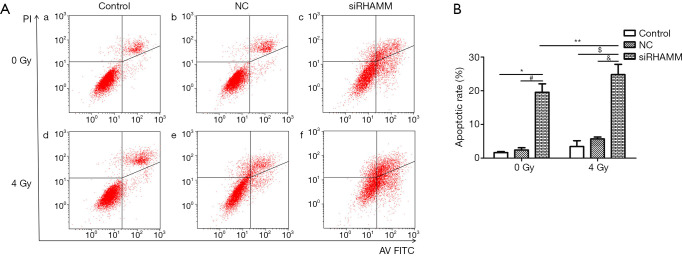
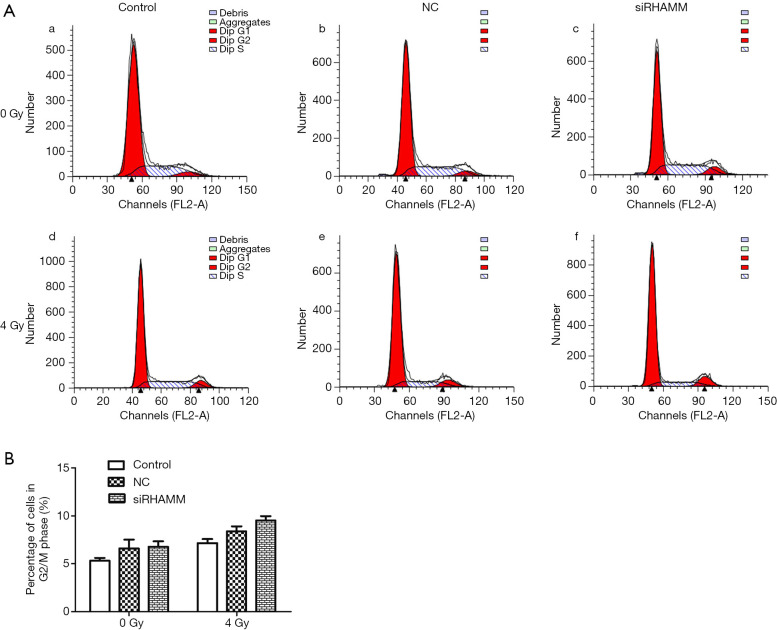
Expression of the gene was negatively correlated with the radiosensitivity of NSCLC cell lines; inhibition of gene expression enhanced the radiosensitivity of A549 cells. The mechanism for this inhibition was associated with reduced proliferation, increased apoptosis induced by radiotherapy, reduced ERK1/2 phosphorylation, and regulation of the ERK1/2 signaling pathway. Inhibition was not associated with increased G2/M phase arrest.
RHAMM is a potential target for radiosensitization of lung adenocarcinomas.
透明质酸介导的运动受体(RHAMM)是主要的透明质酸(HA)受体之一,在多种癌症中表达上调,是非小细胞肺癌(NSCLC)腺癌的不良预后因素。RHAMM也是抑制NSCLC肿瘤转移的潜在治疗靶点。然而,其在NSCLC放射敏感性中的作用尚未确定。本研究旨在探讨RHAMM对肺腺癌细胞系A549放射敏感性的抑制作用及其潜在机制。
采用逆转录定量聚合酶链反应(RT-qPCR)检测NSCLC细胞系A549和H460中该基因的表达。采用集落形成试验分析这两种细胞系的放射敏感性。用小干扰(si)RNA转染抑制A549细胞系中该基因的表达。采用细胞计数试剂盒分析细胞增殖率;采用流式细胞术评估细胞凋亡和细胞周期;采用蛋白质印迹法检测磷酸化细胞外信号调节激酶1/2(p-ERK1/2)和ERK1/2蛋白的表达。
该基因的表达与NSCLC细胞系的放射敏感性呈负相关;抑制该基因表达可增强A549细胞的放射敏感性。这种抑制机制与增殖减少、放疗诱导的凋亡增加、ERK1/2磷酸化减少以及ERK1/2信号通路的调节有关。抑制作用与G2/M期阻滞增加无关。
RHAMM是肺腺癌放射增敏的潜在靶点。