Division of Nephrology, Department of Internal Medicine, Korea University, Anam Hospital, Seoul, Korea.
Kidney Res Clin Pract. 2013 Dec;32(4):147-52. doi: 10.1016/j.krcp.2013.08.001. Epub 2013 Sep 26.
Chronic inflammation is frequently noted in patients with chronic kidney disease (CKD) and contributes to the development and progression of cardiovascular diseases. Monocytes are heterogeneous populations of cells, and they can be divided into subtypes with different phenotypes and functions based on CD14 and CD16 positivity. This study examined whether the proinflammatory CD14(+)CD16(+) monocyte subset expands in predialysis CKD patients, and also whether the expansion of these cells is closely associated with systemic inflammation and cardiovascular risk factors.
The percentages of proinflammatory CD14(+)CD16(+) monocytes were analyzed in 111 predialysis CKD patients using a flow cytometer, and they were compared with brachial-ankle pulse wave velocity as well as the cytokine plasma levels and other clinical parameters.
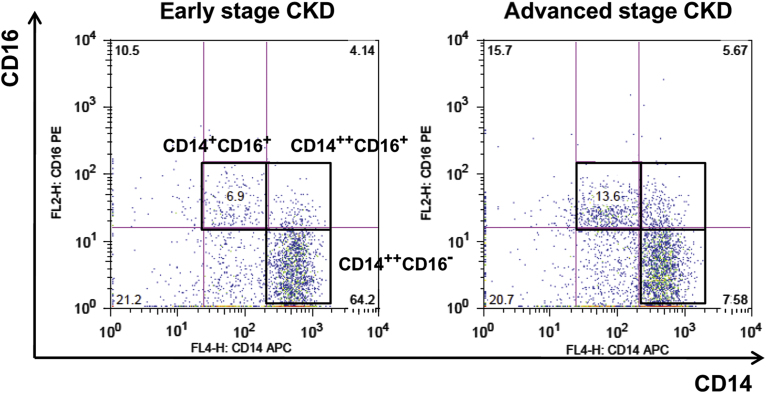
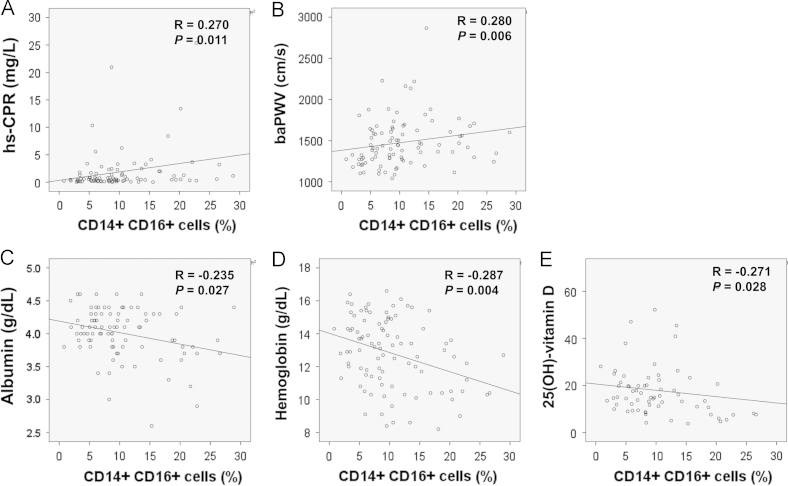
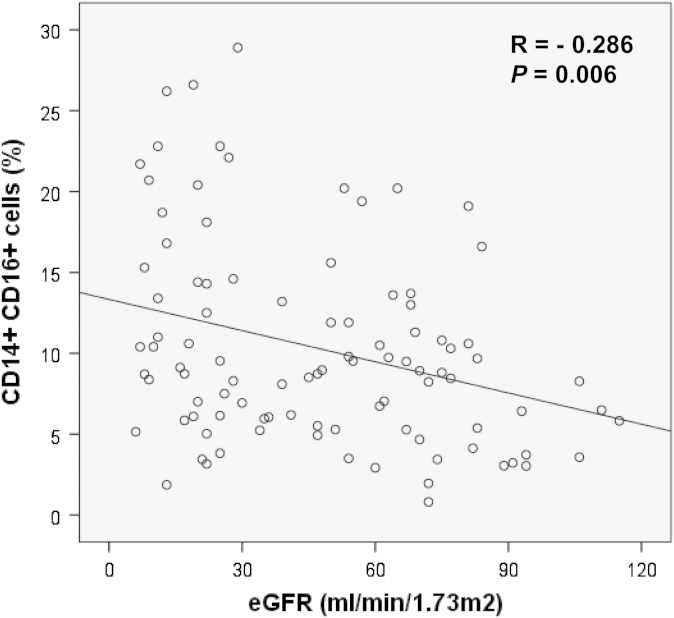
The proportion of CD14(+)CD16(+) monocytes was significantly higher in patients with advanced stages of CKD than in patients with the early stages. Interleukin-6 levels were also high in patients with advanced stages of CKD. The expansion of CD14(+)CD16(+) monocytes showed significant positive correlations with the high-sensitive C-reactive protein levels, and negative correlations with the levels of serum albumin, hemoglobin, and 25(OH)-vitamin D. In addition, the expansion of CD14(+)CD16(+) monocytes was an independent factor correlated with brachial-ankle pulse wave velocity in diabetic CKD patients.
Expansion of the proinflammatory CD14(+)CD16(+) monocyte subset partially accounts for chronic inflammation, malnutrition, and atherosclerosis in CKD.
慢性肾脏病(CKD)患者常伴有慢性炎症,该炎症可促进心血管疾病的发生和发展。单核细胞是异质性细胞群体,根据 CD14 和 CD16 的阳性表达,可以将其分为具有不同表型和功能的亚型。本研究旨在探讨在未透析的 CKD 患者中,促炎型 CD14(+)CD16(+)单核细胞亚群是否会扩增,以及这些细胞的扩增是否与全身炎症和心血管危险因素密切相关。
采用流式细胞术分析 111 例未透析的 CKD 患者促炎型 CD14(+)CD16(+)单核细胞的比例,并与肱踝脉搏波速度以及细胞因子的血浆水平和其他临床参数进行比较。
与 CKD 早期患者相比,CKD 晚期患者的 CD14(+)CD16(+)单核细胞比例显著升高。晚期 CKD 患者的白细胞介素-6 水平也较高。CD14(+)CD16(+)单核细胞的扩增与高敏 C 反应蛋白水平呈显著正相关,与血清白蛋白、血红蛋白和 25(OH)-维生素 D 水平呈负相关。此外,在糖尿病 CKD 患者中,CD14(+)CD16(+)单核细胞的扩增是与肱踝脉搏波速度相关的独立因素。
促炎型 CD14(+)CD16(+)单核细胞亚群的扩增部分解释了 CKD 患者的慢性炎症、营养不良和动脉粥样硬化。