Falk Samantha J, Lee Jaehyoun, Sekulic Nikolina, Sennett Michael A, Lee Tae-Hee, Black Ben E
Department of Biochemistry and Biophysics, Perelman School of Medicine, University of Pennsylvania, Philadelphia, PA, USA.
Department of Chemistry, The Pennsylvania State University, University Park, PA, USA.
Nat Struct Mol Biol. 2016 Mar;23(3):204-208. doi: 10.1038/nsmb.3175. Epub 2016 Feb 15.
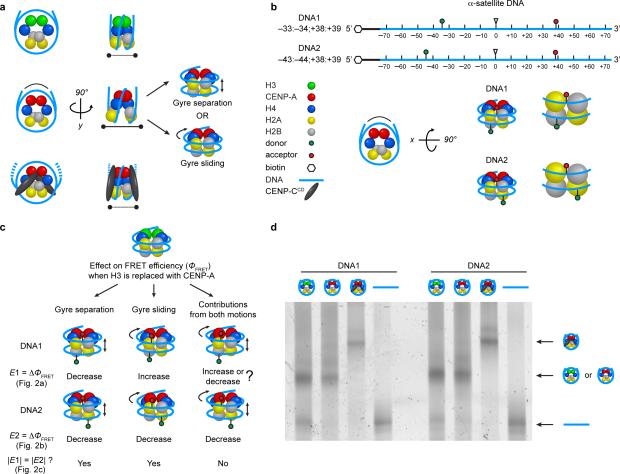
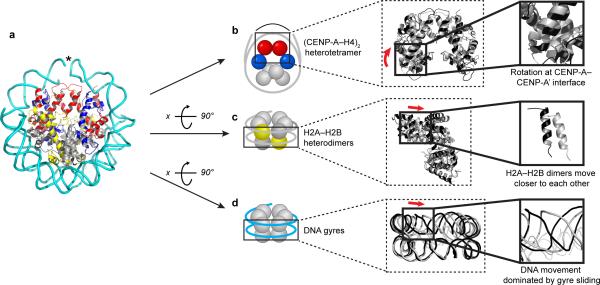
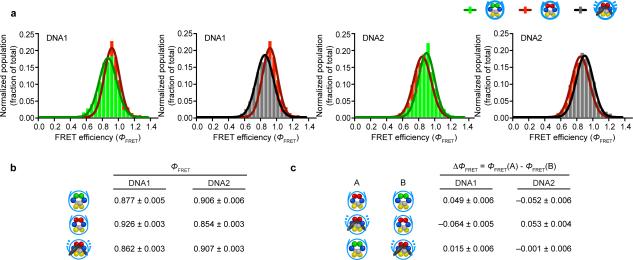
The histone H3 variant CENP-A is incorporated into nucleosomes that mark centromere location. We have recently reported that CENP-A nucleosomes, compared with their H3 counterparts, confer an altered nucleosome shape. Here, using a single-molecule fluorescence resonance energy transfer (FRET) approach with recombinant human histones and centromere DNA, we found that the nucleosome shape change directed by CENP-A is dominated by lateral passing of two DNA gyres (gyre sliding). A nonhistone centromere protein, CENP-C, binds and reshapes the nucleosome, sliding the DNA gyres back to positions similar to those in canonical nucleosomes containing conventional histone H3. The model that we generated to explain the CENP-A-nucleosome transition provides an example of a shape change imposed by external binding proteins and has notable implications for understanding of the epigenetic basis of the faithful inheritance of centromere location on chromosomes.
组蛋白H3变体CENP - A被整合到标记着着丝粒位置的核小体中。我们最近报道,与H3核小体相比,CENP - A核小体具有改变的核小体形状。在这里,我们使用重组人类组蛋白和着丝粒DNA的单分子荧光共振能量转移(FRET)方法,发现由CENP - A引导的核小体形状变化主要由两个DNA螺旋的侧向通过(螺旋滑动)主导。一种非组蛋白着丝粒蛋白CENP - C结合并重塑核小体,将DNA螺旋滑回到与含有传统组蛋白H3的经典核小体中类似的位置。我们生成的用于解释CENP - A核小体转变的模型提供了一个由外部结合蛋白引起形状变化的例子,并且对于理解染色体上着丝粒位置忠实遗传的表观遗传基础具有显著意义。