von Stosch Moritz, Hamelink Jan-Martijn, Oliveira Rui
CEAM, Faculty of Science, Agriculture and Engineering, Newcastle University, Newcastle upon Tyne, NE1 7RU, UK.
REQUIMTE/DQ, Faculty of Science and Technology, University Nova de Lisboa, Campus de Caparica, 2829-516, Caparica, Portugal.
Bioprocess Biosyst Eng. 2016 May;39(5):773-84. doi: 10.1007/s00449-016-1557-1. Epub 2016 Feb 15.
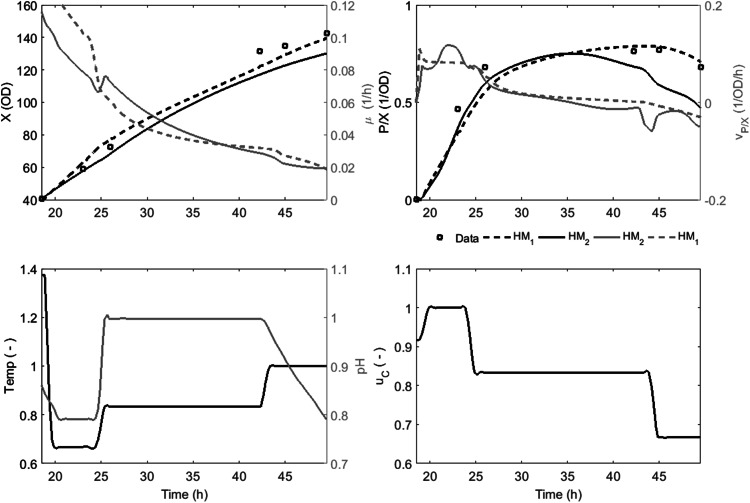
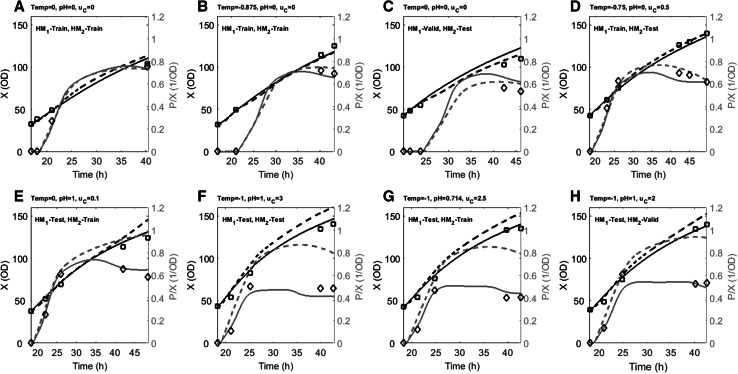
Process understanding is emphasized in the process analytical technology initiative and the quality by design paradigm to be essential for manufacturing of biopharmaceutical products with consistent high quality. A typical approach to developing a process understanding is applying a combination of design of experiments with statistical data analysis. Hybrid semi-parametric modeling is investigated as an alternative method to pure statistical data analysis. The hybrid model framework provides flexibility to select model complexity based on available data and knowledge. Here, a parametric dynamic bioreactor model is integrated with a nonparametric artificial neural network that describes biomass and product formation rates as function of varied fed-batch fermentation conditions for high cell density heterologous protein production with E. coli. Our model can accurately describe biomass growth and product formation across variations in induction temperature, pH and feed rates. The model indicates that while product expression rate is a function of early induction phase conditions, it is negatively impacted as productivity increases. This could correspond with physiological changes due to cytoplasmic product accumulation. Due to the dynamic nature of the model, rational process timing decisions can be made and the impact of temporal variations in process parameters on product formation and process performance can be assessed, which is central for process understanding.
在过程分析技术倡议和质量源于设计范式中,过程理解被强调为生产具有持续高质量的生物制药产品的关键要素。开发过程理解的一种典型方法是将实验设计与统计数据分析相结合。混合半参数建模作为纯统计数据分析的替代方法进行了研究。混合模型框架提供了根据可用数据和知识选择模型复杂度的灵活性。在此,一个参数化动态生物反应器模型与一个非参数人工神经网络相结合,该神经网络将生物量和产物形成速率描述为不同补料分批发酵条件的函数,用于大肠杆菌的高细胞密度异源蛋白生产。我们的模型能够准确描述在诱导温度、pH值和进料速率变化时的生物量生长和产物形成。该模型表明,虽然产物表达速率是早期诱导阶段条件的函数,但随着生产力的提高,它会受到负面影响。这可能与由于细胞质产物积累导致的生理变化相对应。由于模型的动态性质,可以做出合理的过程时间决策,并评估过程参数的时间变化对产物形成和过程性能的影响,这对于过程理解至关重要。