Institute for Health Metrics and Evaluation, University of Washington, Seattle, Washington.
University of California, Berkeley, Berkeley, California.
Am J Trop Med Hyg. 2017 Sep;97(3_Suppl):58-64. doi: 10.4269/ajtmh.15-0315.
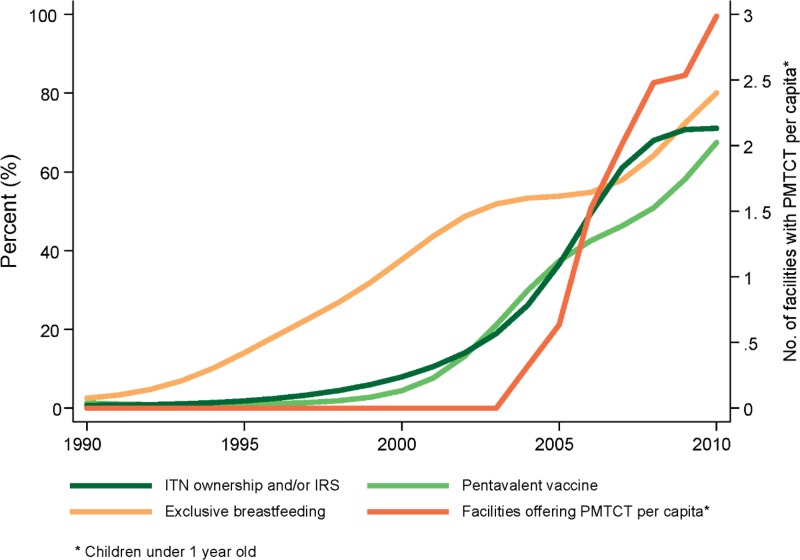
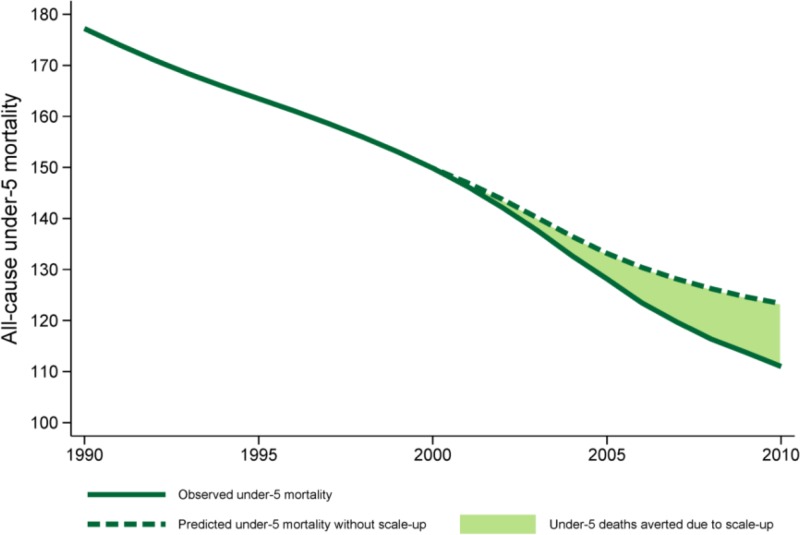
Under-five mortality in Zambia has declined since 1990, with reductions accelerating after 2000. Zambia's scale-up of malaria control is viewed as the driver of these gains, but past studies have not fully accounted for other potential factors. This study sought to systematically evaluate the impact of malaria vector control on under-five mortality. Using a mixed-effects regression model, we quantified the relationship between malaria vector control, other priority health interventions, and socioeconomic indicators and district-level under-five mortality trends from 1990 to 2010. We then conducted counterfactual analyses to estimate under-five mortality in the absence of scaling up malaria vector control. Throughout Zambia, increased malaria vector control coverage coincided with scaling up three other interventions: the pentavalent vaccine, exclusive breast-feeding, and prevention of mother-to-child transmission of HIV services. This simultaneous scale-up made statistically isolating intervention-specific impact infeasible. Instead, in combination, these interventions jointly accelerated declines in under-five mortality by 11% between 2000 and 2010. Zambia's scale-up of multiple interventions is notable, yet our findings highlight challenges in quantifying program-specific impact without better health data and information systems. As countries aim to further improve health outcomes, there is even greater need-and opportunity-to strengthen routine data systems and to develop more rigorous evaluation strategies.
自 1990 年以来,赞比亚的五岁以下儿童死亡率有所下降,2000 年后下降速度加快。赞比亚扩大疟疾控制规模被认为是取得这些成果的原因,但过去的研究并没有充分考虑其他潜在因素。本研究旨在系统评估疟疾媒介控制对五岁以下儿童死亡率的影响。我们使用混合效应回归模型,量化了 1990 年至 2010 年期间疟疾媒介控制、其他重点卫生干预措施和社会经济指标与地区五岁以下儿童死亡率趋势之间的关系。然后,我们进行了反事实分析,以估计在没有扩大疟疾媒介控制的情况下五岁以下儿童的死亡率。在赞比亚各地,增加疟疾媒介控制覆盖率与扩大三种其他干预措施同时发生:五联疫苗、纯母乳喂养和预防母婴传播艾滋病毒服务。这种同时扩大规模使得对干预措施的具体影响进行统计学上的孤立分析变得不可行。相反,这些干预措施共同作用,在 2000 年至 2010 年间使五岁以下儿童死亡率的下降速度加快了 11%。赞比亚扩大多种干预措施的规模引人注目,但我们的研究结果强调,在没有更好的卫生数据和信息系统的情况下,定量评估具体方案影响存在挑战。随着各国努力进一步改善健康结果,更需要--也有机会--加强常规数据系统,并制定更严格的评估策略。