Center for Applied Malaria Research and Evaluation, Department of Tropical Medicine, Tulane University, New Orleans, USA.
Department of Social and Preventive Medicine, School of Public Health, University of Montreal, Montreal, Canada.
Sci Rep. 2018 May 25;8(1):8104. doi: 10.1038/s41598-018-26474-6.
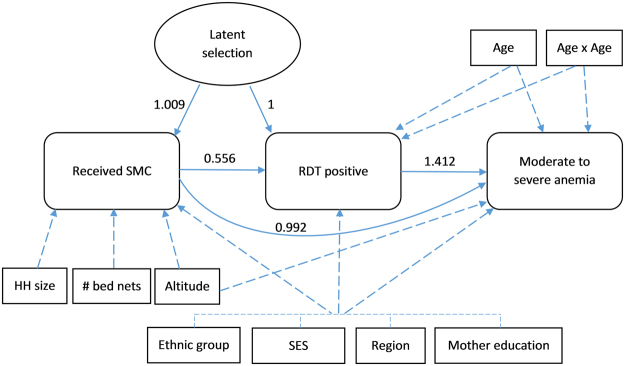
Randomized controlled trials have established that seasonal malaria chemoprevention (SMC) in children is a promising strategy to reduce malaria transmission in Sahelian West Africa. This strategy was recently introduced in a dozen countries, and about 12 million children received SMC in 2016. However, evidence on SMC effectiveness under routine programme conditions is sparse. We aim to measure the effects of the nationwide SMC programme in Mali on the prevalence of malaria and anemia in children 6-59 months. We used data from the 2015 nationally representative malaria indicator survey. A post-test only with non-randomized control group study was designed. We fitted a generalized structural equation model that controlled for potential bias on observed and non-observed variables (endogenous treatment effect model). Having received SMC reduced by 44% (95% CI [0.39-0.49]) the risk of having a positive rapid diagnostic test for malaria. In addition, the programme indirectly reduced by 18% the risk of moderate-to-severe anemia (95% CI [0.15-0.21]). SMC in Mali has substantial protective effects under routine nationwide programme conditions. Endogenous treatment effects analyses can contribute to rigorously measuring the effectiveness of health programmes and to bridging a widening gap in evaluation methods to measure progress towards achieving malaria elimination.
随机对照试验已经证实,季节性疟疾化学预防(SMC)对儿童是一种很有前途的减少萨赫勒西非疟疾传播的策略。该策略最近在十几个国家推出,2016 年约有 1200 万名儿童接受了 SMC。然而,关于常规规划条件下 SMC 效果的证据很少。我们旨在衡量马里全国性 SMC 计划对 6-59 个月儿童疟疾和贫血患病率的影响。我们使用了 2015 年全国代表性疟疾指标调查的数据。设计了一项仅在后测中进行、无随机对照组的研究。我们拟合了广义结构方程模型,控制了观察到和未观察到的变量(内生治疗效果模型)的潜在偏差。接受 SMC 可将疟疾快速诊断检测呈阳性的风险降低 44%(95%CI[0.39-0.49])。此外,该计划还间接地将中重度贫血的风险降低了 18%(95%CI[0.15-0.21])。在常规全国性规划条件下,马里的 SMC 具有显著的保护作用。内生治疗效果分析有助于严格衡量卫生计划的效果,并缩小评估方法的差距,以衡量实现消除疟疾目标的进展。