Vea Isabelle Mifom, Tanaka Sayumi, Shiotsuki Takahiro, Jouraku Akiya, Tanaka Toshiharu, Minakuchi Chieka
Graduate School of Bioagricultural Sciences, Nagoya University, Nagoya, Japan.
National Institute of Agrobiological Sciences, Tsukuba, Japan.
PLoS One. 2016 Feb 19;11(2):e0149459. doi: 10.1371/journal.pone.0149459. eCollection 2016.
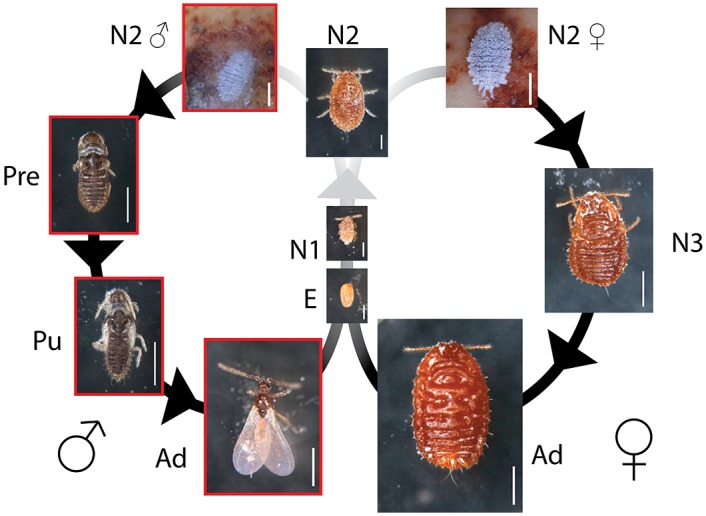
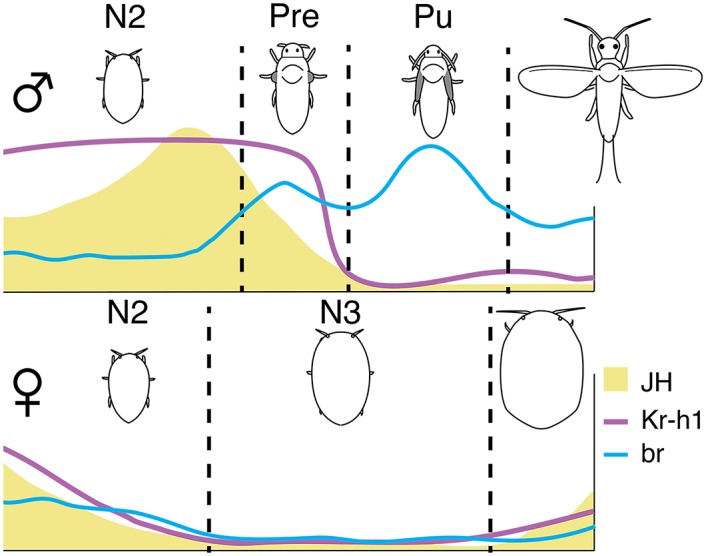
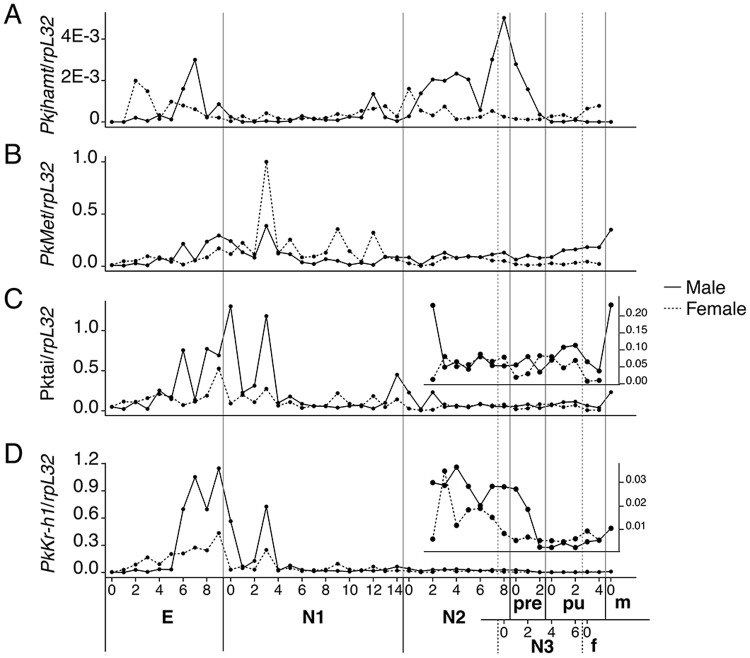
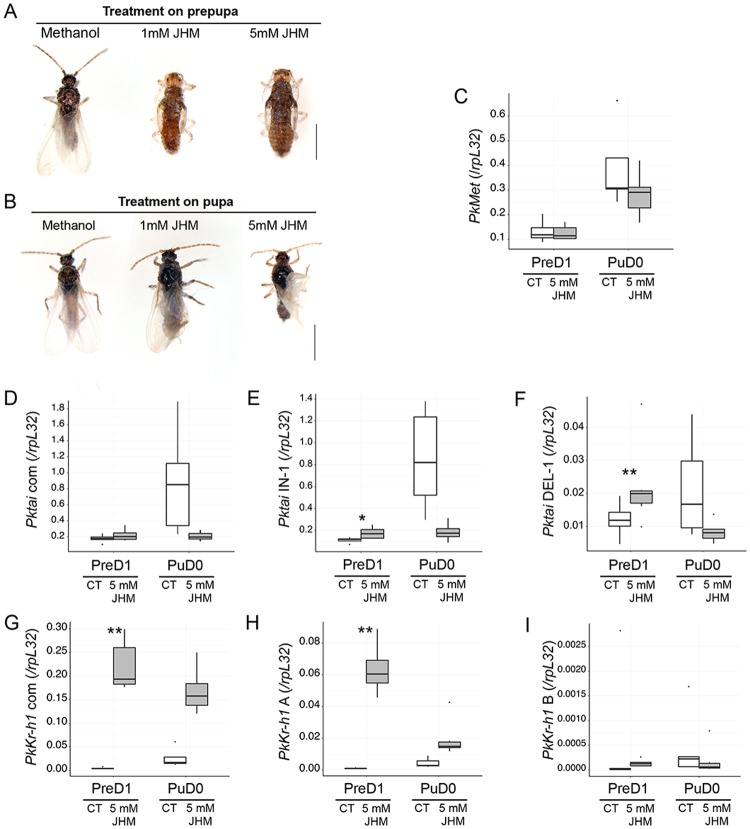
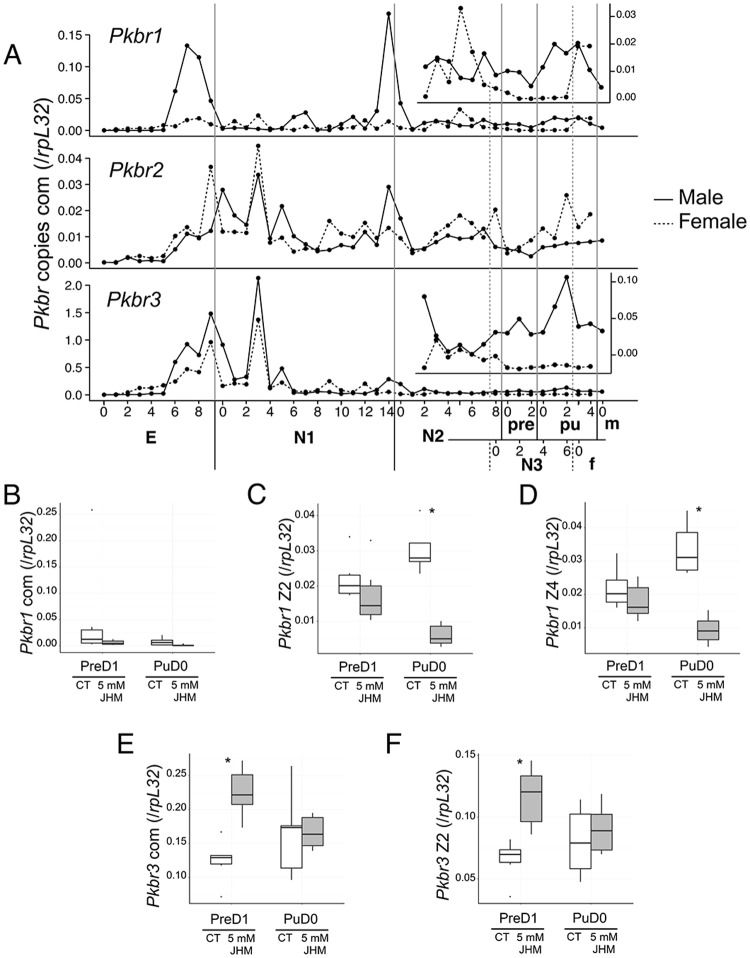
Scale insects have evolved extreme sexual dimorphism, as demonstrated by sedentary juvenile-like females and ephemeral winged males. This dimorphism is established during the post-embryonic development; however, the underlying regulatory mechanisms have not yet been examined. We herein assessed the role of juvenile hormone (JH) on the diverging developmental pathways occurring in the male and female Japanese mealybug Planococcus kraunhiae (Kuwana). We provide, for the first time, detailed gene expression profiles related to JH signaling in scale insects. Prior to adult emergence, the transcript levels of JH acid O-methyltransferase, encoding a rate-limiting enzyme in JH biosynthesis, were higher in males than in females, suggesting that JH levels are higher in males. Furthermore, male quiescent pupal-like stages were associated with higher transcript levels of the JH receptor gene, Methoprene-tolerant and its co-activator taiman, as well as the JH early-response genes, Krüppel homolog 1 and broad. The exposure of male juveniles to an ectopic JH mimic prolonged the expression of Krüppel homolog 1 and broad, and delayed adult emergence by producing a supernumeral pupal stage. We propose that male wing development is first induced by up-regulated JH signaling compared to female expression pattern, but a decrease at the end of the prepupal stage is necessary for adult emergence, as evidenced by the JH mimic treatments. Furthermore, wing development seems linked to JH titers as JHM treatments on the pupal stage led to wing deformation. The female pedomorphic appearance was not reflected by the maintenance of high levels of JH. The results in this study suggest that differential variations in JH signaling may be responsible for sex-specific and radically different modes of metamorphosis.
介壳虫已经进化出了极端的两性异形,这在 sedentary juvenile-like females 和短暂的有翅雄虫身上得到了体现。这种两性异形在胚胎后发育过程中确立;然而,其潜在的调控机制尚未得到研究。我们在此评估了保幼激素(JH)在日本粉蚧 Planococcus kraunhiae(Kuwana)雌雄两性不同发育途径中的作用。我们首次提供了与介壳虫中 JH 信号传导相关的详细基因表达谱。在成虫羽化之前,编码 JH 生物合成限速酶的 JH 酸 O-甲基转移酶的转录水平在雄虫中高于雌虫,这表明雄虫中的 JH 水平更高。此外,雄虫静止的蛹状阶段与 JH 受体基因 Methoprene-tolerant 及其共激活因子 taiman 以及 JH 早期反应基因 Krüppel homolog 1 和 broad 的较高转录水平相关。将雄虫幼虫暴露于异位 JH 模拟物中会延长 Krüppel homolog 1 和 broad 的表达,并通过产生额外的蛹期来延迟成虫羽化。我们提出,与雌虫的表达模式相比,雄虫翅膀的发育首先是由上调的 JH 信号传导诱导的,但预蛹期结束时 JH 水平的下降对于成虫羽化是必要的,这在 JH 模拟物处理中得到了证明。此外,翅膀发育似乎与 JH 滴度有关,因为在蛹期进行 JHM 处理会导致翅膀变形。雌虫的幼态外观并不是由高水平 JH 的维持所反映的。本研究结果表明,JH 信号传导的差异变化可能是导致性别特异性和截然不同的变态模式的原因。