Friday Harbor Laboratories, University of Washington, Friday Harbor, United States.
Department of Biology, University of Washington, Seattle, United States.
Elife. 2024 Apr 3;12:RP92643. doi: 10.7554/eLife.92643.
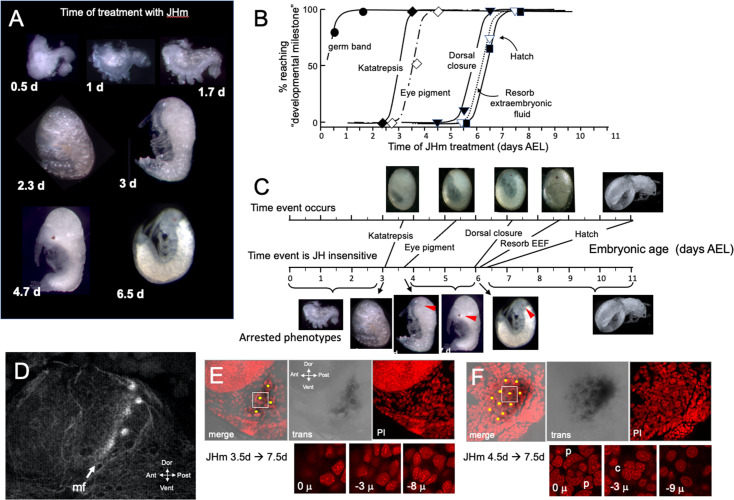
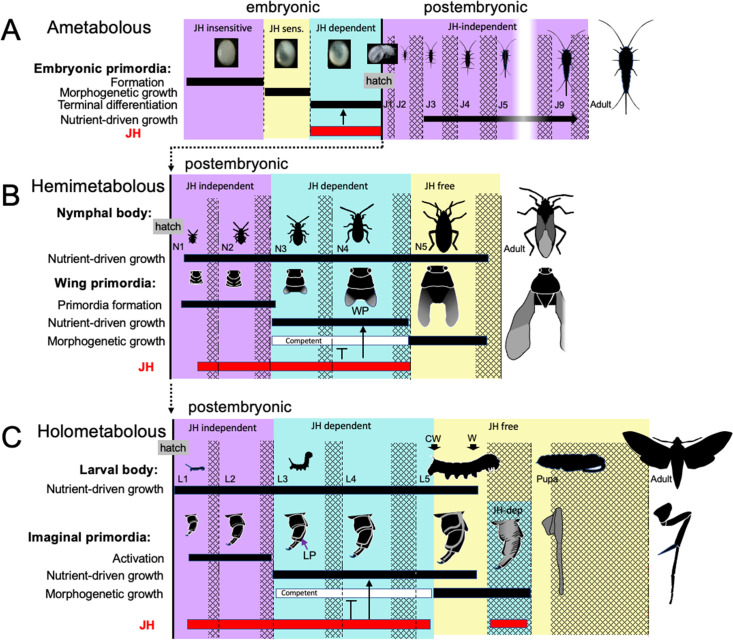
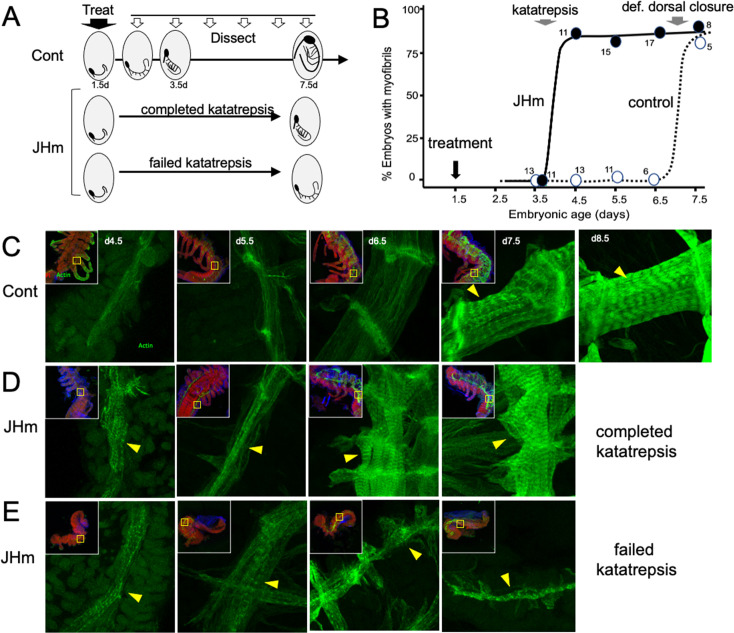
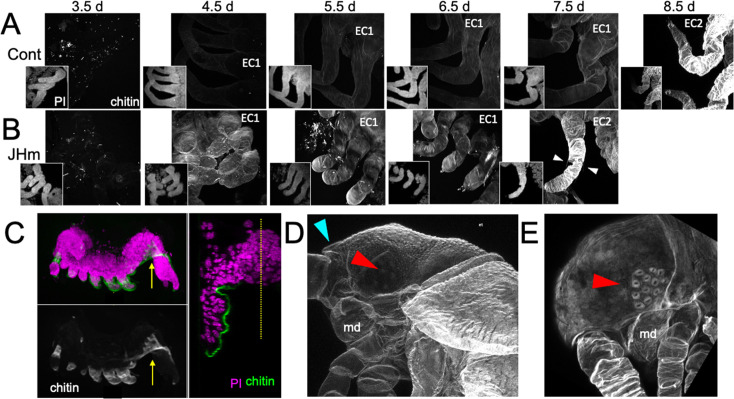
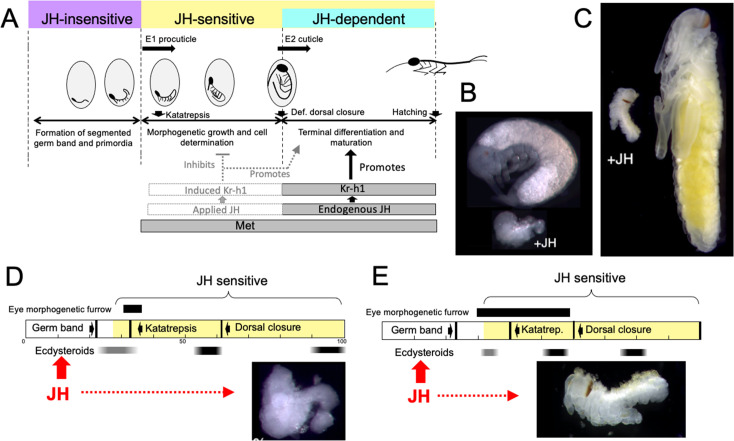
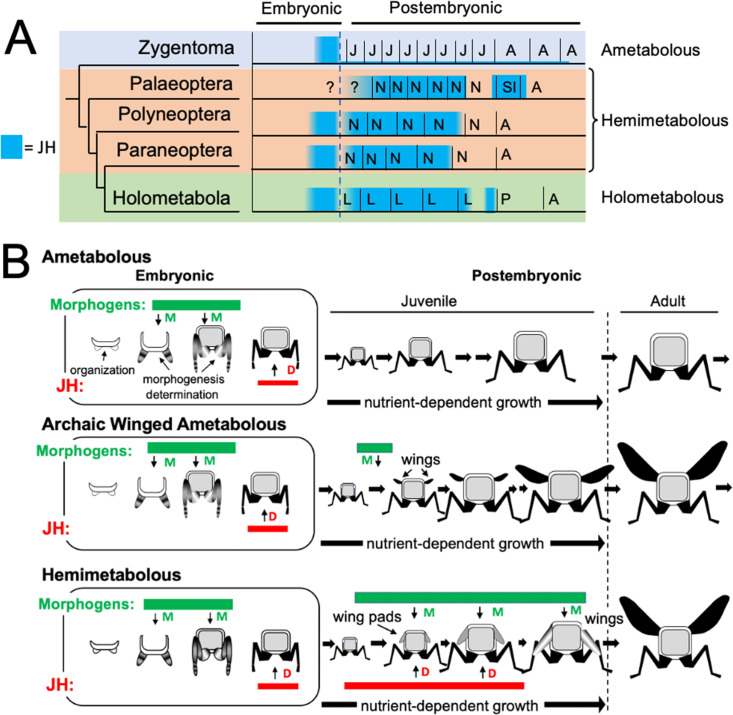
To gain insights into how juvenile hormone (JH) came to regulate insect metamorphosis, we studied its function in the ametabolous firebrat, . Highest levels of JH occur during late embryogenesis, with only low levels thereafter. Loss-of-function and gain-of-function experiments show that JH acts on embryonic tissues to suppress morphogenesis and cell determination and to promote their terminal differentiation. Similar embryonic actions of JH on hemimetabolous insects with short germ band embryos indicate that JH's embryonic role preceded its derived function as the postembryonic regulator of metamorphosis. The postembryonic expansion of JH function likely followed the evolution of flight. Archaic flying insects were considered to lack metamorphosis because tiny, movable wings were evident on the thoraces of young juveniles and their positive allometric growth eventually allowed them to support flight in late juveniles. Like in , we assume that these juveniles lacked JH. However, a postembryonic reappearance of JH during wing morphogenesis in the young juvenile likely redirected wing development to make a wing pad rather than a wing. Maintenance of JH then allowed wing pad growth and its disappearance in the mature juvenile then allowed wing differentiation. Subsequent modification of JH action for hemi- and holometabolous lifestyles are discussed.
为了深入了解保幼激素(JH)如何调节昆虫变态,我们研究了它在无变态的蜚蠊中的功能。JH 的水平在胚胎后期最高,此后水平较低。功能丧失和功能获得实验表明,JH 作用于胚胎组织,抑制形态发生和细胞决定,并促进其终末分化。JH 对具有短 germ band 胚胎的半变态昆虫的类似胚胎作用表明,JH 的胚胎作用先于其作为变态后调节因子的衍生功能。JH 功能的胚胎后扩展可能伴随着飞行的进化。古老的飞行昆虫被认为缺乏变态,因为年幼的若虫胸部有微小的、可移动的翅膀,而且它们的正异速生长最终使它们能够在后期的若虫中支持飞行。与蜚蠊一样,我们假设这些若虫缺乏 JH。然而,JH 在年轻若虫的翅膀形态发生过程中的胚胎后再次出现,可能会重新引导翅膀的发育,使其成为翅膀垫而不是翅膀。JH 的维持允许翅膀垫的生长,而在成熟的若虫中 JH 的消失则允许翅膀的分化。随后还讨论了 JH 作用对半变态和全变态生活方式的修饰。