He Dun-Chun, Zhan Jiasui, Cheng Zhao-Bang, Xie Lian-Hui
Fujian Key Lab of Plant Virology, Institute of Plant Virology, Fujian Agriculture and Forestry University, Fuzhou, 350002, China.
Institute of Plant Protection, Jiangsu Academy of Agricultural Sciences, Nanjing, 210014, China.
Sci Rep. 2016 Feb 22;6:21376. doi: 10.1038/srep21376.
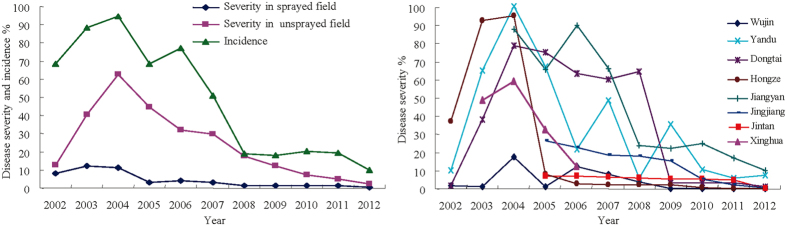
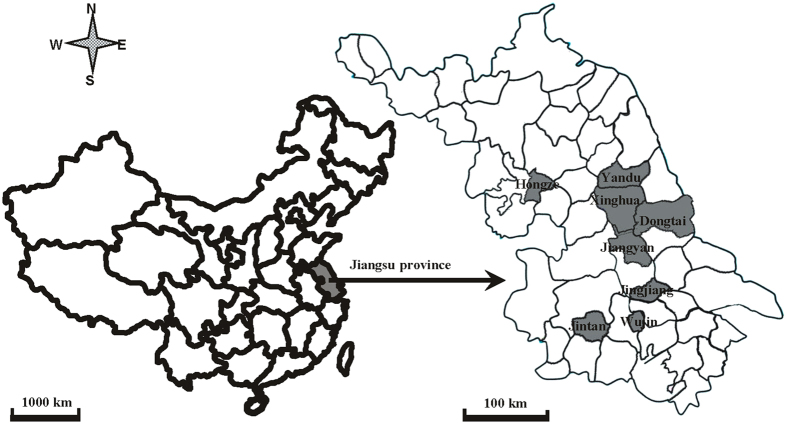
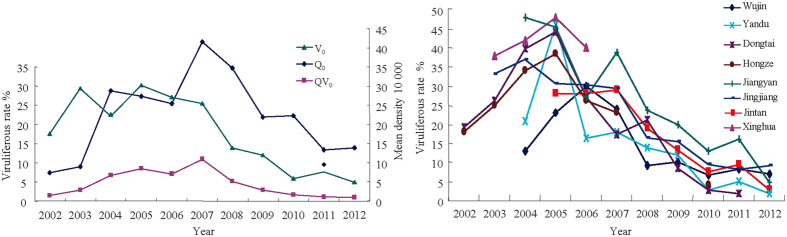
Rice stripe virus (RSV), its vector insect (small brown planthopper, SBPH) and climatic conditions in Jiangsu, China were monitored between 2002 and 2012 to determine key biotic and abiotic factors driving epidemics of the disease. Average disease severity, disease incidence and viruliferous rate of SBPH peaked in 2004 and then gradually decreased. Disease severity of RSV was positively correlated with viruliferous rate of the vector but not with the population density of the insect, suggesting that the proportion of vectors infected by the virus rather than the absolute number of vectors plays an important role in RSV epidemics and could be used for disease forecasting. The finding of a positive correlation of disease severity and viruliferous rate among years suggests that local infection is likely the main source of primary inoculum of RSV. Of the two main climatic factors, temperature plays a more important role than rainfall in RSV epidemics.
2002年至2012年期间,对中国江苏省的水稻条纹病毒(RSV)、其传播媒介昆虫(灰飞虱,SBPH)及气候条件进行了监测,以确定驱动该病流行的关键生物和非生物因素。平均病情严重程度、发病率和灰飞虱带毒率在2004年达到峰值,随后逐渐下降。RSV的病情严重程度与传播媒介的带毒率呈正相关,但与昆虫的种群密度无关,这表明感染病毒的传播媒介比例而非传播媒介的绝对数量在RSV流行中起重要作用,可用于病害预测。多年来病情严重程度与带毒率呈正相关这一发现表明,本地感染可能是RSV初侵染菌源的主要来源。在两个主要气候因素中,温度在RSV流行中比降雨发挥更重要的作用。