Wu Yixuan, Kang Xiangjin, Zheng Haiyan, Liu Haiying, Huang Qing, Liu Jianqiao
Department of Reproductive Medicine, the Third Affiliated Hospital of Guangzhou Medical University, Guangzhou, Guangdong, China.
Key Laboratory of Reproductive Medicine of Guangdong Province, Guangzhou, Guangdong, China.
PLoS One. 2016 Feb 22;11(2):e0149867. doi: 10.1371/journal.pone.0149867. eCollection 2016.
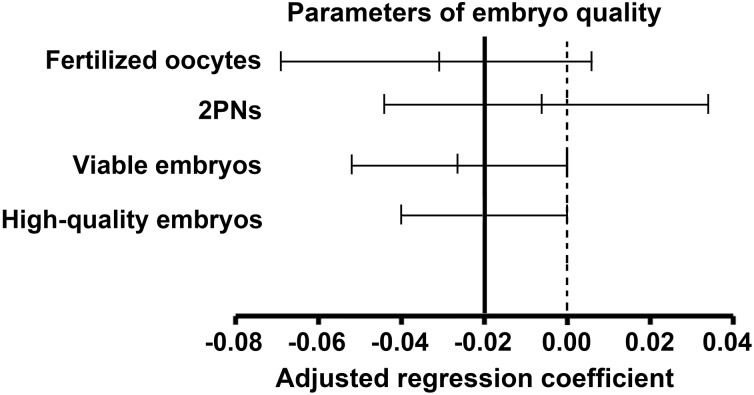
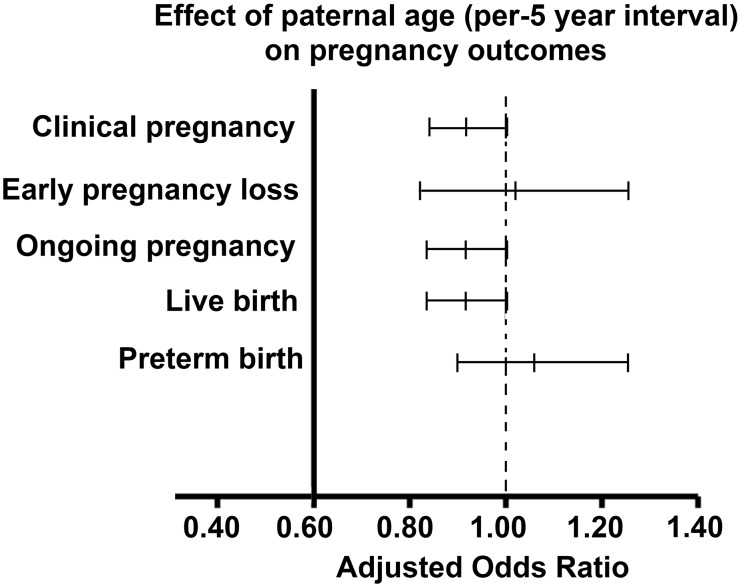
The impact of paternal age on reproduction, especially using assisted reproductive technologies, has not been well studied to date. To investigate the effect of paternal age on reproductive outcomes, here we performed a retrospective analysis of 2,627 intracytoplasmic sperm injection (ICSI) cycles performed at the Reproductive Medicine Center of the Third Affiliated Hospital of Guangzhou Medical University (China) between January 2007 and May 2015. Effect of paternal age on embryo quality [number of fertilized oocytes, 2 pronucleus zygotes (2PNs), viable embryos, and high-quality embryos] was analyzed by multiple linear regression. Relationships between paternal age and pregnancy outcomes were analyzed by binary logistic regression. After adjusting for female age, no association between paternal age and the following parameters of embryo quality was observed: number of fertilized oocytes (B = -0.032; 95% CI -0.069-0.005; P = 0.088), number of 2PNs (B = -0.005; 95% CI -0.044-0.034; P = 0.806), and number of viable embryos (B = -0.025; 95% CI -0.052-0.001; P = 0.062). However, paternal age negatively influenced the number of high-quality embryos (B = -0.020; 95% CI -0.040-0.000; P = 0.045). Moreover, paternal age had no effect on pregnancy outcomes (OR for a 5-year interval), including the rates of clinical pregnancy (OR 0.919; 95% CI 0.839-1.006; P = 0.067), ongoing pregnancy (OR 0.914; 95% CI 0.833-1.003; P = 0.058), early pregnancy loss (OR 1.019; 95% CI 0.823-1.263; P = 0.861), live births (OR 0.916; 95% CI 0.833-1.007; P = 0.070), and preterm births (OR 1.061; 95% CI 0.898-1.254; P = 0.485). Therefore, increased paternal age negatively influences the number of high-quality embryos, but has no effect on pregnancy outcomes in couples undergoing ICSI cycles. However, more studies including men aged over 60 years with a longer-term follow-up are needed.
迄今为止,父亲年龄对生殖的影响,尤其是对辅助生殖技术使用的影响,尚未得到充分研究。为了调查父亲年龄对生殖结局的影响,我们对2007年1月至2015年5月期间在广州医科大学附属第三医院生殖医学中心(中国)进行的2627个卵胞浆内单精子注射(ICSI)周期进行了回顾性分析。通过多元线性回归分析父亲年龄对胚胎质量[受精卵子数、双原核受精卵(2PNs)、存活胚胎和优质胚胎]的影响。通过二元逻辑回归分析父亲年龄与妊娠结局之间的关系。在调整了女性年龄后,未观察到父亲年龄与以下胚胎质量参数之间存在关联:受精卵子数(B = -0.032;95%CI -0.069 - 0.005;P = 0.088)、2PNs数(B = -0.005;95%CI -0.044 - 0.034;P = 0.806)和存活胚胎数(B = -0.025;95%CI -0.052 - 0.001;P = 0.062)。然而,父亲年龄对优质胚胎数有负面影响(B = -0.020;95%CI -0.040 - 0.000;P = 0.045)。此外,父亲年龄对妊娠结局(每5年间隔的OR)没有影响,包括临床妊娠率(OR 0.919;95%CI 0.839 - 1.006;P = 0.067)、持续妊娠率(OR 0.914;95%CI 0.833 - 1.003;P = 0.058)、早期妊娠丢失率(OR 1.019;95%CI 0.823 - 1.263;P = 0.861)、活产率(OR 0.916;95%CI 0.833 - 1.007;P = 学.070)和早产率(OR 1.061;95%CI 0.898 - 1.254;P = 0.485)。因此,父亲年龄增加对优质胚胎数有负面影响,但对接受ICSI周期的夫妇的妊娠结局没有影响。然而,需要更多纳入60岁以上男性且随访时间更长的研究。